What a good cutting board has to do
A cutting board looks like the simplest object in a kitchen, but it has five jobs that pull in different directions. It must be kind to knife edges, so not too hard. It must be hygienic: easy to clean and quick to dry. It must be stable, so it does not cup, twist or crack as the kitchen air changes. It must be durable enough for years of chopping. And its finish must be safe on food.
Making cutting boards is an art with many secrets, and most sit in the choices behind those five jobs: grain direction, species, moisture, gluing, thickness and oil. We take them in turn and say where research ends and trade practice takes over.
End grain, edge grain, face grain: what the knife meets
Wood is a bundle of long, hollow cells running along the trunk, and a board can present them to the knife in three ways.
- Face grain: the wide face of a plank. The knife cuts across the sides of the fibres. Most one-piece boards are made this way.
- Edge grain: strips glued side by side, narrow edges up. Still the sides of the fibres, but a harder, more even surface, as on most butcher-block worktops.
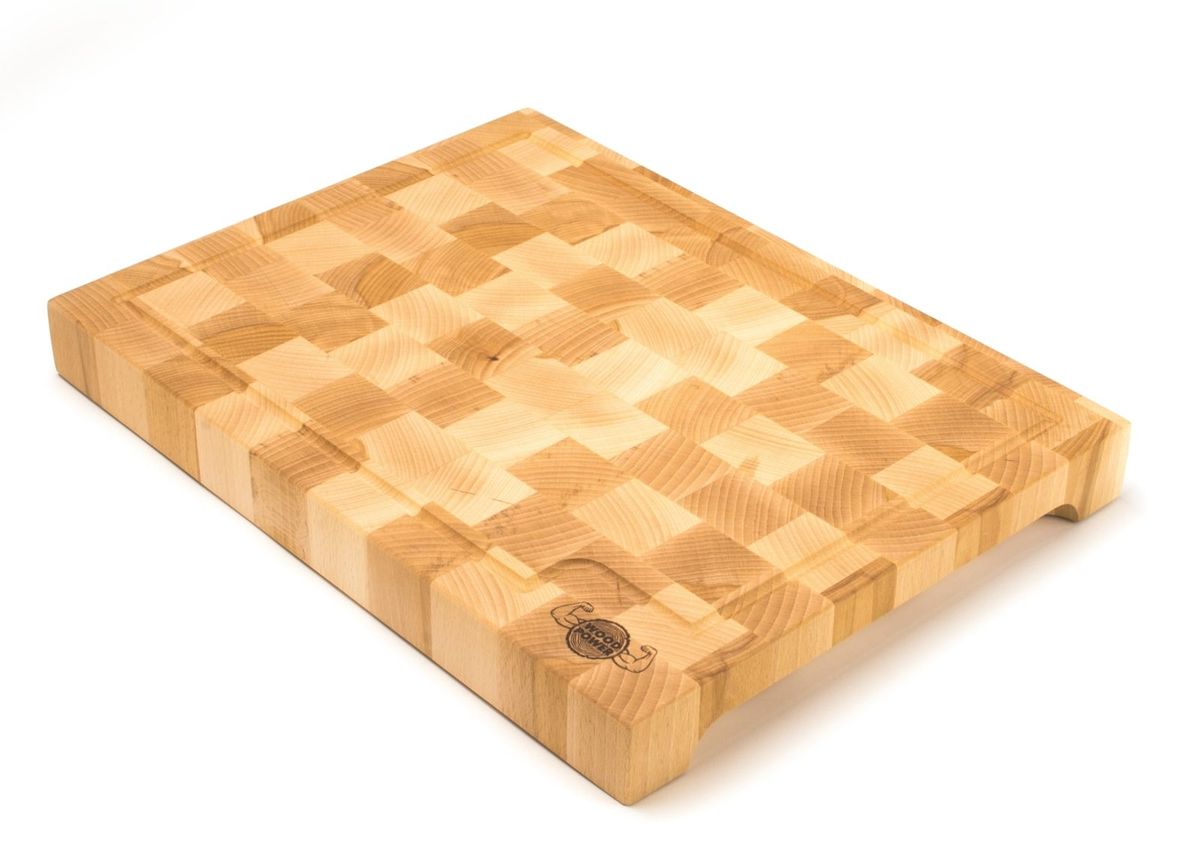
- End grain (Hirnholz in German): short blocks stood on end, so the cut ends of the fibres face up like the bristles of a brush. The growth rings of every block show as a checkerboard.
Why end grain is kinder to knives
On face or edge grain the blade slices across fibres and leaves a cut line. On end grain the edge goes down between the fibre ends and pushes them apart, and many close again when the blade lifts. That is why end grain is said to "self-heal" and to keep knives sharp longer. It is a trade observation, not a measured result: we found no controlled test of edge wear on board materials, and a review notes only that wood "is said to dull knives less than plastic".9
The trade-offs
The FPL's Wood Handbook puts end grain at about 100 times more porous than the side of a board, and liquid water enters it 10 to 100 times faster.1 An end-grain board therefore drinks more oil, takes up more water when left wet and needs oiling more often. It also takes two glue-ups, slow flattening and more waste, which is why it costs more.
Which wood makes a good cutting board
Four properties decide whether a species suits a board: hardness, pores, extractives such as tannins, and movement.
Hardness: the Janka test
The Janka test measures the force needed to press an 11.28 mm steel ball halfway into the wood.10 Too soft, and the board scars and hollows; too hard, and it blunts the knife. The classic European and North American board woods sit around 6,000–6,600 N; Japanese board woods are far softer.
Pores, tannins and movement
Hardwoods carry water in vessels, open tubes that show as pores on the end grain. In ring-porous woods such as oak and ash, a band of large vessels forms each spring; in diffuse-porous woods such as beech and maple, small vessels are spread evenly through the ring.1 On an end-grain board the difference is visible: red oak's pores are so open that air can be blown through a short piece, while white oak's are plugged with ingrowths called tyloses.2 Oak is also rich in tannins, which stain blue-black with iron when the wood is wet.1 Beech has no characteristic odour.2
Stability is beech's one weak point: from green to oven-dry it shrinks 11.7% tangentially, more than maple, cherry or oak.2 On an end-grain board both the radial and tangential directions lie in the surface, so every block moves both ways. The cure is in the making: wood dried to the right moisture content and a finish that slows moisture exchange.
| Species | Pores | Shrinkage R / T | For a cutting board |
|---|---|---|---|
| European beech | Diffuse-porous; small to medium, numerous | 5.8 / 11.7% | Hard and odourless; moves most, so dry it well |
| Hard maple | Diffuse-porous; small to medium | 4.8 / 9.9% | US Food Code reference wood |
| Black cherry | Semi-ring to diffuse-porous; small | 3.7 / 7.1% | Stable, but softer (4,230 N) |
| European oak | Ring-porous; large earlywood pores, plugged by tyloses | 4.7 / 8.4% | Tannins stain with wet iron |
| Red oak | Ring-porous; large, open pores | 4.0 / 8.6% | Air passes through the pores: avoid for chopping |
| European ash | Ring-porous; large earlywood pores | 5.7 / 9.6% | Hard but open-pored |
| Walnut (J. regia) | Semi-ring to diffuse-porous; large earlywood pores | 5.5 / 7.5% | Stable; mid hardness |
| Teak | Ring to semi-ring-porous; large | 2.6 / 5.3% | Very stable, but up to 1.4% silica blunts edges |
Source: Meier, The Wood Database (2026), species entries and article on red and white oak; Hunt (2021), Wood Handbook ch. 16.
Why beech and maple are the classics
Beech and hard maple combine what a board needs: high hardness, small and evenly spread pores, and a neutral taste and smell.1,2 The US Food Code describes them almost by name: wood may not normally be a food-contact surface, but "hard maple or an equivalently hard, close-grained wood" may be used for cutting boards, cutting blocks and bakers' tables.8 European beech (Fagus sylvatica) matches hard maple on the Janka test, 6,460 N against 6,450 N, and is one of Europe's most important, widely available and economical hardwoods.2 Our beech guide and maple guide cover both in detail.
Woods to avoid, and why
- Toxic or sensitising woods. Nearly all parts of the yew are poisonous; cocobolo and other rosewoods (Dalbergia) are notorious sensitisers, and iroko is reported as one.2,11 Reactions are documented mostly for dust, but a food surface is no place to test a sensitiser.
- Open-pored woods such as red oak, and to a lesser degree ash, oak and walnut: large earlywood vessels hold liquid and food residue.1,2 They make fine serving boards, weaker chopping surfaces.
- Resinous softwoods such as pine are soft (Scots pine 2,420 N) and carry resin.2 Yet pine did best of all woods in the bacteria studies below: hygiene is not the only thing a board needs.
- Silica-rich exotics. Teak contains up to 1.4% silica, which blunts edges.2
Is a wooden cutting board hygienic? What the studies show
Wood against plastic
In the best-known study, University of Wisconsin-Madison researchers contaminated new and used boards of nine hardwoods, four plastics and hard rubber with E. coli, Listeria or Salmonella. Fewer bacteria were generally recovered from wood. Clean wood absorbed the inoculum within 3–10 minutes; at loads typical of raw meat the bacteria could then generally not be recovered, and at very high loads they fell by at least 98%, often more than 99.9%, within 12 hours.3 Knife-scarred plastic was hard to clean by hand, while hot water and detergent cleaned wood regardless of species and age.12
A Swiss study found that in very humid conditions both wood and polyethylene stayed heavily contaminated, while in drier air far fewer bacteria were recovered from wood, which dried faster; after a month of use the plastic surface was rough and cavernous.13 At Freie Universität Berlin in 2025, E. coli on sugar maple boards fell to the detection limit within two hours without cleaning, while polyethylene showed higher counts overall.14 A 2006 review cites an epidemiological study in which plastic boards in home kitchens appeared hazardous for salmonellosis, and wooden boards did not.9
Not every study favours wood: after restaurant-style washing at Cornell, plastic measured cleaner and a few colonies survived only on worn wood.15 Still, a review of 20 years of research concluded that wood's porosity does not make it less hygienic than smooth surfaces, may even help, and that wood can produce antimicrobial compounds.16
What the evidence says about beech
Beech shares what makes a clean wooden board perform well: it takes up surface liquid quickly, dries, and cleans with hot water and detergent; it is also hard and close-grained, the property the US Food Code asks for.8,12 Two German studies tested beech on its own. In one, bacteria died off fastest on pine, while on beech and poplar they survived about as long as on plastic.4 In the other, pine, then oak, reduced bacteria fastest among seven European woods including beech, and only those two were singled out as clearly better than plastic.5 A 2023 master's thesis found bacteria grew more readily on polypropylene than on beech, though its author could not validate the results.17
The fair summary: a clean, dry beech board is at least as hygienic as a plastic one in the tests that included beech, and wood in general compares well with worn, knife-scarred plastic. Beech does not show the strong extra antibacterial effect measured for pine and oak, so its safety comes from how it is made, cleaned and dried. In practice: wash it with hot water and detergent straight after use, stand it on edge to dry, keep separate boards for raw meat or fish, and replace a deeply worn or cracked board.13,18
| Study | Materials | Main finding | Beech |
|---|---|---|---|
| Ak, Cliver & Kaspar 1994 (USA) | 9 hardwoods; 4 plastics and hard rubber; new and used | Fewer bacteria recovered from wood; at high loads ≥98%, often >99.9% fewer after 12 h; scarred plastic hard to clean | Species not named in the abstract |
| Welker et al. 1997 (USA) | Wood and plastic, commercial washing | Plastic measured cleaner; sporadic colonies only on worn wood | Not stated |
| Gehrig et al. 2000 (Switzerland) | Wood and polyethylene | Humid: both high; drier: fewer on wood, which dried faster; brush and detergent cleaned all | Not stated |
| Schönwälder et al. 2002 (Germany) | Pine, spruce, beech, poplar; plastic | Pine fastest; beech and poplar comparable to plastic | Tested: as good as plastic |
| Milling et al. 2005, Holzforschung (Germany) | 7 European woods incl. beech; polyethylene | Pine, then oak, fastest; pine and oak clearly better than plastic | Tested: not among the best |
| Cliver 2006 (review) | Epidemiological evidence | Plastic boards at home appeared hazardous for salmonellosis, wooden boards did not | Not stated |
| Svärd 2023 (Sweden, thesis) | Beech, bamboo; polypropylene | Bacteria grew more readily on plastic; results not validated | Tested: better than plastic (preliminary) |
| Bischoff et al. 2025 (Germany) | Sugar maple; HDPE | E. coli to detection limit in 2 h on maple without cleaning; HDPE higher overall | Maple, not beech |
Source: Ak, Cliver & Kaspar (1994a, 1994b); Welker et al. (1997); Gehrig et al. (2000); Schönwälder et al. (2002); Milling et al. (2005); Cliver (2006); Svärd (2023); Bischoff et al. (2025). Summarised from the published abstracts.
The rules for wooden boards in contact with food
In the EU, a cutting board is a food-contact article under Regulation (EC) No 1935/2004: finished, with glue and oil, it must not transfer constituents to food in quantities that endanger health or spoil the food.6 Wood is among the materials for which specific EU measures may be adopted, but none exists yet, so national rules may apply.6,7 Our worktop article explains this framework in detail.
Food businesses also follow the EU hygiene regulation, which asks for smooth, washable, corrosion-resistant and non-toxic food-contact surfaces "unless food business operators can satisfy the competent authority that other materials used are appropriate".19 Wood is therefore not banned in European professional kitchens. Japan's hygiene manual for kitchens that serve 300 portions of one menu at a time or 750 a day goes the other way: it says cutting boards, colanders and wooden utensils are likely to retain contamination, and that wooden utensils should be avoided as far as possible.18
How an end-grain board is made: the secrets
Straight, clear, dry lamellas
The strips, or lamellas, must be straight-grained and free of knots, cracks and pith, which crack or drop out of small blocks. And they must be dried to the moisture the board will live at: in a heated home, wood settles at about 7.5% moisture content at 40% relative humidity and 9.1% at 50% (at 20 °C).20 Wood glued wetter keeps shrinking, and the glue lines take the strain. See our articles on kiln drying and equilibrium moisture content.
The glue
Board makers use polyvinyl acetate (PVAc) glue, classified in Europe by EN 204: D3 for frequent short exposure to running or condensed water, D4 for frequent long exposure.21 A board washed daily needs at least D3, and D4 is the safer choice. There is no EU list of approved glues; ask the maker for its food-contact statement. Some publish one: one American maker states that its waterproof glue is "U.S. FDA approved for indirect food contact (cutting boards)".22 The wood glue article explains the D classes.
The two glue-ups
- Rip the lamellas to equal thickness and glue them edge to edge into a long-grain panel, as for any edge-glued panel.
- Flatten the panel and crosscut it into strips whose width becomes the board's thickness, for example 40 mm.
- Turn every strip 90° so the end grain faces up.
- Glue the strips together again, end grain up.
Flip every second strip end for end before the second glue-up and the lamellas alternate in a checkerboard; shift every second strip by half a block and they stagger like brickwork. Both patterns stop glue lines running straight across the board.
Flattening end grain: why a planer is dangerous
The second glue-up never comes out flat, and end grain is the hardest surface in woodworking to flatten. A thickness planer meets the fibre ends head on and tears out the trailing edge; a university workshop safety procedure forbids end-grain planing "as dangerous splitting, chipping and kickback will occur".23 Professionals use a wide-belt or drum sander, or a router on a sled, then sand progressively finer.
Thickness: why end grain needs 4 cm or more
On an end-grain board both surface directions run across the grain, where wood is weakest. For American beech, the FPL gives a tensile strength across the grain of 7.0 MPa against a bending strength along it of 103 MPa, about 15 times lower (our calculation).10 FPL also notes that the tendency to cup rises with the ratio of width to thickness.1 Good end-grain boards are therefore thick: the SARAL board described below is 30 × 40 cm and 4 cm thick.24
Chamfers, juice grooves and feet
A small chamfer stops the blocks at the rim from chipping, and a juice groove catches liquid from meat and fruit. Rubber or silicone feet stop sliding and hold the board off the worktop so the underside can dry too. A board lying on a wet worktop takes up moisture on one face only, and uneven moisture makes a panel cup; FPL notes the same for siding, where treating the back face reduces cupping.1
Oiling a cutting board: which oil, and why
A cutting board is not lacquered: a film would be cut through on the first day. Boards are oiled, because oil penetrates, slows water uptake and is easy to renew.1 Our article on oil, hardwax oil and lacquer compares the finishes used on furniture and worktops.
Drying, semi-drying and non-drying oils
The iodine value measures how unsaturated an oil is: the higher it is, the more reactive the oil.25
- Drying oils such as linseed and tung have high values, about 190 for linseed and roughly 170–200 in published ranges.25,26 They polymerise with oxygen and cure inside the wood into an easy-to-clean barrier to liquid water, but FPL notes they may need several weeks to cure fully.1
- Semi-drying oils such as sunflower sit at roughly 110–145.25,26 They penetrate well, but alone they cure slowly and incompletely, so a pure semi-drying oil can stay tacky and, like the non-curing vegetable oils FPL warns about, go rancid.1,25
- Non-drying oils such as olive oil (about 80) never cure, and FPL warns they can feed microbes and turn rancid.1,25 Mineral (paraffin) oil and paraffin wax do not go rancid or support microbes, but they do not cure either, so they wash out and need frequent renewal.1
A blend combines the two: sunflower oil carries the finish deep into the wood, linseed oil gives it the reactivity to cure. The linseed must be the right kind. Cold-pressed oil is pressed from the seed without additives, whereas boiled linseed oil and many quick-drying finishes contain driers, metal soaps of cobalt, manganese, zirconium, calcium, zinc or copper.27 Those belong on floors and furniture, not on a food surface.
Our oil blend
We finish our boards with a recipe of our own: food-grade sunflower oil blended with cold-pressed, food-grade linseed oil, with no driers. It keeps the natural look of the beech and gives a microporous, breathable finish that does not crack, peel or flake. It is easy to maintain over the long term: re-coating needs no sanding, and a worn patch can be repaired locally. We also find it resists saliva and sweat, which is why we use the same kind of finish on children's toys and on furniture in heavy use.
What "certified" can mean on a board oil
- US food regulations. 21 CFR 172.878 sets the purity of white mineral oil allowed in food, 21 CFR 178.3620 allows it in articles that touch food, and 21 CFR 178.3700 covers petrolatum.28,29,30 They describe a grade of oil, not a finished board.
- EN 71-3 limits the migration of 19 elements, such as lead and cadmium, from toy materials.31 A toy-safety test, not a food-contact test.
- DIN 53160 tests whether colour transfers into saliva and sweat simulants.32 Not a food-contact migration test either.
- National food-contact rules may apply where the EU has no specific measure, and the finished board must meet Regulation 1935/2004 in any case.6,7
How we oil, and how to re-oil at home
- Start from finely sanded wood (120–180 grit), clean and dry.
- Spread one thin, even coat with a brush, roller or lint-free cloth, along the grain, and wipe off any oil the wood has not taken up.
- Let it dry for about 8–10 hours.
- Apply a second coat for the final protection.
At home, re-oil a clean, fully dry board when the surface looks pale. End grain drinks more than long grain, so the first re-oiling may take more than you expect.1 WoodPower's care instructions also allow occasional mineral oil or beeswax.24
Safety: cloths soaked in drying oils such as linseed can self-ignite as the oil cures. FPL advises immersing them in water and sealing them in a water-filled, airtight metal container straight after use.1 Never leave them crumpled in a bin.
Why cutting boards crack
- The dishwasher. FPL calls dishwashers "very hard on any kind of wooden object, no matter what finish is used".1
- Soaking. End grain takes up water 10 to 100 times faster than the faces.1 A board left in the sink swells underneath while the top stays dry, then shrinks back unevenly.
- Drying near heat. On a radiator or next to the hob, one face dries far below its equilibrium moisture content. Beech, with 11.7% tangential shrinkage, reacts strongly.2
The WoodPower care instructions say the same: no dishwasher, no soaking, a damp cloth, storage away from heat.24
Japanese and European traditions
The Japanese manaita
The traditional Japanese manaita is a plank of soft, light wood. Japan's Ministry of Agriculture, Forestry and Fisheries (MAFF) recommends domestic hinoki cypress (Chamaecyparis obtusa), which smells fresh, drains well and dries quickly, and whose components, in the ministry's words, have antibacterial and antifungal effects.33 A Kappabashi kitchenware dealer in Tokyo says professional cooks swear by hiba (Thujopsis dolabrata) from Aomori, valued for its density and hinokitiol, a natural antibacterial compound.34 Ginkgo (icho), a soft wood at 3,340 N, is another classic.2
The board is wetted before use and rinsed straight after, which MAFF says makes it last longer, then dried upright in the shade so it does not warp.33 Boards are separated by food: MAFF suggests marking a home board's sides for "vegetables and fruit" and "meat and fish", and the large-kitchen manual requires dedicated knives and boards for raw fish, raw meat and vegetables, and for cooked food and food eaten raw.18,33 Professional kitchens also use synthetic boards: Hasegawa makes wood-core boards with a synthetic-rubber surface and states they are widely used in sushi restaurants, ryōtei, inns and hotels because the soft surface is kind to the edge.35
The European end-grain block
The European tradition comes from the butcher. Chopping blocks were built from vertical blocks of hardwood standing on end, at about worktop height, with a board-shaped Hackbrett for vegetables and herbs, and their surface was regularly sanded or wire-brushed.36 One museum example, used from about 1920 in a butcher's shop founded in 1897, is a single oak trunk bound with two iron rings so it would not split.36 Blocks in hardwoods such as oak, beech and hard maple were made to take cleavers; hard maple is still a standard butcher-block wood.2,36 The German Hirnholzbrett is the kitchen descendant of that block.
| Japanese manaita | European end-grain block | |
|---|---|---|
| Typical woods | Hinoki, hiba, ginkgo; soft synthetic boards in professional kitchens | Hardwoods such as beech, oak and hard maple |
| Grain on the surface | A plank: the knife cuts the sides of the fibres | End grain: blocks stood on end |
| Hardness of the wood | Soft (ginkgo 3,340 N) | Hard (beech 6,460 N, maple 6,450 N) |
| Knives | Thin, delicate blades; slicing strokes, raw fish | Chef’s knives and cleavers; chopping, bones and joints |
| Before use | Wetted with water | Used dry; oiled regularly |
| Separation | Separate boards or sides: vegetables and fruit, meat and fish; mandatory by use in large kitchens | Easy-to-clean surfaces required in food businesses (EU) |
| Care | Rinsed straight after use; hot water or salt and brush; dried upright in the shade | Washed and dried; butchers sanded or wire-brushed the surface |
Source: MAFF (n.d.); MHLW (2016); Nippon.com (2026); Hasegawa Kagaku Kogyo (2026); Wintersport- und Heimatmuseum Bad Sachsa (2026); Regulation (EC) No 852/2004; Meier, The Wood Database (2026).
Each system fits its knives. A thin, delicate Japanese blade drawn through raw fish needs a soft surface that spares its edge.37 A European chef's knife or cleaver chopping through joints needs a heavy, hard surface that does not move or split, and end grain gives that hardness while letting the edge sink between the fibres.
How we make end-grain boards at SARAL
Buying an end-grain cutting board: a checklist
- Grain. An end-grain board shows the growth rings of every block; long stripes mean edge grain.
- Species. Diffuse-porous hardwoods such as beech, maple or cherry. No open-pored red oak for chopping, and no known sensitisers.
- Thickness. About 4 cm or more for end grain.
- Construction. Tight glue lines; no gaps, knots or cracks; no torn-out fibres.
- Finish. Oiled, not lacquered. Ask what any "food-safe" or "certified" claim rests on.
- Details. Feet so the underside can dry, eased edges, a juice groove for meat.
Where to buy our boards

Our end-grain beech boards are made by SARAL for RomDeko, a Romanian company and our client. We also handle RomDeko's warehousing and fulfilment, and we are glad to support a Romanian company in bringing them to customers.
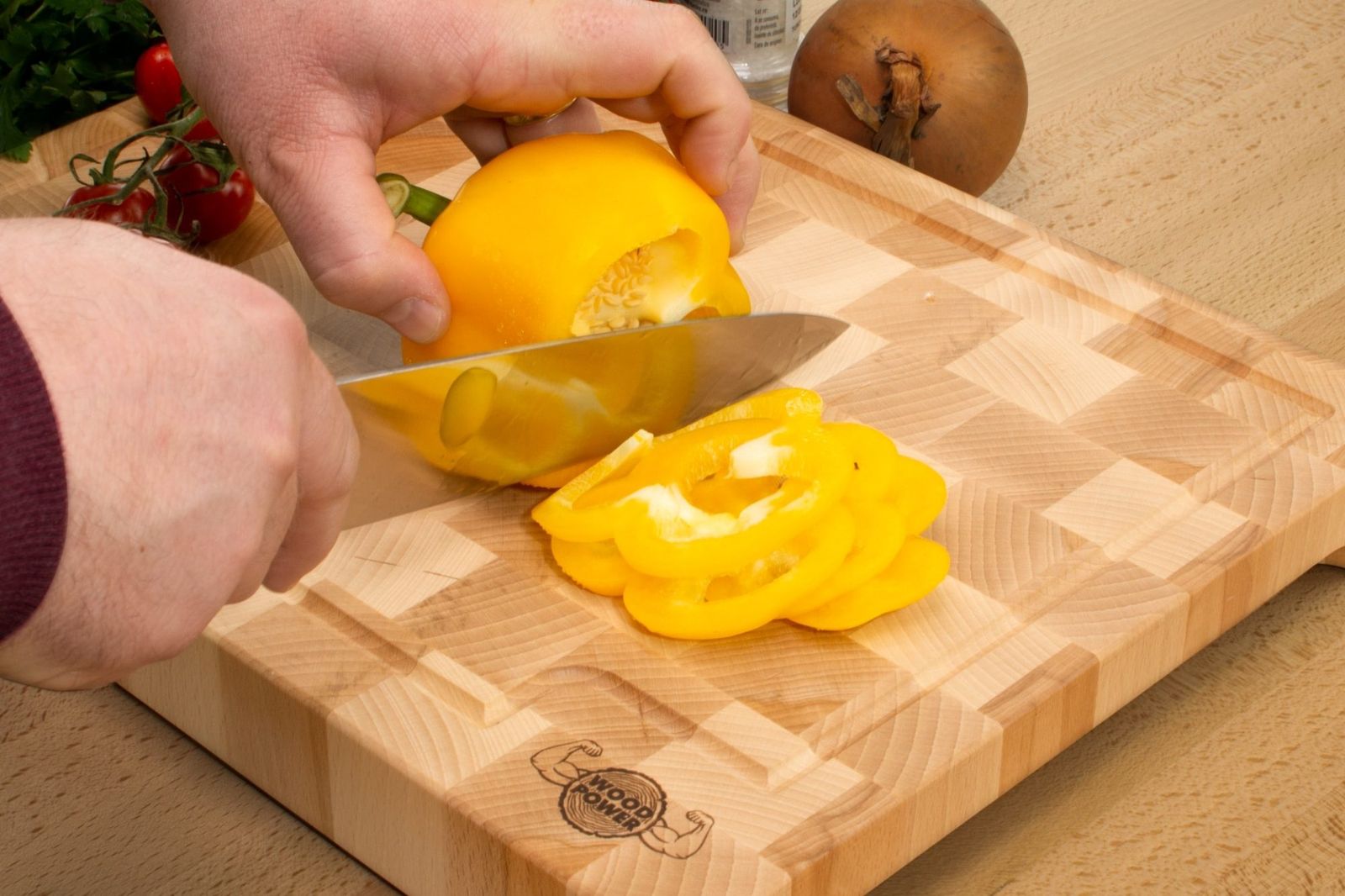
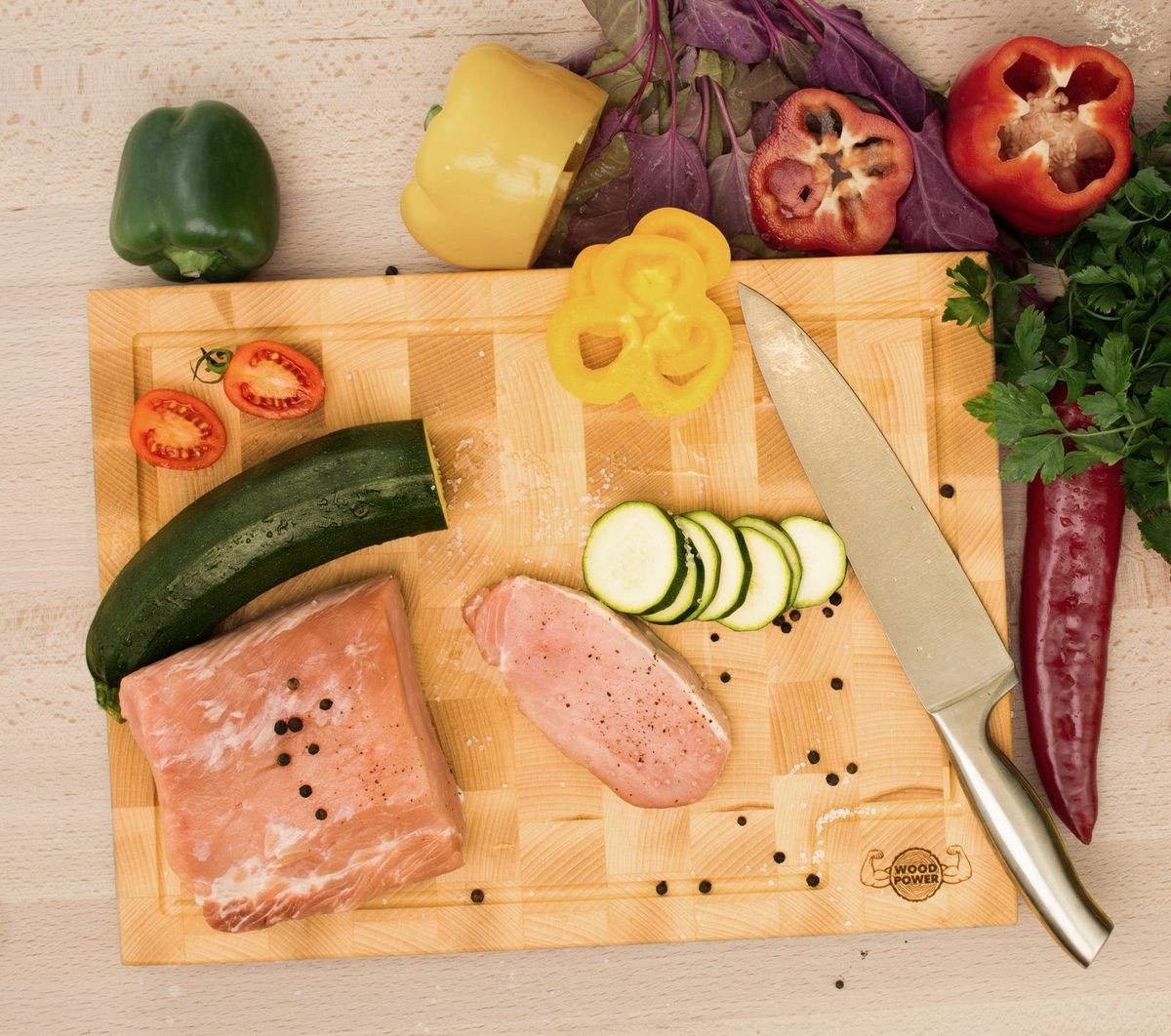
The board in the photos is the professional kitchen cutting board in solid beech, 30 × 40 cm: 4 cm thick, end grain, with a juice groove and silicone anti-slip feet, oiled without lacquer and not dishwasher-safe. It carries the WoodPower® brand and is sold and delivered on eMAG by RomDeko.24 We also make WoodPower's training equipment.
WoodPower states that its boards are treated with "special, certified oils, without pigment".24 Behind that wording is our in-house blend of food-grade sunflower oil and cold-pressed, food-grade linseed oil, described in the oiling section above.
For every product sold, WoodPower plants a tree with Trees for the Future, according to the brand.24 Trees for the Future is a non-profit that partners with farmers across Africa to restore degraded land through regenerative farming, with diverse trees and crops: timber lots, fruit trees, living fences and vegetable beds.38
Frequently asked questions
Is an end-grain cutting board better than a normal one?
It is kinder to knives and hides cut marks better, but it absorbs more oil and water, needs more care and costs more to make.1 For heavy daily chopping it is the better surface; for serving and light work, edge grain is enough.
Is beech good for cutting boards?
Yes. European beech is as hard as hard maple on the Janka test, diffuse-porous and odourless.2 In the studies that tested it, beech was as hygienic as plastic, without the stronger antibacterial effect of pine or oak, so clean it and let it dry.4,5
What oil should I use on a wooden cutting board?
A food-grade oil. Drying oils such as cold-pressed linseed cure in the wood, semi-drying oils such as sunflower penetrate well, and blends combine both; food-grade mineral oil and paraffin wax do not cure and need renewing more often. Avoid boiled linseed oil with metallic driers.1,25,27