Sycamore, Norway maple, field maple: which maple is which
European maple timber comes from three native species of the genus Acer, and the common names are a trap. In Britain "sycamore" means Acer pseudoplatanus, a maple; in North America the same word means the plane tree, Platanus occidentalis, a different wood.4
- Sycamore, Acer pseudoplatanus: Romanian paltin de munte, German Bergahorn. The palest and most valued European maple, and the classic wood for violin backs.1,5
- Norway maple, Acer platanoides: Romanian paltin de câmp, also arțar; German Spitzahorn.1,2
- Field maple, Acer campestre: Romanian jugastru, German Feldahorn. Usually a small tree.1,10
- Box elder, Acer negundo: Romanian arțar american, German Eschenahorn. A North American ornamental listed by EPPO among Romania's invasive plants; its wood is light, soft and rarely sold as lumber.1,3,11
The Romanian word arțar causes most of the confusion. The standard dictionary (DEX) defines it as Acer platanoides, and the 1989 dendrological dictionary lists A. platanoides as "arțar, paltin de câmp" and A. negundo as "arțar american". Regional usage also applies arțar to field maple, box elder, Tatar maple and even sycamore.2 The National Forest Inventory sidesteps the word and uses paltin de munte, paltin de câmp and jugastru.8 When someone offers you "arțar", ask which species it is.
In trade, "maple" often means North American timber. Hard maple is sugar maple, Acer saccharum; soft maple covers lighter species such as red maple. Holz vom Fach notes that hard maple is often imported because European maple is available only in relatively small quantities.12,13
Properties of European maples compared with hard maple, beech and oak
For comparable numbers we use The Wood Database and check them against German data from the Bavarian State Institute of Forestry (LWF). The hard maple values are for the American A. saccharum; the Janka values for Norway and field maple are estimates from specific gravity.4,14,15,5
| Property | Sycamore (A. pseudoplatanus) | Norway maple (A. platanoides) | Field maple (A. campestre) | Hard maple (A. saccharum, N. America) | Beech (F. sylvatica) | Oak (Q. robur) |
|---|---|---|---|---|---|---|
| Density at 12% MC (kg/m³) | 615 | 645 | 690 | 705 | 710 | 675 |
| Janka hardness (N) | 4,680 | 4,510* | 5,110* | 6,450 | 6,460 | 4,980 |
| Bending strength, MOR (MPa) | 98.1 | 115.0 | 123.0 | 109.0 | 110.1 | 97.1 |
| Stiffness, MOE (GPa) | 9.9 | 10.6 | 11.8 | 12.6 | 14.3 | 10.6 |
| Crushing strength (MPa) | 55.0 | 59.0 | – | 54.0 | 57.0 | 46.3 |
| Tangential shrinkage, green to oven-dry (%) | 7.8 | – | – | 9.9 | 11.7 | 8.4 |
| T/R shrinkage ratio | 1.7 | – | – | 1.9 | 2.0 | 1.8 |
| EN 350 durability class | 5 | 5† | 5 | non-durable‡ | 5 | 2 (–4) |
* Estimated by The Wood Database from specific gravity. † Holz vom Fach gives class 5 for maple (Acer spp.) in general. ‡ The Wood Database: non-durable to perishable. – no data. Source: Meier, The Wood Database (Sycamore Maple, Norway Maple, Field Maple, Hard Maple, European Beech, English Oak); durability classes from LWF Wissen 62 and 77 and Holz vom Fach.
Density and hardness
Sycamore is the lightest of the three European maples. LWF gives mean densities of 0.63 g/cm³ for sycamore, 0.66 for Norway maple and 0.72 for field maple.10 At a Janka hardness of 4,680 N, sycamore is about as hard as oak (4,980 N) and clearly softer than beech (6,460 N) or American hard maple (6,450 N).4,16,17,12 German Brinell values across the grain agree: 27 N/mm² for maple, 34 for beech, 34–41 for oak.5 LWF still calls sycamore hard and notably resistant to abrasion; Norway maple is coarser, harder and stronger, and preferred for handles and tools.5,10
Shrinkage and stability
Sycamore is one of the least-shrinking native hardwoods. LWF gives it a volumetric shrinkage of 11.2–12.8% from green to oven-dry, against 17.5–17.9% for beech and 12.6–15.6% for oak. Per 1% change in moisture content in service, sycamore moves 0.22–0.30% tangentially, oak 0.36% and beech 0.41%.5 Once dry, maple stays put. Drying it takes more care, because it tends to crack and distort and is extremely sensitive to discolouration.5
Durability: indoors only
Sycamore and field maple are durability class 5, the lowest, under EN 350, and Holz vom Fach gives class 5 for maple in general.5,10,13,18 Maple also resists wood-boring beetles poorly, and LWF advises workshops that store it to check their stock regularly.10
Working, gluing and finishing maple
Despite its hardness, sycamore machines cleanly. It saws, slices and peels well, planes to an even, smooth surface, profiles, carves and turns very well, and bends well but splits poorly. Nails and screws hold well, and gluing poses no problems.5 Two cautions: maple burns easily under blunt or fast router cutters, and it can blotch when stained, which a pre-conditioner or gel stain helps to avoid.4,13
Maple polishes easily and takes stain in any shade.5 The real finishing issue is light. Sycamore yellows noticeably; UV-resistant lacquers delay the yellowing but cannot prevent it in the long run, which is one reason why maple furniture is often stained in pastel shades.5,13 Steamed maple turns reddish and has been used to imitate pear, sometimes sold misleadingly under that name.5

Keeping maple white: discolouration during drying
With maple, colour is value. Sycamore has no colour difference between sapwood and heartwood, and the trade wants its yellowish-white to almost white wood. Older trees often form a grey-brown to brown false heart, which LWF counts as a value-reducing defect together with blackish streaks and light-brown "liver spots".5 Holz vom Fach notes that such a heart can appear from a trunk diameter of about 30–40 cm.13 The rest of the risk lies in drying. Our article on wood drying defects covers stains in general; here is what is specific to white maple.
Why maple stains: enzymes, oxidation and slow drying
The drying manual of the US Forest Products Laboratory (FPL) calls these defects enzymatic oxidation stains. They include sticker stain, interior greying (noted especially in maple) and the pinking and browning seen inside light-coloured woods such as hard maple, and they often show only after planing.6 The cause is slow drying, probably less than 5% moisture loss a day, at 10–54 °C while the wood is wetter than 40%. The colour may appear only later, below 15% moisture content, and kiln temperatures above 66 °C at the end of the schedule make it worse.6
The reaction can start in the log: research cited by the FPL found sticker stain almost inevitable in lumber sawn from old logs, however good the kiln operator. Chemical dips do not reach deep enough; the only practical prevention is to dry fresh lumber fast.6
Winter felling, fast sawing and end-racking
The European tradition answers with cold and speed: LWF lists winter felling, prompt sawing and rapid drying as the special care sycamore needs.5 A 1950 FPL report on maple and birch sapwood adds a caveat. Winter-cut logs stain less in normal winters, but logs stored until summer can stain as badly as summer-cut wood.19 It also describes end-racking: fresh boards stood on end against a ridge pole, crossed in an inverted V so that any mark stays at the ends, for 3–15 days depending on the weather. Old-timers considered it the only sure way to prevent sticker stain in maple, and it was reported in use with very white European sycamore.19
Kiln practice for white maple
The FPL checklist for white woods is specific: use logs stored for less than two weeks in warm weather, stack the lumber within 12 hours of sawing, use dry stickers at 8–10% moisture content, run air speeds above 2.54 m/s, reach a wet-bulb depression of at least 6 °C within the first 6 hours, start at 43–49 °C and exceed 71 °C only for equalising and conditioning.6 For 25–38 mm white lumber, maple included, the manual recommends a schedule with a lower starting temperature and humidity than usual, because both give brighter, whiter wood.6 Our guide to kiln drying hardwood explains how schedules are built.
Other sources point to the same ceiling. An FPL test on American soft maple found that drying soon after harvest below 42 °C greatly reduces discolouration, and Holz vom Fach advises keeping maple below 45 °C so that it does not darken.20,13
Figured maple: flame (fiddleback) and bird's-eye
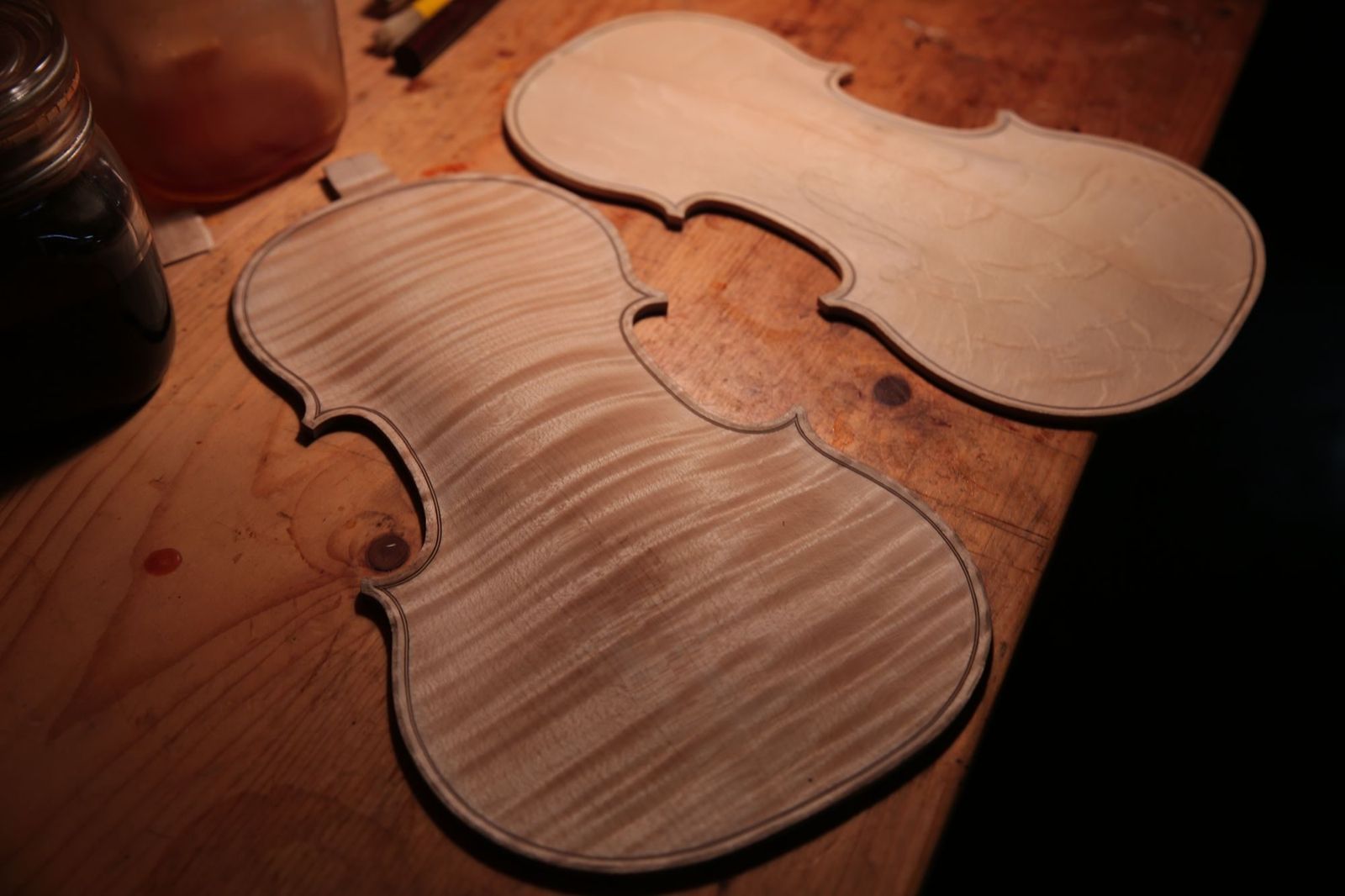
Some maples grow figure, and figure multiplies value. The most important figure in Europe is flame: Riegelahorn in German, fiddleback in English because violin backs have been made from it for centuries, paltin creț in Romanian. It comes from a wavy course of the fibres, which reflect light differently so that the cut surface shows bands of light and dark.5 European maples also produce burr (Maser) and "pyramids" from forks, and the butt logs of field maple often carry wavy grain and burr that veneer mills pay well for.5,10
What causes flame figure
The cause is unknown. A 2013 review by scientists from the Thünen Institute of Forest Genetics and the Northwest German Forest Research Institute found signs that the trait is inherited, probably recessively given its rarity. A virus is unlikely, and because flame is often limited to one half or the butt of a stem, the cause is probably multifactorial.7 In French maple stands two to five per cent of trees are figured. Flame cannot be read from the bark; windows punched into the sapwood give a hint, but certainty comes only after felling.7
Bird's-eye maple: an American figure
Bird's-eye figure, small dark "eyes" scattered across the face, is a speciality of North American sugar maple. LWF states that it does not occur in the native German maples and attributes it to small knot-like structures with local fibre deviations, best shown on rotary-cut veneer.5 A US Forest Service paper reports that its cause is unknown; similar figure has been described in European maples, but it is rarer and less valuable there. The same paper shows how figure drives value: bird's-eye veneer typically made up less than 1% of the harvested volume but could account for half the value of a timber sale.21 Figure, not volume, sets the price of the best maple.
We found no European standard for grading figure. Veneer buyers judge each log, and tonewood dealers use their own scales, so compare photographs or samples of the actual pieces, not grade names.
What figured maple fetches: value-timber auction prices
German and Austrian forest owners sell their best logs each winter at value-timber auctions (Wertholzsubmissionen). The logs are laid out on a yard, buyers submit sealed written bids, and the highest bid wins.22,23 Figured sycamore has repeatedly topped these sales.23,24
| Date | Sale | Maple result | Context |
|---|---|---|---|
| 2003 | Eppingen forest office, Baden-Württemberg | Figured maple stem: €28,000 | – |
| Jan 2011 | Heiligenkreuz, Lower Austria | Figured maple: about €7,000/m³, Austria's most expensive stem | About €365,000 for about 1,000 m³ of hardwood |
| Spring 2011 | Arnstein, Bavarian State Forests | Sycamore stem: more than €44,500 | Called a "world-record stem" at the time |
| Jan 2012 | Dresden, Sachsenforst | Top log a figured sycamore: €8,022 (€5,209/m³); sycamore average €585/m³, highest of all species | Average for all species €272/m³ |
| Spring 2012 | Near Ageville, eastern France | Figured maple, 4.5 m³: €61,537 | More than 80 cm diameter, 8.5 m long |
| Feb 2019 | St. Florian, Upper Austria | Most expensive stem a figured maple, €6,700; top bid for a maple €3,800/m³ | Average about €447/m³ |
| Feb 2020 | St. Florian, Upper Austria | Top bid of the sale a figured maple, €5,120/m³ (€7,117 for the stem) | Average €481/m³; oak average €500/m³ |
| Jan 2026 | Saxony | Sycamore average €338/m³ | Average for all species €615/m³; top log an oak at €2,012/m³ |
Top prices are for the best few logs of each sale and are not prices for maple lumber. Source: Naujoks et al. (2013), AFZ-DerWald 5/2013; Amt der NÖ Landesregierung (2011); Sachsenforst (2012); Freistaat Sachsen (2026); top agrar Österreich (2019); Tips (2020).
The record prices are for single stems: €28,000 for a figured maple from the Eppingen forest office in 2003, more than €44,500 for a sycamore from the Bavarian State Forests' Arnstein district in 2011, and €61,537 in 2012 for a figured maple from near Ageville in eastern France, 4.5 m³ in volume.7 By our calculation the French stem made about €13,700 per cubic metre. At regional sales the best figured stems have drawn bids of about €3,800 to €7,000 per cubic metre.22,23,25,24
Plain sycamore is another matter. At the Saxon sale of January 2026 it averaged €338/m³ against €615/m³ for all species, and the top log was an oak.26 Auction prices describe the best few per cent of logs, not ordinary lumber, and we found no open European price index for maple sawnwood.
Tonewood: sycamore for violin backs, ribs and necks
A violin is a spruce top on a maple body. The top, sound post and bass bar are resonance spruce (Picea abies); the back, ribs and neck are usually curly sycamore.27,5 Sycamore is light for its strength: at the violin-making school in Mittenwald, Bavaria, which has used native sycamore for about 150 years, the ribs are bent from strips about 1.2 mm thick.28
How much the maple adds to the sound is debated. LWF's wood scientists write that the sound comes from the spruce top; Romanian researchers reply that wavy grain improves acoustic as well as visual properties.5,27 Either way, the figure is what luthiers pay for.
Reghin, Romania's violin town
Reghin, in Mureș county, has made violins since 1951, when the luthiers Roman Boianciuc and Alexandru Apăteanu made the first ones in the workshop from which the state factory, today's Hora, grew. It made 37 violins in its first year and 435 the next.29,30 According to a 2021 AFP report, Vasile Gliga, who trained at Hora, started in 1988 with two violins; in 2020 his company sold 50,000 instruments, 2% of them in Romania.30
The wood is local. Hora uses spruce and maple from the Carpathians, seasoned naturally for 5–10 years and sometimes up to 20.29 AFP reported that Reghin's reputation rests partly on old flame maples in the surrounding forests, and that some Chinese makers buy Reghin-type wood through middlemen and sell their violins as made of "European wood".30
What makes a good tonewood billet
- Clear, fine-ringed wood. Instrument makers use only fine-ringed, completely defect-free maple; figured wood is chosen for backs mainly for its looks.5
- Density and colour. Luthiers sort sycamore into anatomical quality classes. A 2023 study of such classes found correlations between density, brightness, redness, ring width and the acoustic and elastic properties.31 Published oven-dry densities of curly maple for violins span 480–750 kg/m³.27
- Long natural seasoning. Wood for musical instruments is dried for 3–12 years or more, depending on the quality class, and kiln drying is avoided where possible because even mild kiln conditions can harm the acoustic qualities of resonance wood.27
- Altitude. An article from the Mittenwald school states that the flamed maple most used in violin making grows above 1,000 m.28 Treat this as craft experience, not a rule.
- The cut. Resonance wood is cut radially, and logs of 400–600 mm diameter are chosen to allow it.27 On radial faces sycamore shows its rays as small, reddish, lustrous flecks.5 Our article on quarter-sawn timber explains the cuts.
Uses: furniture, floors, kitchenware and turnery
In furniture, sycamore is mostly used as veneer for fronts, doors and small pieces, and as solid wood for kitchens. A solid maple top belongs to every traditional German inn table, because its fine pores are easy to keep clean and it resists wear. Maple is also the light wood in inlays and stringing. On floors and stairs, LWF rates its wear resistance at least equal to oak and beech, which makes it one of the most common parquet woods.5
Turnery uses maple's fine, even texture: chair and table legs, rolling pins, spoons, whisks, cutting boards, toys, chess pieces and recorders, for which maple and pear are the main woods.5 Field maple is valued for axe and tool handles, toys and kitchenware; one toy maker in Upper Franconia prefers it to sycamore for its smoother, denser surfaces.10

Chopping boards and food contact
Maple is the classic chopping-board wood, and the US Food Code says so. Wood may not normally be used as a food-contact surface, but "hard maple or an equivalently hard, close-grained wood" may be used for cutting boards, bakers' tables and utensils such as rolling pins and salad bowls.32 A 2016 review of two decades of studies concluded that wood's porous structure does not explain its poorer hygiene reputation and may even help, partly because wood produces antimicrobial compounds.33 In the EU, wooden boards fall under the general rules of Regulation (EC) No 1935/2004, with no harmonised specific measure for wood.34,33 Our article on solid wood worktops covers food contact on kitchen surfaces.
Maple in Romania's forests
Romania's National Forest Inventory (IFN) publishes its latest results only by species group. In cycle III (2020–2025), maples belong to the "other hard broadleaves" (foioase tari) with hornbeam, ash and others: 1.16 million ha, 16.4% of the forest area, with 310 million m³ of standing timber.35 Our article on Romania's hardwood forests explains the inventory.
The first cycle (2008–2012) reported individual species, and sycamore made the list. Of 105 tree species recorded, 16 covered more than 1% of the forest area each. Paltin de munte covered 80,173 ha, 1.4%, level with small-leaved lime and common ash, and held 24.6 million m³ of standing timber, 1.1% of the total, at an average of 307 m³ per hectare. Norway maple and field maple did not reach 1%.8
Sycamore rarely forms pure stands; it grows on rich soils at the foot of slopes, in ravines and along streams, mixed with ash, elm and lime.36 In Romania, as the name paltin de munte ("mountain maple") suggests, it is a tree of the hills and mountains. Norway maple grows in small groups or as single trees, and field maple is a subdominant tree of oak and mixed broadleaved forests up to about 1,600 m.37,38
Much of the best maple habitat is protected. Maple and lime forests on slopes, screes and in ravines (Tilio-Acerion, habitat 9180) are a priority habitat under the EU Habitats Directive, and sycamore often dominates them.36 IFN III also places 1.42 million ha, about 20% of Romania's forest area by our calculation, in the class where no regulated wood harvest takes place.35 Romanian sycamore is therefore a real but scattered resource, bought log by log out of mixed stands.
Maple in Europe: Germany, France, the Balkans and trade
Germany: maple is gaining ground
Germany's fourth national forest inventory (BWI 2022) reports maple as its own species group. It stocks 329,208 ha, 3% of the timberland, up by 71,000 ha from 2.3% in 2012, and its standing volume rose by 18.3 million m³ to 77.2 million m³.9 The inventory also warns that after the drought years sooty bark disease is causing increasing damage, with high mortality, in sycamore stands.9
France, the Balkans and the Carpathians
In France sycamore is common in the north-east and in the mountains. A 2019 Ministry of Agriculture species sheet, based on IGN data for 2013–2017, puts sycamore stands at about 24.6 million m³ standing and lists sycamore and Norway maple as main species on 140,900 ha.39 A 2023 study by the timber federation FNB with IGN and FCBA counts the "large maples" among France's secondary hardwoods, species without an established market outlet.40
Sycamore's native range runs through the Carpathians and the Dinaric Alps, and Norway maple is native from Greece and the Balkans northwards.36,37 We found no open species-level maple statistics for Bosnia and Herzegovina, so we quote none. One regional risk is documented: the North American canker fungus Eutypella parasitica can severely damage sycamore stems and has been spreading from Slovenia and Croatia towards Austria.36
Trade: a small niche that depends on imports
Customs data show how small the maple trade is. In 2025 the EU imported 2,965 tonnes of maple sawnwood (CN 4407 93) from outside the EU, worth €4.7 million, down from 5,255 tonnes in 2016; Canada and the USA supplied 86% of it. By our calculation the average import value rose from about €1,410 per tonne in 2016 to €2,404 in 2022, then eased to €1,582 in 2025.41
Show the data
| Year | All non-EU suppliers | Canada | USA |
|---|---|---|---|
| 2016 | 5,254 t | 3,188 t | 1,733 t |
| 2017 | 4,751 t | 2,775 t | 1,498 t |
| 2018 | 4,862 t | 2,680 t | 1,512 t |
| 2019 | 4,722 t | 2,946 t | 1,151 t |
| 2020 | 4,413 t | 2,556 t | 1,176 t |
| 2021 | 5,704 t | 3,617 t | 1,280 t |
| 2022 | 3,812 t | 2,161 t | 1,241 t |
| 2023 | 3,468 t | 1,451 t | 1,342 t |
| 2024 | 3,085 t | 1,299 t | 1,148 t |
| 2025 | 2,965 t | 1,631 t | 924 t |
Converted from 100 kg units. Average import value, our calculation: €1,410/t in 2016, €2,404/t in 2022, €1,582/t in 2025. Source: Eurostat Comext, dataset DS-045409, product 440793, partner EXT_EU27_2020, CA and US (data updated 16 October 2026).
National flows are small too: in 2025 Germany imported 1,893 tonnes of maple sawnwood from all sources, and Romania exported 132 tonnes.41
How we handle maple requests at SARAL
Buying maple: a checklist
- Name the species in Latin. Write Acer pseudoplatanus, A. platanoides or A. campestre on the order, not "arțar" or "maple". For American hard maple, write A. saccharum.
- Specify the colour. White wood only, or false heart, streaks and liver spots allowed, and in what proportion.5,13
- Ask about felling and drying. When were the logs felled, how soon were the boards stacked, and at what temperature did drying start?6
- Inspect planed samples from the actual batch: chemical stains often show only after planing.6
- Check moisture content against your target, and look for beetle activity in stored air-dry stock.10
- For figured wood, buy on photographs or samples of the actual pieces, and agree whether the figure must run the full length; it is often limited to part of a stem.7
- For tonewood, ask for the cut, ring width, density, and the length and method of seasoning.27,31
- Document the legal origin exactly as you would for beech or oak.
Frequently asked questions
Is sycamore the same as maple?
In Europe, yes. Sycamore is Acer pseudoplatanus, a maple, called paltin de munte in Romanian and Bergahorn in German. In North America "sycamore" means the plane tree, a different wood.4
Is maple good for chopping boards?
Yes. The US Food Code names hard maple as the reference wood for cutting boards, and research does not show wood to be less hygienic per se. Keep boards clean and dry.32,33
What causes flamed or curly maple?
A wavy course of the wood fibres, which reflects light in bands. Why some trees grow it is unknown; heredity seems to play a part, and only about 2–5% of trees in French maple stands are figured.7,5
Why does maple turn yellow or grey?
Grey and brown stains come from enzymatic oxidation when wet maple dries too slowly at warm temperatures; fast, cool drying prevents them. Yellowing after finishing is caused by light, and UV-resistant lacquers slow it but do not stop it.6,5