European beech at a glance
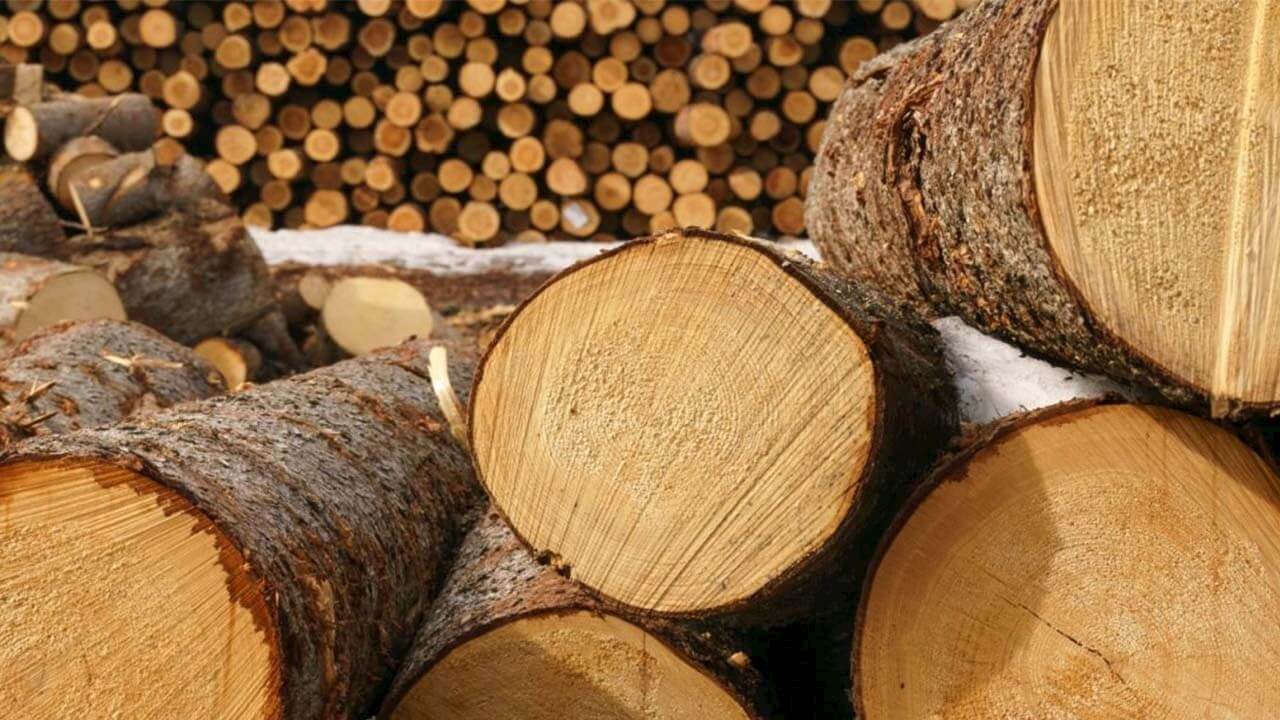
European beech, Fagus sylvatica (fag in Romanian, Rotbuche in German), is a pale, fine-textured hardwood with a straight grain and a moderate natural lustre. Its colour is a pale straw, sometimes with a pink or brown hue.1 It is hard, strong and wear-resistant, machines, glues, finishes and turns well, and the Wood Database calls it a mainstay for many European woodworkers.1
Beech has two weaknesses that every buyer should know about. It shrinks and swells more than oak, and it has no natural durability against decay.5,7 Both are manageable, and most of this guide is about how.
Beech in Romania: the largest forest species
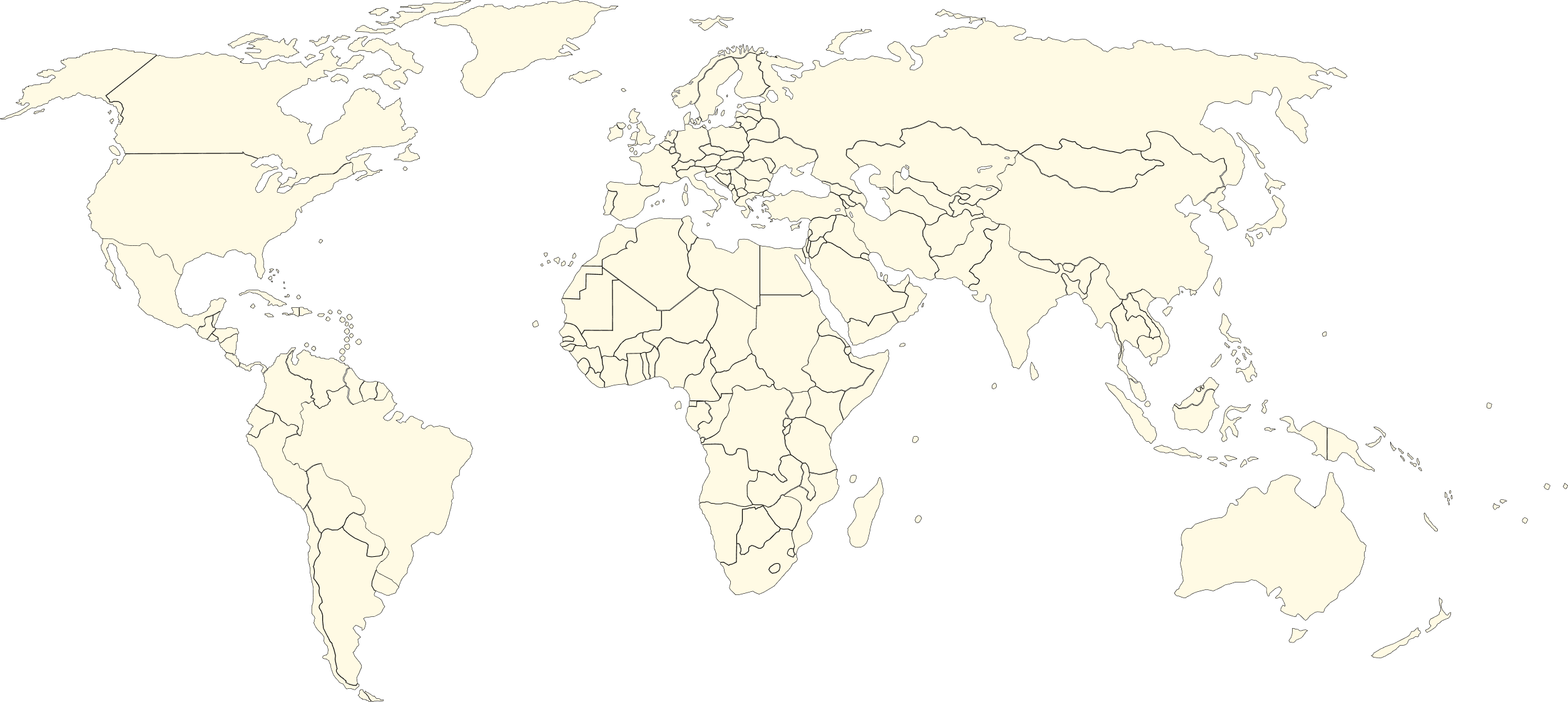
Romania is one of Europe's beech countries. According to the third cycle of the National Forest Inventory (IFN, 2020–2025), beech stands cover 2,525,177 ha, or 35.8% of the country's forest area: more than the conifers (25.2%) and twice the oaks (18.1%). Beech holds 912.9 million m³ of standing timber, 37.2% of the total, and grows by about 21.9 million m³ a year, while the inventory measured a harvest of about 8.5 million m³ a year.2 In the official harvest statistics for 2025, beech made up 5.58 million m³, or 32.1% of the roundwood felled by certified operators.8
The two sources measure different things, and the inventory's harvest figure is higher than the official statistics; our article on Romania's hardwood forests in numbers explains why and goes through the data species by species. For a buyer, the conclusion is simple: in Romania, beech is the most plentiful hardwood by a wide margin.
Why beech is the classic chair wood
Chairs are the hardest test for furniture timber. Thin legs, rails and backs are loaded in bending every time someone sits down, leans back or tips the chair on two legs. Beech combines the three properties such parts need: strength, stiffness and the ability to be bent.
Strength, stiffness and hardness
The Wood Database gives European beech a bending strength of 110.1 MPa and a stiffness of 14.3 GPa, against 97.1 MPa and 10.6 GPa for European oak.1,9 The German DIN 68364 values tell the same story: a bending strength of 120 N/mm² and a stiffness of 14,000 N/mm² for beech, against 95 and 13,000 for oak.7 Beech is also hard: 6,460 N on the Janka test, about 30% more than oak's 4,980 N, and a Brinell hardness of 34 N/mm² across the grain, level with oak.1,7,9
| Property | Wood Database | DIN 68364 / 68100 |
|---|---|---|
| Density | 710 kg/m³ | 720 kg/m³ (range 540–910) |
| Hardness | Janka 6,460 N | Brinell 72 along / 34 across grain (N/mm²) |
| Bending strength | 110.1 MPa | 120 N/mm² |
| Stiffness (MOE) | 14.3 GPa | 14,000 N/mm² |
| Compression strength along grain | 57 MPa | 60 N/mm² |
| Shrinkage green to oven-dry, radial / tangential / volumetric | 5.8 / 11.7 / 17.9% | 5.8 / 11.8 / 17.5–17.9% |
| Movement per 1% MC, radial / tangential | – | 0.20 / 0.41% |
| EN 350 durability class | 5 (not durable) | 5 |
Source: Meier, The Wood Database, European Beech; LWF Bayern, LWF-Wissen 12 (DIN 68364, DIN 68100, Grosser 1989) and LWF-Wissen 65 (movement per 1% MC); EN 350 class from Holz vom Fach.
As always with wood, the averages hide a spread. The DIN tables give a mean density of 720 kg/m³ for beech, but a range from 540 to 910.7 For demanding parts, straight grain and the right density matter as much as the species.
Steam bending: from Thonet No. 14 to today
Beech "responds superbly to steam-bending", in the Wood Database's words, and Holz vom Fach confirms that it bends well after steaming.1,5 The industrial proof came in 1859 with Michael Thonet's chair No. 14: six pieces of steam-bent beech, ten screws and two nuts, shipped flat. By 1930, 50 million had been sold.10
Steamed vs unsteamed beech: colour, process and uses
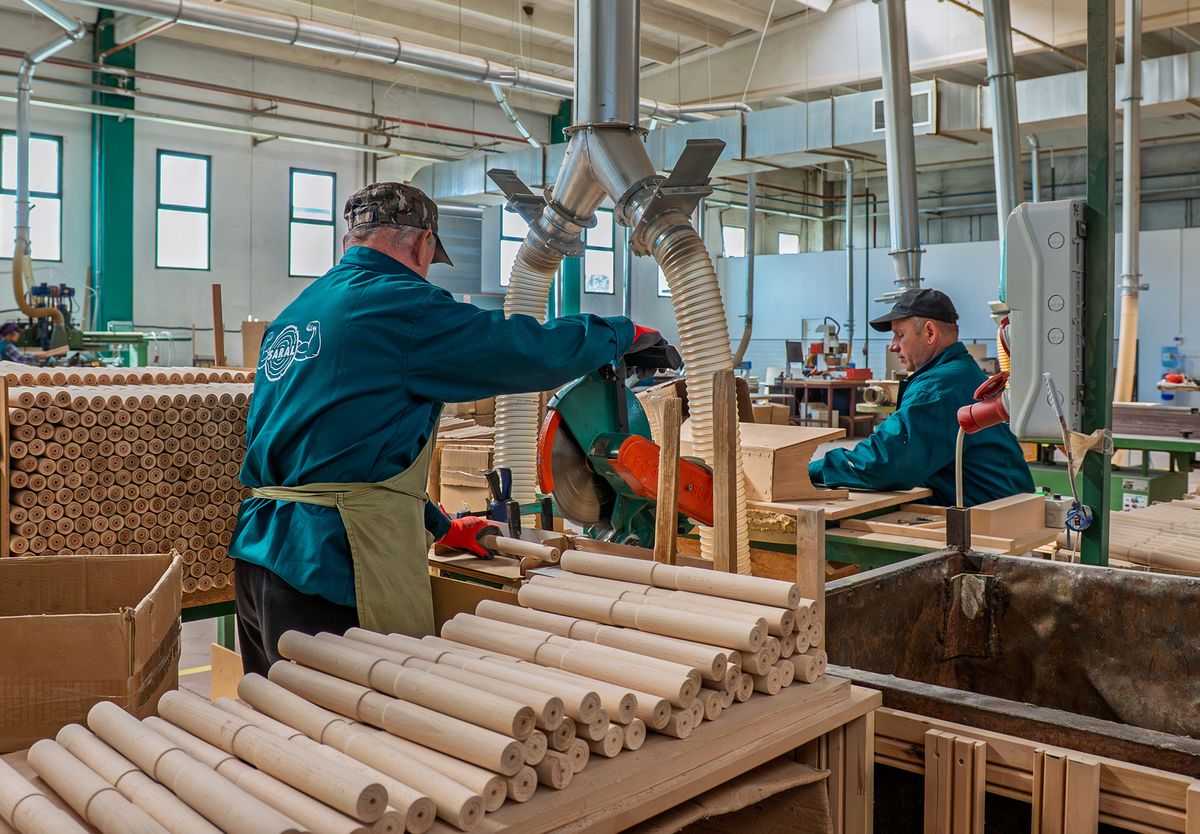
Beech is sold in two colour forms. Unsteamed beech keeps its natural pale, whitish-grey to yellowish colour. Steamed beech has been treated with steam while wet, which turns it pink-brown and, with stronger treatment, dark brown-red.3 The Wood Database notes that beech veneer usually looks slightly darker and more golden, because slicing veneer requires the wood to be steamed first.1
What steaming does to the colour
Steaming wet beech starts chemical reactions in the wood: water-soluble compounds are extracted, hemicelluloses are broken down and the lignin's colour-bearing groups change.3 The result is measurable. In a study at the Technical University in Zvolen, beech blanks 38 mm thick were steamed in an autoclave at 95–125 °C for 3 to 12 hours. Their lightness L* (on a scale where 100 is white and 0 is black) fell from 76.8 for unsteamed wood to 64.9 after 12 hours at 95 °C, 59.2 at 105 °C, 54.5 at 115 °C and 49.1 at 125 °C.3
Show the data
| Steaming time | 95 °C, steam-air mixture | 105 °C, saturated steam | 115 °C, saturated steam | 125 °C, saturated steam |
|---|---|---|---|---|
| 0 h | 76.8 | 76.8 | 76.8 | 76.8 |
| 3 h | 73.4 | 70.0 | 66.3 | 61.5 |
| 6 h | 69.8 | 66.3 | 60.5 | 56.3 |
| 9 h | 66.7 | 61.6 | 57.0 | 52.5 |
| 12 h | 64.9 | 59.2 | 54.5 | 49.1 |
Source: Dzurenda (2022), BioResources 17(1): 1690–1702, table 2. Laboratory autoclave, 38 × 100 × 800 mm blanks of wet beech.
Two things follow for buyers. First, "steamed beech" is not one colour: the shade depends on temperature and time, so ask for a sample, not just the word. Second, colour consistency between batches depends on the steaming process being repeated precisely.
Which one to choose
Choose unsteamed beech when you want the palest, most neutral wood or plan to stain or paint it light. Choose steamed beech for a warmer, more even tone. The kiln has to follow the choice: colour-sensitive beech is dried more gently, as our kiln drying guide explains.
Red heart in beech: what it is, why it forms and what it costs
Many older beech trees develop a reddish-brown, irregularly shaped core known as red heart or false heartwood (German Rotkern).3,5 Unlike the true heartwood of oak, it is facultative: it forms only under certain conditions. Holz vom Fach says it mostly forms from about 80 years of age, favoured by external factors such as broken branches.5 The mechanism, as Knoke (2002) describes it, is oxygen entering the central parts of older trees, where the living cells are already dead or weak.4
Thicker trees, more red heart
Red heart becomes more likely as trees grow. A Bavarian model, based on Knoke and Schulz-Wenderoth (2001), assumes that a white beech with a diameter at breast height of up to 30 cm has a 4% chance of forming red heart within ten years; at 50–60 cm the chance is 45%, and at 70–80 cm it is certain.4 Forestry advice from Baden-Württemberg puts the threshold at about 60 cm and 120 years, below which devaluation by red heart is hardly to be feared.11
Show the data
| Probability within 10 years | |
|---|---|
| ≤30 cm | 4% |
| 30–40 cm | 16% |
| 40–50 cm | 31% |
| 50–60 cm | 45% |
| 60–70 cm | 65% |
| 70–80 cm | 100% |
Model assumptions for Bavarian stands, not a measured incidence rate. Source: Knoke (2002), Silva Fennica 36(4): 841–851, table 4, after Knoke & Schulz-Wenderoth (2001).
How red heart affects grade and price
Red heart does not weaken beech, and it does not change its durability: Holz vom Fach rates beech, red heart included, as EN 350 class 5.5 What it changes is the price. Knoke describes red heart as severely devaluing beech timber "mainly for aesthetical reasons", and cites yearly losses of €5.1 million reported for North Rhine-Westphalia.4 In his study logs were graded from A (no red heart at the felling cut) to D (red heart wider than half of the stump diameter).
The price gap can be large. In the state forests of Baden-Württemberg in 1999, A-grade made up under 5% of beech sawlogs and C-grade 58%; C-grade logs fetched an average of only €45/m³, against €351 for A and €111 for B.11 The figures are old, but they show why sawmills and buyers sort for it. In panels the effect is the same: one producer's data sheet for beech panels allows no red or brown heart on the best (A) face.12
There is also a market for red heart. Holz vom Fach notes that red-hearted beech suits decorative furniture and interiors with demanding design.5 In the German furniture trade it is often sold as Kernbuche. Do not confuse it with other, quality-reducing discolourations of beech, which Holz vom Fach warns against.5 And because red heartwood gives up moisture more slowly, it needs careful drying.5
Movement: beech shrinks more than oak
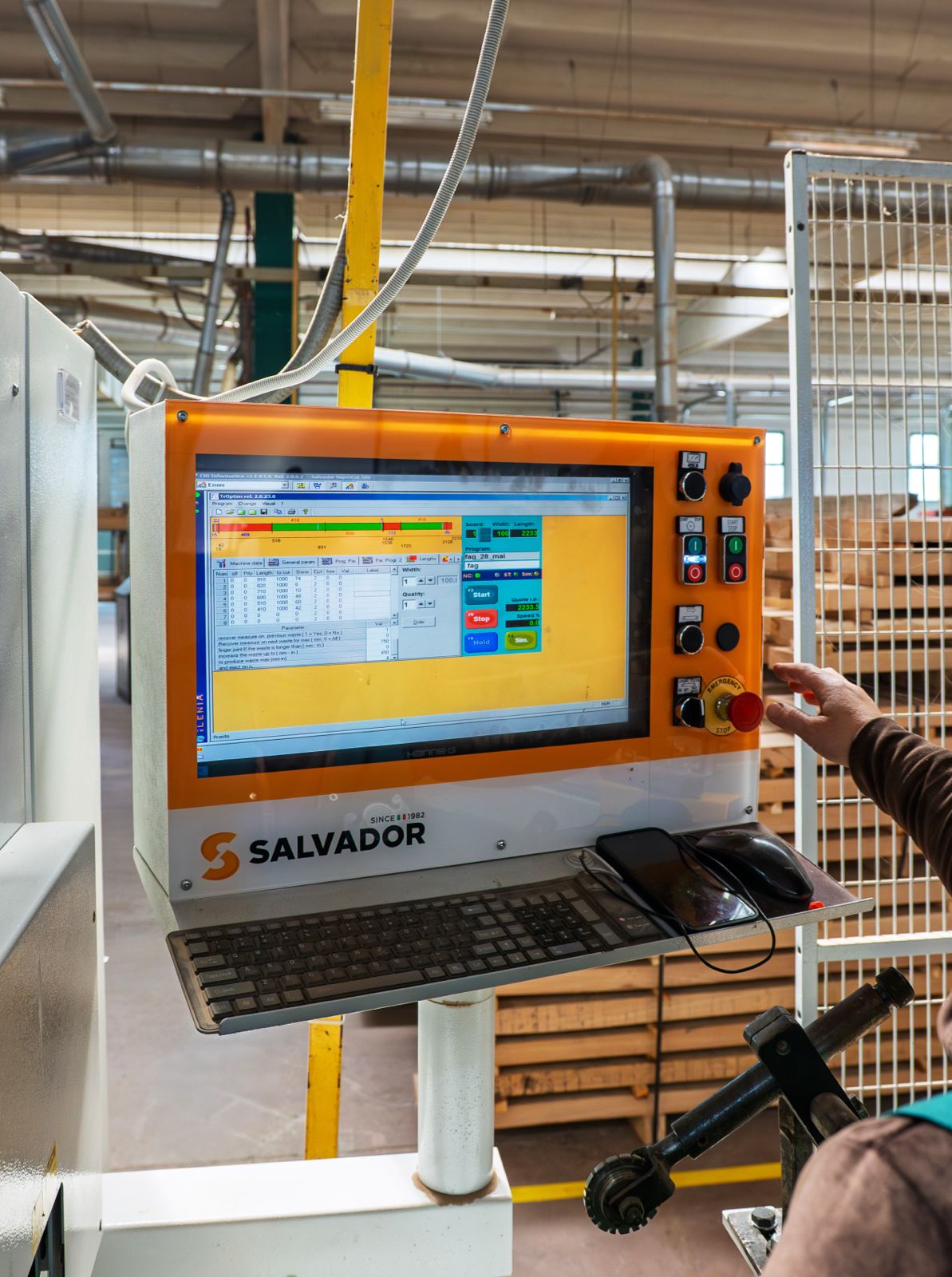
Beech is a "high-movement" wood. From green to oven-dry, the German DIN 68100 values give it 5.8% radial, 11.8% tangential and 17.5–17.9% volumetric shrinkage, against 4.0–4.6%, 7.8–10.0% and 12.6–15.6% for oak.7 Holz vom Fach warns that strongly shrinking beech tends to warp and crack during drying, and that stacking and drying need care to avoid discolouration.5
Show the data
| Beech | Oak | |
|---|---|---|
| Radial | 5.8% | 4.3% |
| Tangential | 11.8% | 8.9% |
| Volumetric | 17.7% | 14.1% |
Ranges plotted at their midpoint: beech volumetric 17.5–17.9; oak 4.0–4.6, 7.8–10.0 and 12.6–15.6. Source: DIN 68100 and Grosser (1989) via LWF Bayern, LWF-Wissen 12, table 13.
In service, what matters is the movement per point of moisture content between 5% and 20%: 0.41% tangentially and 0.20% radially for beech, against 0.36% and 0.16% for oak.6 On a 200 mm flat-sawn board, a change from 10% to 6% MC means about 3.3 mm of width (200 × 0.41% × 4, our calculation). The same board cut on the quarter would move about half as much.
Design and drying rules for beech
- Dry beech to the moisture content of the room where it will live, and keep it there until it is machined and finished.
- For wide glued surfaces, such as table tops and worktops, prefer narrow or quarter-sawn lamellas and leave room for movement.
- Seal all faces of a panel equally, so that both sides take up and lose moisture at the same rate.
Moisture content targets for beech furniture and panels
Hardwood for furniture, cabinets and millwork is usually dried to 6–8% moisture content. US guidance for interior woodwork aims at an average of 8%, with individual pieces between 6% and 10%.13 Beech's high movement makes that target more important, not less. Our kiln drying guide covers how to specify and check it.
Not for outdoors: EN 350 class 5 and the alternatives
Beech is rated EN 350 durability class 5, not durable, and that includes its red heart.5,14 Outdoors it needs protection: Holz vom Fach mentions preservative treatment, as in railway sleepers, or wood modification such as thermo-beech.5 Its sapwood takes preservative very well, red heart poorly.5 For untreated outdoor work, oak heartwood is the better choice; our comparison of oak, beech and ash sets out the durability classes side by side.
The European beech market: logs to China, sawmills at home
A large share of Europe's beech still leaves the continent as logs. Germany exported 626,000 m³ of beech logs in 2024, 19% more than the 526,000 m³ of 2023; China was the main buyer with 274,000 m³ (+26%), ahead of Austria with 221,000 m³.15 From January to October 2025, China imported 555,000 m³ of European beech logs, led by Germany (241,300 m³) and France (93,400 m³), with Slovakia up 144% to 61,100 m³.16
At the same time, the German beech sawmilling industry is concentrated in few hands. Pollmeier cut 715,000 m³ in 2025 at three sites, 55% of Germany's total hardwood cut of 1.29 million m³, and plans 850,000 m³ for 2026.17 German beech log prices from state forests stood at 127.5 in 2025 (2015 = 100), after a peak of 133.5 in 2023.18
Romania works differently. FAO data show it exported only about 22,000 m³ of hardwood industrial roundwood in 2024.19 Most Romanian hardwood is therefore sawn and processed in the country, which suits European furniture makers who prefer to buy dried, graded timber or finished components instead of logs.
How we work beech at SARAL
Buying beech lumber, panels and components: a checklist
- Steamed or unsteamed? Say which, and ask for a colour sample from the current batch.
- Red heart rules. Excluded, allowed up to a share of the face, or wanted as Kernbuche. Write it into the order.
- Moisture content and tolerance. Typically around 8% for interior furniture; ask how it was measured.13
- Cut and lamella width for panels and tops. Quarter-sawn or narrow lamellas reduce movement.6
- Face grade. For panels, agree the grade of each face and how knots, colour and glue lines are judged.12
- Use. Indoors only, unless the beech is treated or modified for outdoor use.5
Frequently asked questions
What are the properties of beech wood?
European beech weighs about 710 kg/m³ at 12% moisture, is hard (Janka 6,460 N), strong and stiff in bending (110 MPa, 14.3 GPa), has a fine even texture, machines and glues well and bends very well with steam. It moves more than oak and is not durable outdoors.1,5,7
What is steamed beech?
Beech treated with steam while wet, which changes its chemistry and turns it from pale straw to pink-brown or, with longer or hotter steaming, dark red-brown. In tests, 12 hours at 95 °C cut lightness from 76.8 to 64.9 on the L* scale.3
Is red heart in beech a defect?
Not structurally. Red heart is a facultative coloured core that forms mostly in older, thicker trees. It lowers the price for aesthetic reasons and is excluded from top appearance grades, but beech with red heart has the same durability class, and some buyers want it for its colour.4,5,12
Is beech good for furniture?
Yes, especially for chairs and parts loaded in bending: it is stronger and stiffer than oak and bends well with steam. For wide tops, control the moisture content carefully, because beech moves more than oak.1,6,9