Two families: penetrating finishes and film-forming finishes
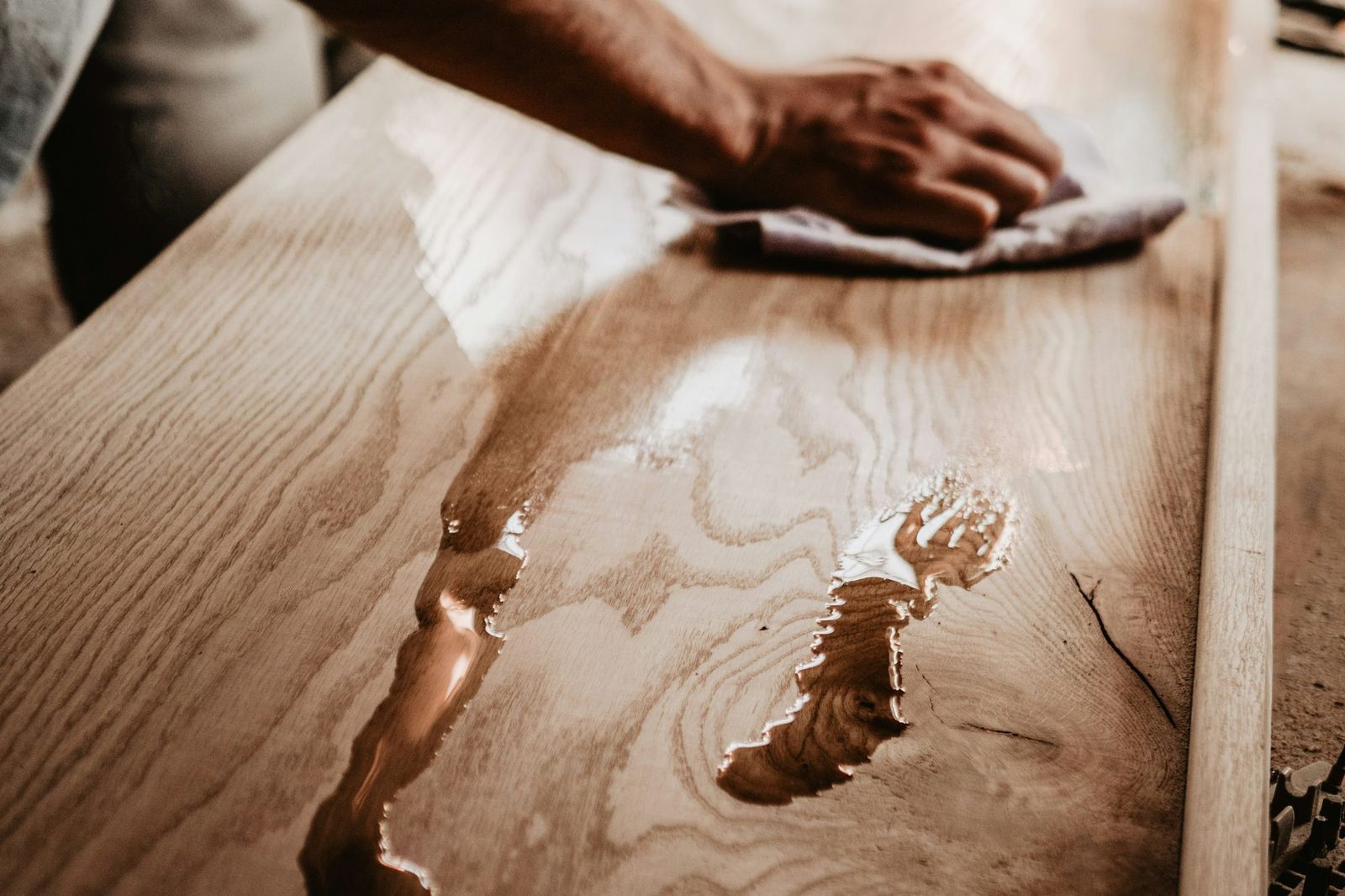
Every clear wood finish either soaks into the wood or sits on top of it. FPL, the US Forest Products Laboratory, draws the line clearly: penetrating finishes such as oils flow into the pores and do not form a film, so they cannot crack or flake; film-forming finishes such as varnish and lacquer build a continuous layer on the surface.1 Hardwax oil sits on the penetrating side: oil carries wax into the surface layer, which leaves a thin, open finish rather than a coating you could peel.
One fact applies to both families. A finish cannot change the equilibrium moisture content of wood; it only slows down the rate at which water enters and leaves it.1 A lacquered table top and an oiled one end up at the same moisture content in the same room. The lacquered top just gets there more slowly, which smooths out daily swings but not seasonal ones. That is why a finish never replaces correctly dried wood and correct fixings; the moisture content article explains the physics.
Oil and hardwax oil
Drying oils such as linseed and tung oil penetrate the wood and cure by reacting with air; FPL notes that they can take several weeks to cure fully. Non-drying oils such as olive or sunflower oil never cure, can go rancid and feed microorganisms, which is why FPL advises against vegetable oils on food surfaces and suggests paraffin oil or wax instead.1
Modern hardwax oils combine drying plant oils with waxes and driers. Two products show how they are used:
- A German hardwax oil designed for wooden floors is applied in two thin coats, each drying for about 8–10 hours at 23 °C and 50% relative humidity, and covers about 24 m² per litre per coat. For renovation of an oiled floor, one coat on the cleaned surface is usually enough.2
- A Belgian two-component hardwax oil is applied in a single layer, with the excess wiped off within 15 minutes. It covers 30–50 m² per litre, can be used after 24–36 hours, reaches 80% of its cure in two days and should not be cleaned with water for the first five days. Its data sheet declares 0 g/l VOC.8
The strengths of oil are feel and repair. An oiled surface keeps the texture of wood, scratches show less, and because there is no film edge, a worn patch can be cleaned and re-oiled without sanding the whole piece. FPL notes the same for penetrating finishes in general: they need little surface preparation and can be thinned to blur the boundary between old and new coats.1 The price is maintenance and lower stain resistance.
Lacquer: water-based, two-component and UV-cured
Lacquers and varnishes build a film. FPL describes the trade-off: smooth films are easier to clean and keep wood from getting dirty better than oils, and thicker films also protect against scratches and dents; but films are worn away by repeated cleaning and abrasion, and thicker, harder films are needed for high-wear uses such as floors. Indoors, a clear film has no fundamental reason not to last essentially forever, because there is no sunlight damage to the wood beneath it.1
Water-based two-component polyurethane
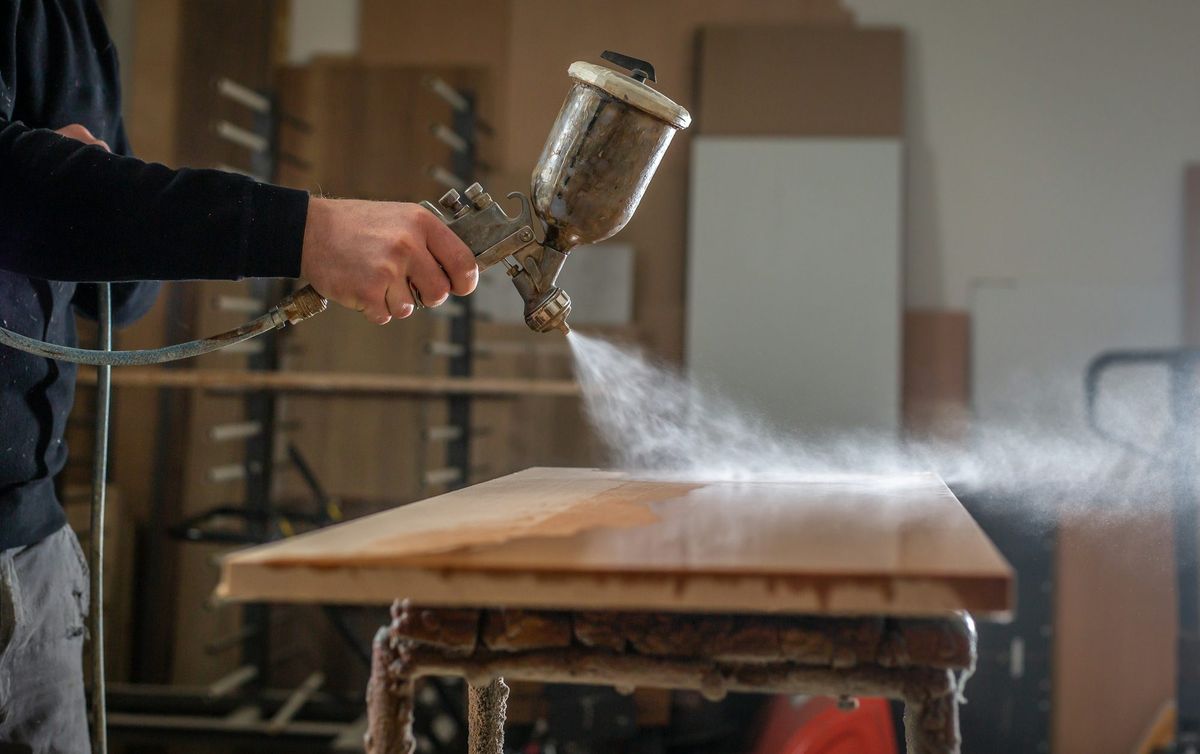
Two-component (2K) water-based polyurethane is the standard film for floors and heavily used furniture. One such floor lacquer, a 2K waterborne polyurethane with about 32% solids, is applied as a primer plus two coats, at 8–10 m² per litre per coat, with 2–3 hours between coats. It takes light foot traffic after about 6 hours and full use after 12. Its data sheet also limits work to two full coats a day because the water can swell the wood, and requires intermediate sanding if the previous coat has dried for more than 24 hours.3 The same sheet makes a point every buyer should hear: no surface-applied finish can prevent physical damage to the timber or "harden" the floor.3
UV-cured lacquer
UV-cured lacquers harden under ultraviolet lamps in a factory line. A resin supplier describes the curing as almost instant, says its energy-curable resins emit low to zero VOC, and notes that the process works particularly well on flat surfaces such as kitchen fronts, flat-pack furniture and solid wood doors.9 UV lacquer is therefore a finish you specify from a manufacturer, not one you apply on site.
Oil, hardwax oil and lacquer compared
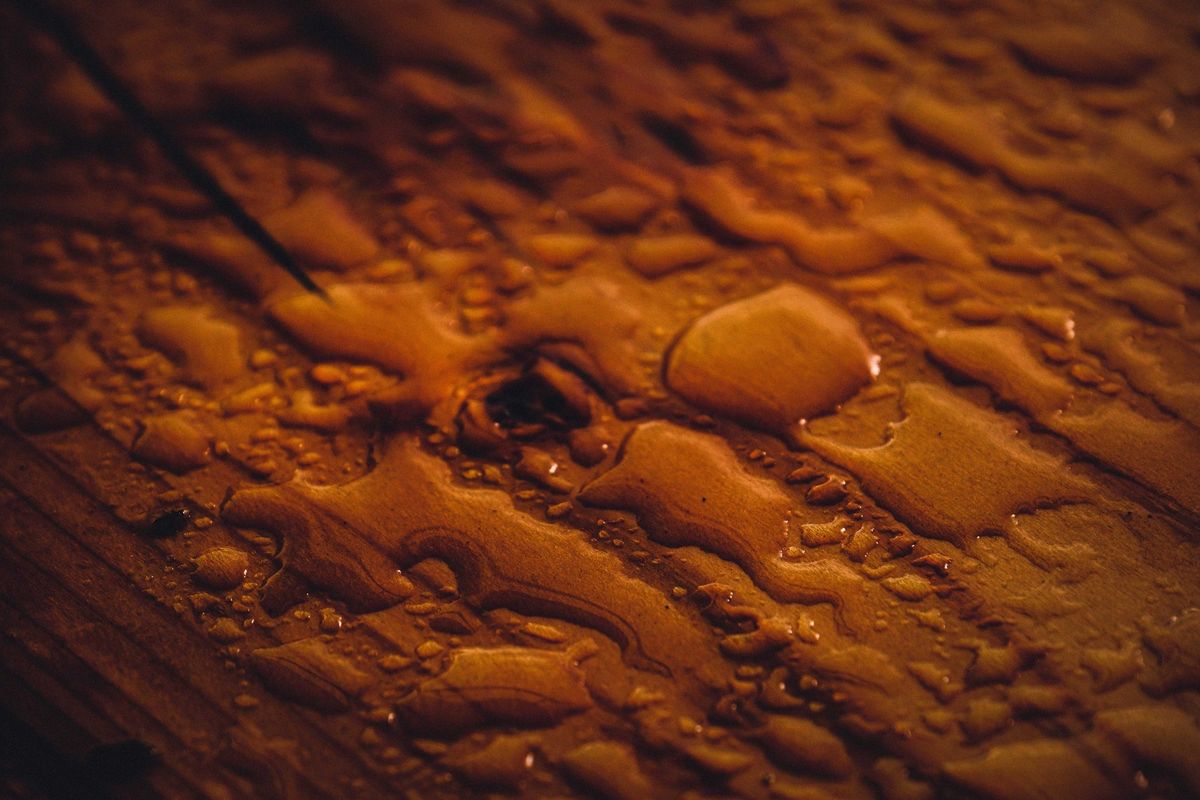
The table sets the families side by side, using the example data sheets above. Treat the figures as examples of each type, not as the rule for every product.
| Drying oil | Hardwax oil | 2K water-based lacquer | UV-cured lacquer | |
|---|---|---|---|---|
| Where it sits | In the wood, no film | In the surface layer, no closed film | Film on the surface | Film on the surface |
| Where applied | Workshop or on site | Workshop or on site | Workshop or on site | Factory line under UV lamps |
| Curing | Full cure can take several weeks | 8–10 h per coat (two coats), or 24–36 h for a single-coat 2K oil | 2–3 h between coats; light use after 6 h, full use after 12 h | Almost instant |
| Coverage per coat | Not given | 24 m²/l (floor oil); 30–50 m²/l (2K oil) | 8–10 m²/l; primer plus two coats | Not given |
| Cleaning and stains | Less stain-resistant than a film | Less stain-resistant than a film | Smooth film, easiest to clean | Smooth film, easiest to clean |
| Repair | Re-oil the worn area | One coat on the cleaned surface | Abrade, then one or two new coats | Specified and applied by the manufacturer |
| VOC in the examples | Not given | 0 g/l (2K oil); up to 500 g/l (solvent-borne floor oil) | Below 5% | Low to zero (supplier statement) |
Source: Hunt (2021), Wood Handbook FPL-GTR-282, chapter 16; Osmo, Produktinformation Hartwachs-Öl Original (12/20); Rubio Monocoat Oil Plus 2C technical sheet (2014); Bona Traffic HD technical data sheet (2025); Covestro, UV resins for furniture.
Coverage per coat says a lot about film build. The less a litre covers, the more material stays on each square metre.
How resistant is the surface? DIN 68861-1 and EN 12720
For furniture, resistance to household liquids is tested by leaving each test substance on the surface, on a soaked filter paper, for a fixed time and then rating the spot. EN 12720 defines the method and a rating scale from 5 (no change, the test area cannot be told from the surroundings) to 1 (strong change, the surface structure altered or the material partly dissolved). The German standard DIN 68861-1 adds sets of substances and exposure times grouped into stress groups, such as 1A and 1B.10,11
A test report for a two-component water-based furniture lacquer on beech veneer shows what group 1B involves: 22 substances, from water, coffee and condensed milk for 16 hours to acetone for 10 seconds, each with a required rating.10
| Test substance | Exposure | Required | Result |
|---|---|---|---|
| Water | 16 h | 5 | 5 |
| Coffee (40 g/l) | 16 h | 5 | 5 |
| Black tea (10 g/l) | 16 h | 5 | 5 |
| Condensed milk, 10% fat | 16 h | 5 | 5 |
| Olive oil | 16 h | 5 | 5 |
| Red wine | 6 h | 5 | 5 |
| Beer | 6 h | 5 | 5 |
| Mustard | 6 h | 5 | 5 |
| Acetic acid 10% | 1 h | 5 | 5 |
| Ethanol 48% | 1 h | 4 | 4 |
| Disinfectant 2.5% | 10 min | 5 | 5 |
| Acetone | 10 s | 2 | 3 |
Source: EPH Dresden (2017), test report 2717647 for ADLER-Werk Lackfabrik, DIN 68861-1:2011 group 1B, rated to EN 12720:2014. 12 of 22 substances shown.
Oils can be tested in the same way. The German worktop oil quoted in our worktops article declares resistance to wine, beer, cola, coffee, tea, fruit juice, milk and water to DIN 68861-1A, and only when two coats of about 30–40 ml/m² are applied.11 Two lessons follow. Ask for the group, the list of substances and the test report, not just the standard number. And check the conditions: the result belongs to the tested build-up, number of coats and curing time.
Repair and maintenance
Maintenance is where the two families differ most in daily life. Oiled and hardwax-oiled surfaces need periodic refreshing, most where they are used hardest. For worktops, one maker recommends a maintenance coat of worktop oil every 6–12 months, or sooner where the surface looks dull.12 For an oiled floor, one coat on the cleaned surface usually renews it.2 No sanding, no dust, and the room is usable the next day.
A lacquered surface needs almost no care while the film is intact. When it does wear through, typically on the walking line of a stair or around a sink, the repair is larger: the 2K lacquer above asks for cleaning and superficial abrasion followed by one or two new coats on previously lacquered surfaces.3 On furniture, deep scratches in a lacquer film are hard to repair invisibly, because the new lacquer has to blend into the old film.

Which finish where: furniture, worktops, stairs and floors
- Dining tables and desks. Lacquer resists rings from glasses and is easiest to wipe; hardwax oil feels warmer and can be repaired locally. Choose by how the table will be used and by who will maintain it.
- Chairs. Arms and seat edges see constant hand contact and cleaning. Factory lacquer or a durable oil system both work; see how solid wood chairs are made.
- Kitchen worktops and slabs. Mostly oiled, because the wet zone around a sink is easier to maintain locally than to re-lacquer. The worktops article and the article on live-edge slabs cover the details.
- Stairs and floors. Both hardwax oil and 2K lacquer are used. Slip resistance matters here, and it depends on the specific product and on wear; ask the finish maker for a test value. The oak stair treads article explains the slip tests.
- Outdoors. Different rules apply. Clear films on wood fully exposed to weather last only about ten years at best, and penetrating finishes need renewing every few years.1
VOC limits: what the Decopaint Directive actually covers
Volatile organic compounds (VOC) are the solvents that evaporate from a finish as it dries. The EU rule people quote is Directive 2004/42/EC, the "Decopaint" Directive. Its scope is narrower than many labels suggest.
What it covers
The Directive limits the total VOC content of certain paints and varnishes, to reduce their contribution to ground-level ozone. A VOC is defined as an organic compound with an initial boiling point of 250 °C or less, and the VOC content is measured in grams per litre of product in its ready-to-use state. The "paints and varnishes" it covers are the products in twelve listed subcategories, described as coatings applied to buildings, their trim and fittings, and associated structures.4 For wood, the relevant ones are trim and cladding paints, trim varnishes and woodstains, minimal-build woodstains, primers and one- and two-pack performance coatings, a category that explicitly includes floor coatings for wood.4
Show the data
| Water-borne | Solvent-borne | |
|---|---|---|
| d Trim and cladding paints | 130 g/l | 300 g/l |
| e Trim varnishes and woodstains | 130 g/l | 400 g/l |
| f Minimal-build woodstains | 130 g/l | 700 g/l |
| g Primers | 30 g/l | 350 g/l |
| i One-pack performance coatings | 140 g/l | 500 g/l |
| j Two-pack performance coatings | 140 g/l | 500 g/l |
Category i includes floor coatings for wood; j covers two-pack reactive coatings for specific end uses such as floors. Source: Directive 2004/42/EC, Annex I (subcategories) and Annex II, table A (Phase II limits).
Products in scope must carry a label with their subcategory, the limit value for it and the maximum VOC content of the product, ready to use.4 You can see this on a tin. The German hardwax oil quoted above, sold for floors, declares the EU limit for category i as 500 g/l and a VOC content of at most 500 g/l.2 The same maker's oil for furniture and worktops states that no EU VOC limit applies to it.11 Same chemistry, different intended use, different position under the Directive.
What it does not cover
- Factory finishing. Member states must exempt products sold for exclusive use in an installation registered or authorised under the solvent emissions rules, now Chapter V of the Industrial Emissions Directive 2010/75/EU.4,13 Wood coating lines that consume more than 15 tonnes of solvent a year fall under that regime, which limits emissions from the plant rather than the content of the tin.13
- Emissions from finished furniture. The Directive regulates the product in the can, not what a finished table releases into a room. For the finished article, other rules apply; for example, since 6 August 2026 furniture placed on the EU market may release no more than 0.062 mg/m³ of formaldehyde in the REACH chamber test, whatever its coating.14 The edge-glued panels article explains that limit.
- Food safety and health. The Directive is an air-quality measure. It states that it does not affect measures taken to protect the health of consumers and workers.4 A low-VOC lacquer is not automatically food safe, and a food-contact claim says nothing about VOC.
Food contact: what Regulation 1935/2004 actually covers
Regulation (EC) No 1935/2004 applies to materials and articles that, in their finished state, are intended to come into contact with food, are already in contact with it, or can reasonably be expected to come into contact with food or transfer their constituents to it under normal or foreseeable use.5 The words "finished state" matter. The regulation applies to the coated chopping board or worktop, not to the tin of oil on the shelf. The maker of the finished article is the one placing a food-contact material on the market, and the finish supplier's statements are inputs to that maker's own assessment.
The core rule is Article 3: under normal or foreseeable conditions, the material must not transfer constituents to food in quantities that could endanger human health, change the food's composition unacceptably or spoil its taste and smell. Articles not yet in contact with food when sold must carry the words "for food contact", a specific indication of use or the glass-and-fork symbol.5
Where the EU detail stops
Annex I lists 17 groups of materials for which specific EU measures may be adopted, including wood, waxes and varnishes and coatings.5 Specific measures exist for plastics, ceramics, regenerated cellulose film, recycled plastics and active and intelligent materials, plus substance rules such as those on bisphenols and epoxy derivatives, and a regulation on good manufacturing practice that applies to all food-contact materials. Where no specific EU measure exists, member states may keep national rules, and most do.6 The bisphenol rule does reach coatings: Regulation (EU) 2024/3190 bans the use of bisphenol A in the manufacture of food-contact varnishes and coatings, as well as plastics, adhesives and other groups.7
What the labels on finishes mean
Finish labels often cite tests that sound like food safety but are not:
- EN 71-3 is part of the toy safety series and limits the migration of 19 elements, such as lead, cadmium and chromium, from toy materials.15
- DIN 53160 tests whether colourants migrate from articles of daily use into saliva and sweat simulants, for objects that may be put in the mouth.16
- EN 1186 is a series of test methods for overall migration into food simulants, written for plastics.17 A finish maker can use these methods voluntarily, which is useful evidence, but the result does not make an oil "approved for food contact" by itself.
FPL's practical advice for wood that touches food is simple: dishwashers are hard on any wooden object whatever the finish, film finishes are easiest to clean, paraffin oil and wax do not go rancid or support microbes, and whatever you use, look for products that are food grade.1
What we do before the finish at SARAL
How to specify a wood finish: a checklist
- The system, not just the product. Primer, number of coats, coverage per coat, intermediate sanding and curing time before use.
- The technical data sheet and safety data sheet for each component.
- Resistance evidence. For furniture and worktops, the DIN 68861-1 group or EN 12720 results with the list of substances, exposure times and the tested build-up.
- VOC label. For coatings in Decopaint scope, the subcategory, the limit value and the product's maximum VOC content. For factory finishing, ask how the plant meets its solvent emission permit.
- Formaldehyde. For finished furniture, evidence that the article meets the REACH limit in force since 6 August 2026.
- Food contact. For surfaces that touch food, a written statement for the finished surface, what it is based on (tests, simulants, conditions) and which national rules it refers to.
- Slip resistance for stairs and floors, with the test method and value.
- Maintenance. The maintenance product, the interval and the repair method, handed to the end user.
- All faces. Confirmation that undersides, ends and cut edges are finished too.
Frequently asked questions
Hardwax oil or lacquer: which is better for a table?
Lacquer resists stains and is easiest to clean; hardwax oil feels like wood and can be repaired locally without sanding. For a family dining table that is wiped often, a 2K water-based lacquer is the low-maintenance choice; for a table you want to repair yourself, choose hardwax oil.1,3,2
Is hardwax oil food safe?
There is no EU approval list for wood finishes. The finished surface must meet the general requirements of Regulation (EC) No 1935/2004 and any national rules. Labels citing EN 71-3 or DIN 53160 are toy and saliva tests, not food-contact tests, so ask the maker what its food-safety claim is based on.5,6,15,16
Oil or lacquer for oak stairs?
Both work. Hardwax oil can be refreshed on the walking line without sanding the whole tread; a 2K lacquer needs less care until it wears through, then needs abrasion and recoating. Ask either way for a slip-resistance test value.2,3
Which wood finish has the lowest VOC?
Among the products in this article, a solvent-free two-component oil declares 0 g/l, a water-based 2K lacquer declares less than 5% VOC, and a solvent-borne hardwax oil for floors declares up to 500 g/l, the EU limit for its category.8,3,2 For coatings in scope, the Decopaint label on the tin gives the maximum VOC content.4
How often should oiled wood be re-oiled?
It depends on wear. One worktop maker recommends every 6–12 months; for floors and furniture, refresh the finish when the surface starts to look dull in the areas used most.12,2