What counts as a solid wood panel
In European standards, a panel made of solid wood pieces glued together is a solid wood panel (SWP). EN 12775 sets the terminology and classification, and EN 13353 sets the requirements.1,2 In the trade the same product goes by many names: edge-glued panel, laminated panel, butcher-block blank, Leimholz in German, panou încleiat in Romanian.
EN 13353:2022 covers panels up to 80 mm thick for use in dry, humid and exterior conditions, matching service classes 1, 2 and 3 of Eurocode 5. Its requirements cover dimensional tolerances, moisture content at dispatch, bonding quality, biological durability, mechanical properties and formaldehyde release, with separate technical classes for non-structural and structural use.2 The class thresholds sit behind the paywall, so the numbers in this article come from manufacturer declarations and open sources, and we say which.
Single-layer and multi-layer panels
A single-layer panel is what most furniture makers mean by an edge-glued panel: one layer of lamellas, all with the grain running the same way, glued along their edges. It looks and machines like a wide solid board, and it moves like one.
A multi-layer panel, usually three-ply, glues two face layers over a core laid at 90°. In one Austrian producer's design, the faces are continuous lamellas glued edge to edge and the core lamellas are finger-jointed along their length. The cross layer restrains the faces, which makes the panel far more stable across its width. Hardwood three-ply panels in maple, birch, steamed beech, oak, alder, ash and cherry are declared SWP/2 NS with 10 ± 3% moisture at delivery.5 EN 13017-2, which classifies hardwood panels by appearance, requires outer layers of at least 3.5 mm on multi-layer panels.8
Single-layer panels dominate furniture, worktops and stair treads because their edges show solid wood all the way through. The rest of this article focuses on them.
Continuous lamella or finger-jointed lamella: what actually changes
German buyers search for "durchgehende Lamelle" for a reason: it is the one choice that changes how a panel looks, costs and behaves. The terms are simple.
- Continuous lamella (DL, durchgehende Lamelle): every strip runs the full length of the panel. A European oak worktop panel built this way uses lamellas 30–45 mm wide and as long as the panel, 1,500–3,000 mm.3
- Finger-jointed lamella (KGZ, keilgezinkt): every strip is built from shorter clear pieces joined end to end with a finger joint. In one producer's beech panels the pieces are 200–600 mm long and 30–45 mm wide.4
| Build-up | Lamella width | Lamella length | Thickness | Moisture at delivery | Class and adhesive |
|---|---|---|---|---|---|
| Continuous lamella (DL), European oak | 30–45 mm | Full panel length, 1,500–3,000 mm | 19 / 26 / 40 mm | 10 ± 2% | SWP/1 NS, PVAc D3 |
| Finger-jointed (KGZ), European beech, pro grade | 30–45 mm | 200–600 mm | 27 / 38 mm | 10 ± 2% | SWP/1 NS, PVAc D4 |
| Finger-jointed (KGZ), European beech, general grade | 30–45 mm | 200–600 mm | 18–38 mm | 10 ± 2% | SWP/1 NS, PVAc D3 |
| Three-ply hardwood panel | Continuous face lamellas | Finger-jointed cross core | – | 10 ± 3% | SWP/2 NS |
Source: Osmo Holz und Color, data sheets 09/25 (Profi-Leimholz Eiche DL, Profi- and Hobby-Leimholz Buche KL); Tilly Holzindustrie, product information 05-2022.
Appearance and price
A continuous-lamella panel shows long, unbroken grain lines, which is why it is the usual choice for visible table tops, solid-wood fronts and premium treads. It is also the more expensive build, because every lamella has to be clear over its whole length, and long clear oak or beech is the scarcest part of a log.
A finger-jointed panel uses the clear pieces that remain after defects are cut out. That is the economic logic of optimisation and finger jointing: material that would otherwise become firewood ends up in a panel. The price is a busier face, with a joint every few hundred millimetres in each lamella, and the benefit is consistency, because short pieces can be sorted for colour more tightly than full-length boards.
Machining and visible joints
The orientation of the finger joint matters for what you will see. Some producers cut the fingers so that the profile shows on the edge of the lamella, not on the face; the joint then appears as a fine line across the face and the zigzag only on the panel ends and edges.4 FPL calls the two orientations horizontal and vertical joints, depending on whether the profile shows on the edge or on the wide face.9 If you will profile the panel edge, ask which way the fingers run, because a router will expose them.
Is a finger-jointed panel weaker?
A finger joint is not as strong as clear wood in tension. A well-made end joint can reach up to 90% of the tensile strength of clear wood, while a plain end-grain butt joint reaches only about 25%.9 In a 2024 study of industrially finger-jointed beech lamellas, the joints reached 63.1 N/mm² against 98.1 N/mm² for unjointed controls, about 64%, and a modified profile reached about 72% (percentages are our calculation from the reported means).10
For a panel used as a cabinet side, a shelf of modest span or a table top on a frame, those losses rarely govern; flatness, stiffness and the glue lines between lamellas matter more. For long, heavily loaded spans, such as wide shelves or stair treads, ask for continuous lamellas or for the supplier's test data.
SWP/1, SWP/2, SWP/3: choosing the technical class
Every panel made to EN 13353 carries a technical class. In practice the designations read like this:2,5
- SWP/1 for dry conditions, typically heated interiors.
- SWP/2 for humid conditions: interiors with higher humidity, and protected exteriors not directly exposed to weather.
- SWP/3 for exterior conditions.
- A suffix NS means non-structural and S means structural. A manufacturer's "SWP/2 S L3" is a structural three-ply panel for humid interiors and protected exteriors; "SWP/1 NS" is a non-structural panel for dry areas.5
Most hardwood furniture and worktop panels are SWP/1 NS. Both oak and beech panels in the data sheets we reviewed are declared SWP/1, for non-structural use in dry areas, and marked "not for exterior use".3,4 A bathroom vanity top or a panel in a humid basement calls for SWP/2. A panel that will carry structural load needs the S class and the declared values that go with it, not a furniture panel.
Moisture at delivery: why 8–10% matters
A solid wood panel keeps trading moisture with the air around it. At 20 °C, wood settles at about 6.0% moisture content (MC) in air at 30% relative humidity, 9.1% at 50% and 12.0% at 65%.6 That equilibrium moisture content is the level the panel will drift towards once installed, whatever it was at delivery. The moisture content article explains the physics.
Show the data
| Relative humidity | Wood moisture content |
|---|---|
| 10% | 2.8% |
| 20% | 4.5% |
| 30% | 6.0% |
| 40% | 7.5% |
| 50% | 9.1% |
| 60% | 10.9% |
| 70% | 13.3% |
| 80% | 16.4% |
| 90% | 20.7% |
Heated rooms in winter often sit at 30–40% RH; humid summers reach 60–70%. Source: IVK (2024), TKH-Merkblatt 3, Anlage 1.
Manufacturers declare delivery moisture by class. One Austrian producer declares 8 ± 2% for SWP/1 panels and 10 ± 3% for SWP/2 panels; a German producer ships its oak and beech furniture panels at 10 ± 2%.3,4,5 EN 13353 has its own clause on moisture content at dispatch, but its values are not public, so treat these as manufacturer declarations.2
The practical rule follows: match delivery moisture to the room. A panel delivered at 10% and fitted in a heated living room that sits at 30–40% relative humidity in winter will dry towards 6.0–7.5% and shrink.6 The German adhesives association assumes wood in living spaces at about 8% MC, which is why most processing data for furniture assume that level.6
How much does a 600 mm panel move?
Wood shrinks and swells most along the growth rings (tangentially), about half as much across them (radially) and only slightly along the grain.11 For a width estimate, FPL advises using tangential values for flat-sawn wood and radial values for quarter-sawn wood.11 German practice publishes the same behaviour as a differential swelling coefficient, the percentage change in dimension per 1% change in MC.
A worked example
Take a 600 mm wide single-layer panel that moves between a heated winter (30% RH, about 6% MC) and a humid summer (65% RH, about 12% MC), a change of 6 points of MC.6 With coefficients for European species, the width change is 600 mm × coefficient × 6. For beech, with 0.41% per 1% MC tangentially and 0.20% radially, that gives about 14.8 mm for flat-sawn lamellas and 7.2 mm for quarter-sawn ones.6 Oak (0.34 and 0.18) gives 12.2 and 6.5 mm; ash (0.28 and 0.17) gives 10.1 and 6.1 mm.
Show the data
| Flat-sawn lamellas (tangential) | Quarter-sawn lamellas (radial) | |
|---|---|---|
| Beech | 14.8 mm | 7.2 mm |
| Oak | 12.2 mm | 6.5 mm |
| Ash | 10.1 mm | 6.1 mm |
| Cherry | 11.2 mm | 6.1 mm |
Coefficients in % per 1% MC: beech 0.41 / 0.20, oak 0.34 / 0.18, ash 0.28 / 0.17, cherry 0.31 / 0.17 (tangential / radial). Source: Our calculation: 600 mm × differential swelling coefficient × 6 points of MC. Coefficients and EMC from IVK (2024), TKH-Merkblatt 3, Anlagen 1 and 2 (data from Toscha and Lohmann, Holzlexikon). European species.
These are calculations for a free, unrestrained panel with the moisture change fully through its thickness. Real panels move a little less, because the moisture change lags behind the air and finishes slow it down. Individual pieces also scatter: FPL puts the coefficient of variation of shrinkage at about 15%.11 The order of magnitude is the point. A beech table top can grow by more than a centimetre over a summer, and every fixing has to allow it.
What the example means for design
- Fix tops with slotted brackets, buttons or elongated holes, never with rigid glue blocks across the grain.
- Leave an expansion gap where a panel meets a wall or a frame, and size it from the calculation, not from habit.
- Choose species and cut to suit the room: oak and ash move less than beech, and quarter-sawn lamellas roughly halve the movement of any species.
Growth-ring orientation and the "alternate the rings" rule
Many joiners are taught to alternate the growth rings of neighbouring lamellas, heart side up, then heart side down. The idea is that each strip cups in the opposite direction to its neighbour, so the panel stays flat overall. The practice is contested among experienced makers, and we found no laboratory study that measures it on hardwood panels.
What the physics does say is clear. Alternating the rings changes the shape of the distortion, turning one large cup into a gentle ripple, but it does not change the width movement, because each flat-sawn lamella still moves tangentially.11 Narrow lamellas reduce the cup of each strip. Quarter-sawn or rift-sawn lamellas, with the rings closer to vertical, reduce both cup and width movement.
Face grades A, B and C, and glue-line quality
EN 13017-2 classifies hardwood panels by surface appearance.8 Producers then publish their own grade descriptions. The German data sheets we reviewed, based on that family of standards, show what a buyer can expect.3,4,12
| Feature | A face | B face | C face |
|---|---|---|---|
| Knots | Practically knot-free; isolated pin knots up to approx. 3 mm | Pin knots up to approx. 5 mm (beech); sound knots, pin knots up to approx. 8 mm (oak) | Sound, firmly grown knots up to approx. 10 mm |
| Glue line | Max. 0.2 mm, no open joints | Max. 0.2 mm (beech), 0.3 mm (oak) | Max. 0.3 mm |
| Colour | Uniform; no red or brown heart in beech | Discolouration allowed | Marked discolouration allowed |
| Grain | Uniform structure and grain | Irregular structure and grain | Lively structure and grain |
| Surface | Sanded both sides, grit 120, no defects | Grit 120, isolated defects allowed | Grit 120, isolated defects allowed |
Source: Osmo Holz und Color, data sheets 09/25 (Profi-Leimholz Eiche DL and Buche KL; Hobby-Leimholz Buche KL). One manufacturer's grading; up to 3% grading errors tolerated.
Two lines in these sheets deserve attention. The first is the glue-line thickness: at most 0.2 mm on A faces and 0.3 mm on C faces, with no open joints allowed on any face.3,12 A thick glue line shows as a dark seam and is a sign of poor jointing. The second is the tolerance for grading errors, up to 3% of panels, with the buyer expected to inspect before machining.3 If you will rely on a grade, agree on how it is checked before the panels are cut.
For beech, ask about red heart. The A face in one producer's sheet excludes red or brown heart entirely, while lower grades allow discolouration.4 Panels with a deliberate red-heart look are sold separately as "Kernbuche".5

Adhesives and formaldehyde: D3, D4 and the 2026 REACH limit
Most single-layer hardwood panels for furniture are bonded with polyvinyl acetate (PVAc) dispersion glue, the white glue of the trade. The data sheets we reviewed declare PVAc to EN 204 class D3 for oak and D3 or D4 for beech.3,4,12 EN 204 classifies these thermoplastic glues for non-structural use: D3 for interiors with frequent short exposure to water or high humidity, D4 for frequent long exposure and for exteriors protected by a suitable coating.13 The wood glue article explains what those classes test and what they do not.
Formaldehyde enters the picture with aminoplast adhesives such as melamine-urea-formaldehyde (MUF), which FPL lists among the main adhesives for end-jointing and edge-gluing lumber in Europe.9 Since 6 August 2026, REACH Annex XVII entry 77 forbids placing furniture and wood-based articles on the EU market if they release more than 0.062 mg/m³ formaldehyde under the test conditions of Appendix 14; other articles have a limit of 0.080 mg/m³.7 The test runs in a chamber at 23 °C, 45% relative humidity, a loading of 1 m² per m³ and one air change per hour, until a steady state is reached.7
Articles in which formaldehyde occurs only naturally in the material are exempt, and so are second-hand articles.7 Solid wood itself releases traces of formaldehyde, which is why that exemption exists. A panel bonded with a formaldehyde-based adhesive, or a piece of furniture that combines it with other boards, falls under the limit. When you buy, ask what adhesive bonds the panel and, if it contains formaldehyde, for evidence of compliance with entry 77.
Thicknesses and lamella widths for worktops, treads and furniture
There is no single standard size, but producer data give a feel for the market. A continuous-lamella oak panel comes in 19, 26 and 40 mm, 600–1,210 mm wide and 1,500–3,000 mm long; a finger-jointed beech worktop panel comes in 27 and 38 mm, 630 mm wide and 4,100 mm long; general-purpose beech panels run from 18 to 38 mm.3,4,12 Lamella widths of 30–45 mm are typical across these products.3,4
- Furniture carcasses and shelves: 18–27 mm, finger-jointed or continuous depending on what shows.
- Table tops and worktops: 26–40 mm. Thicker tops look heavier and resist sag, but they also move the same percentage as thin ones.
- Stair treads: thickness depends on span, load and national stair rules.
Narrower lamellas cup less and make a more stable panel; wider lamellas show more of the figure and have fewer glue lines. Panels are also delivered machined: cut to size, edged, drilled and profiled on CNC, which avoids waste and handling at the buyer's end.
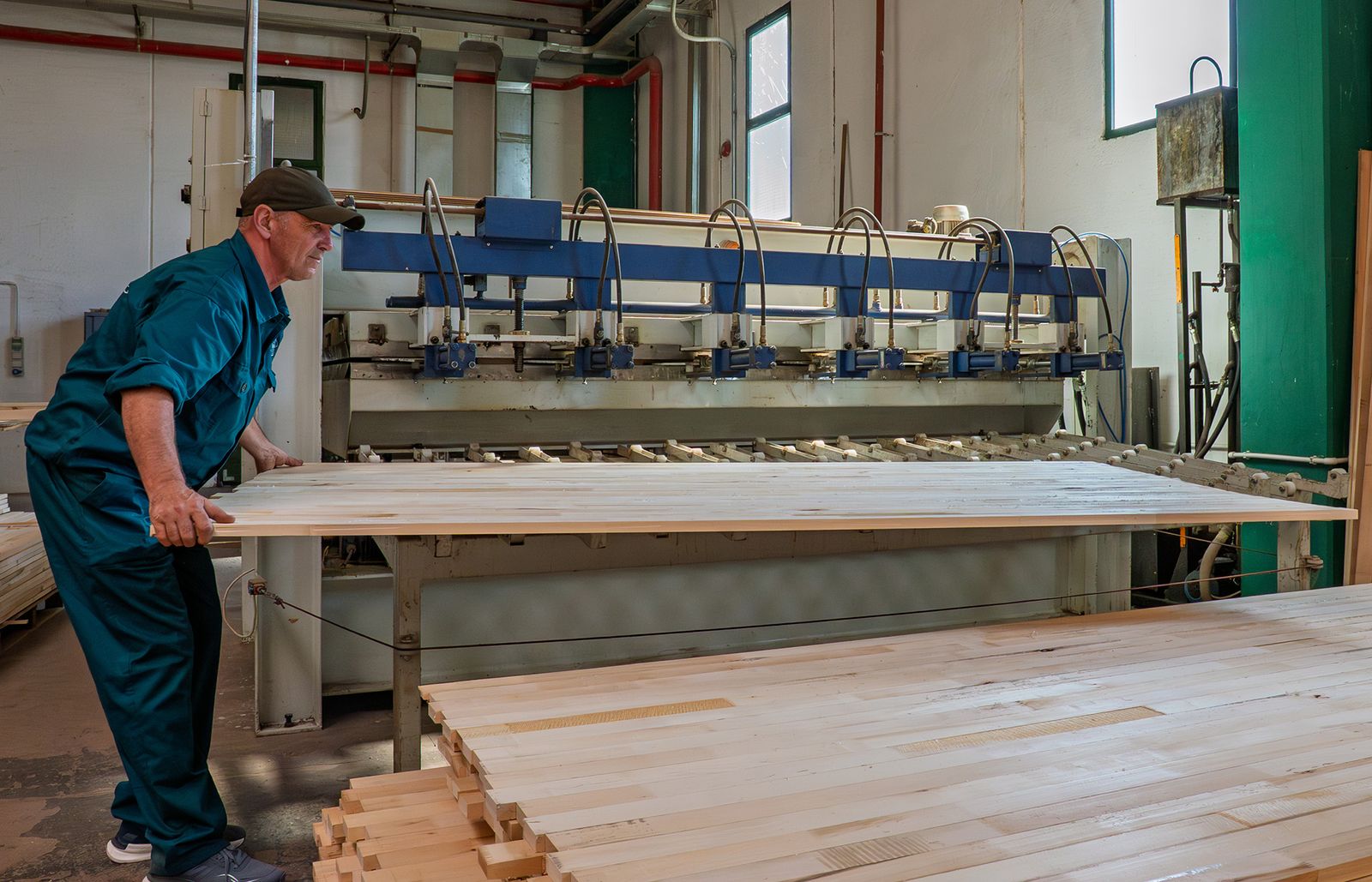
How we make panels at SARAL
How to specify an edge-glued panel: a checklist
- Species and cut. Oak, beech or ash; flat-sawn, rift or quarter-sawn lamellas. For beech, state whether red heart is acceptable.
- Lamella build. Continuous (DL) or finger-jointed (KGZ), lamella width, and whether finger joints may show on the face or edge.
- Technical class. SWP/1, SWP/2 or SWP/3, and NS or S.
- Moisture at delivery and tolerance, matched to where the panel will be used, and how it was measured.
- Face grades for both sides, with the supplier's written grade description, maximum glue-line thickness and the tolerance for grading errors.
- Adhesive. Type and EN 204 class, and for any formaldehyde-based system, evidence of compliance with REACH entry 77.
- Dimensions and tolerances, including flatness, and whether you want sheets or parts machined to drawing.
- Packing and storage. Film-wrapped, stored flat and supported. Panels left in a damp warehouse arrive at the wrong moisture content.
If you buy furniture components rather than sheets, the same list applies to each part.
Frequently asked questions
Are finger-jointed panels good for table tops?
Yes, for most tables. The joints cost some tensile strength, but a top supported by a frame is not loaded in pure tension. Choose continuous lamellas when the look of long unbroken grain matters or when the top will span far without support.9,10
Edge-glued panels or plywood?
Plywood is cross-laminated, so it barely moves across its width, but its edges show layers and its face is a thin veneer. An edge-glued panel is solid wood through and through, can be sanded and refinished many times and shows solid edges, but it moves with humidity and has to be fixed accordingly.11
What does "durchgehende Lamelle" mean?
It means continuous lamella: each strip in the panel is one piece over the full panel length, with no finger joints.3 The opposite is "keilgezinkt", finger-jointed.
What moisture content should a solid wood panel have?
For heated interiors, around 8% is the usual assumption; manufacturers declare 8 ± 2% or 10 ± 2% for interior panels and 10 ± 3% for humid-interior panels.3,5,6 Let the panel acclimatise in the room before you fix it.