The brand and the range
WoodPower® is a sister brand of FeetUp® and makes wooden training equipment for calisthenics, handstands and yoga. Its best-known products are parallettes: in the brand's words, portable versions of the parallel bars used in gymnastics.1 Around them sit a board for handstands and push-ups and two versions of small blocks for arm balances. Everything in the range is made at our factory in Bălțați, Iași county, Romania.
The products look simple: a round bar between two end pieces, a flat board, a block. That simplicity is exactly what makes them hard to make well. There is no upholstery to hide behind and no hardware to adjust. The user holds the bare wood, puts the full body weight through it and notices at once if a bar rocks, a surface is slippery or an edge is sharp.
| Product | Use | Size (L × W × H) | Detail | Wood (as stated) |
|---|---|---|---|---|
| PowerBoard | Handstand, balance | 78 × 29 × 2 cm | Laser-cut hand markers | European beech |
| PowerBars XS | Parallettes, push-ups | 23 × 14 × 10 cm | Ø 4 cm bar | Hardwood |
| PowerBars XS long | Parallettes, push-ups | 38 × 14 × 10 cm | Ø 4 cm bar | Not stated |
| PowerBars XL | Parallettes, extra height | 38 × 21 × 20 cm | Ø 4 cm bar, Community Design | Not stated |
| BalanceBlocks Comfort | Handstand, arm balance | 14 × 9 × 6 cm | Curved top | European lime |
| BalanceBlocks Flat | Handstand, arm balance | 14 × 9 × 6 cm | Flat top | European lime |
Source: WoodPower product pages and product images, accessed 24 October 2026. Sizes are per single piece as shown in the brand's dimension drawings.
The PowerBars XL carry a registered European Community Design, No. 006 316 543, according to the product page.1 The PowerBoard has laser-cut markers that guide hand placement.2
The challenge: four requirements at once
Each of the four requirements is ordinary on its own. Together, at volume, they shaped every decision on the line.
- Precision. A parallette is used in pairs. If the two bars of a pair differ in height, or one end piece is not square to the floor, the user feels it in the wrists in the first push-up. The same applies to the blocks, which are used in pairs.
- Joints. The joint between a round bar and its end piece carries the full body weight, plus bending and twisting every time the user shifts, kicks up or lands. It has to stay tight for years of that.
- Naturally oiled wood. The products are lightly oiled for grip with sweaty hands.1,3 An oiled surface forgives nothing: every machining mark and every patch of raised grain stays visible and tactile.
- Mass production. All of this had to hold at thousands of units a month, not for a batch of prototypes.
What SARAL built: one process for six products
The range draws on the whole chain of the factory, from timber we saw and kiln-dry ourselves to finished, packed products. What makes the WoodPower® work different from furniture components is repetition: the same few parts, made in the thousands, with the same contact surfaces every time.
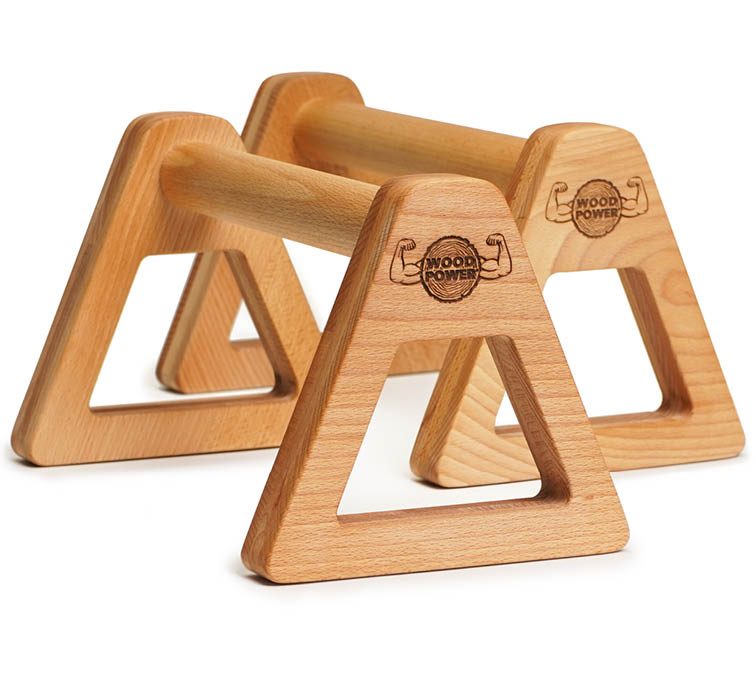
Shapes such as the triangular end frames of the PowerBars XL or the curved top of the BalanceBlocks Comfort are where machining accuracy shows. Our 3- and 5-axis CNC machines cut contours, holes and grooves in series, and the guide to CNC machining of hardwood explains why fixturing and tooling decide whether part number 5,000 matches part number one. The logos and the PowerBoard's hand-placement markers are made with our laser cutting and engraving, which is digitally controlled and works from CAD files.

Materials and joints
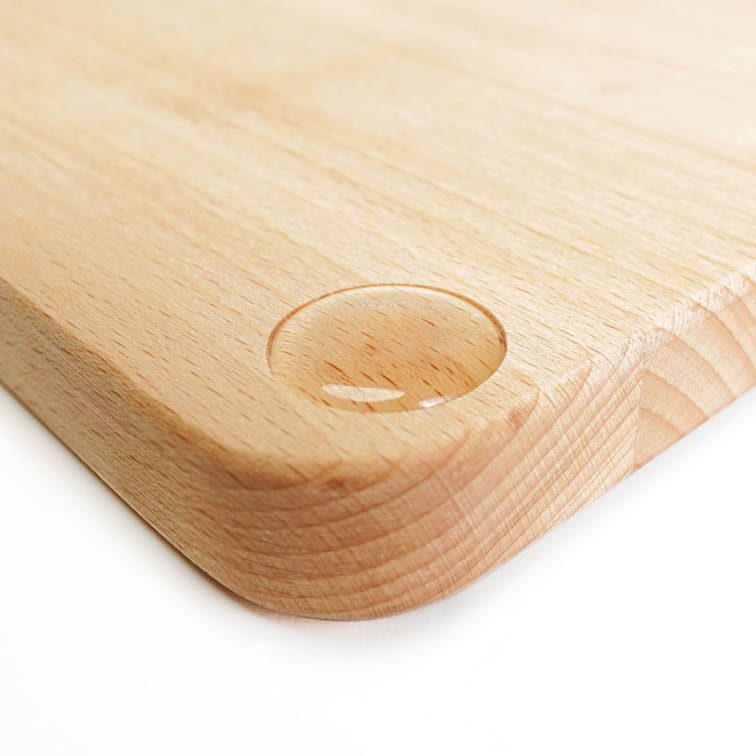
The product pages describe the range as durable hardwood made in Europe. The PowerBoard's product images name European beech, the BalanceBlocks' European lime (linden).2,4,5 Beech is hard, strong and wear-resistant, the qualities a board under a full body needs; our European beech guide covers it in depth. The close-up of the PowerBoard below shows its end grain: the board is built from edge-glued lamellas, which keeps a wide, thin part flatter than a single wide board would stay.
The bar-to-end-piece joint
On all three PowerBars the grip is a round bar with a diameter of 4 cm, seated in the two end pieces.1,3,6 That joint is the heart of the product. It is loaded in bending when the user pushes down, in torsion when the user twists, and in shock when the user lands from a jump. A joint that survives one heavy load can still fail after many smaller ones, so it has to be judged on repetition, not only on peak strength.
The US Forest Products Laboratory makes the same point about glued joints in general: even a well-made finger or scarf joint in end grain, which can reach up to 90% of the tensile strength of clear wood, often survives fewer load cycles before failure than the solid wood itself.7 Our article on finger-jointing strength explains why fatigue, not a single load, is the real test for any glued wooden part that is loaded over and over.
Finishing: oiled, not lacquered
The finish of a training product is a grip question first and a looks question second. A lacquer forms a film on the surface; an oil does not. The FPL's Wood Handbook describes penetrating finishes, oils among them, as finishes that flow into the pores of the wood and do not form a film, so they cannot crack or flake, and they are renewed simply by cleaning and applying another coat.8 For the WoodPower® range that means the hand stays in contact with the wood itself, which is what the brand promises: a lightly oiled natural finish for grip with sweaty hands.1
The same source notes that drying oils can need several weeks to cure.8 In mass production that is a scheduling question as much as a finishing one: oiled parts need time and space before they can be packed. Silicone pads under each product take care of the other half of stability, traction on the floor.1 For a fuller comparison of finishes, see our article on oil versus lacquer.
Quality control and stress testing
The WoodPower® PowerBars were load-tested at the Technical University of Braunschweig (TU Braunschweig) in Germany. In static tests, each size held well beyond any load a person can put on it: more than 1,000 kg for the XS long, more than 1,200 kg for the XL and more than 2.5 tonnes for the compact XS. The chart below shows the results; the rest of this section explains what such testing involves.
A strength test on training equipment usually has three parts. A static test applies a load well above body weight, in the direction the product is loaded in use, and checks that nothing breaks or stays deformed. A fatigue or durability test applies a lower load many thousands of times, which is how joints actually fail in service. A stability check looks at tipping and sliding, which for parallettes and blocks depends on the footprint and the pads as much as on the wood.
The European standards follow the same logic. EN ISO 20957-1 sets general safety requirements and test methods for indoor stationary training equipment, with classes for domestic and for supervised professional use; it was revised in 2024.9 Furniture has its own methods: EN 1728 specifies tests for the strength and durability of seating structures, whatever the material or design.10 Neither scope names small free-standing props such as parallettes, which is why testing the finished product at an independent university laboratory matters.
Packed, inserted, ready to ship
None of the WoodPower® products leaves SARAL as bare parts. Every product leaves in its final retail packaging, complete with its inserts, and ready to ship to the end customer. For the brand this removes a repacking step between factory and buyer; for us the packing station is part of the line, not an afterthought. Our packaging lines, 10,000 m² of warehouse space and logistics network are described under additional services.
Results in numbers
What we learned
- Simple products expose everything. Without upholstery or hardware, the wood surface and the joint are the product. Tolerances that would pass in a furniture frame are felt at once in the hands.
- Pairs double the precision requirement. A part has to match its drawing and its partner. That shapes how parts are machined, sorted and packed.
- A natural finish needs a clean surface underneath. Oil shows every sanding mark, so the quality of the finish is decided at the sanding station.
- Fatigue is the real test. A bar that holds one heavy load proves little; the joint has to stay tight through thousands of push-ups, landings and twists.
Product list
The WoodPower® range made at SARAL:
- WoodPower® PowerBoard
- WoodPower® PowerBars XS
- WoodPower® PowerBars XS long
- WoodPower® PowerBars XL
- WoodPower® PowerBars Set (XL + XS)
- WoodPower® BalanceBlocks Comfort
- WoodPower® BalanceBlocks Flat
Frequently asked questions
What wood are WoodPower parallettes made of?
The brand describes the range as durable hardwood made in Europe. The product images name European beech for the PowerBoard and European lime for the BalanceBlocks.2,4
Why are wooden parallettes oiled and not lacquered?
An oil penetrates the wood and does not form a film, so the hand grips the wood itself and the surface cannot crack or flake. The brand chose a light oil finish for grip with sweaty hands.1,8
Were the WoodPower products load-tested?
Yes. The PowerBars were load-tested at the Technical University of Braunschweig in Germany and held more than 1,000 kg (XS long), more than 1,200 kg (XL) and more than 2.5 tonnes (XS) in static tests.