

What D1, D2, D3 and D4 really mean
Every bottle of white wood glue in a European shop carries a D number. It comes from EN 204, which classifies thermoplastic wood adhesives for non-structural applications into durability classes D1 to D4, based on the dry and wet strength of bond lines after set conditioning treatments.1 "Thermoplastic" in practice means polyvinyl acetate (PVAc) dispersion glue, the white glue of the trade, and its cross-linked versions. The standard names furniture, interior structures, panelling, doors, windows and stairs as typical uses, and it says plainly that it does not specify the temperature resistance of bond lines.1
EN 204 describes the classes by example climates and uses:1
- D1: interior, where the wood moisture content does not exceed 15%.
- D2: interior with occasional short exposure to running or condensed water or to occasional high humidity, with wood moisture up to 18%.
- D3: interior with frequent short exposure to running or condensed water or heavy exposure to high humidity; exterior not exposed to weather.
- D4: interior with frequent long exposure to running or condensed water; exterior exposed to weather, but protected by an adequate surface coating.
| Class | Example service conditions | Dry: 7 days climate | +3 h cold water, re-dried | +4 days cold water, tested wet | +4 days cold water, re-dried | +6 h boiling, 2 h cold, tested wet |
|---|---|---|---|---|---|---|
| D1 | Interior, wood moisture ≤ 15% | ≥ 10 | – | – | – | – |
| D2 | Interior, occasional short exposure to water or high humidity, wood moisture ≤ 18% | ≥ 10 | ≥ 8 | – | – | – |
| D3 | Interior, frequent short exposure to water or heavy humidity; exterior not exposed to weather | ≥ 10 | – | ≥ 2 | ≥ 8 | – |
| D4 | Interior, frequent long exposure to water; exterior exposed to weather with adequate coating | ≥ 10 | – | ≥ 4 | – | ≥ 4 |
Source: EN 204:2016, tables 1 and 2 (public preview of SIST EN 204:2016). Standard climate 20 °C / 65% RH or 23 °C / 50% RH. A dash means the sequence is not required for that class.
The test behind the label
The classes are earned in a laboratory test under EN 205. Two thin strips of beech are glued in an overlapping joint, conditioned in one of five sequences and pulled apart. The mean of 20 test pieces has to reach the minimum for each sequence of the class. After seven days in a standard climate, every class must reach 10 N/mm². D3 adds a test after four days in cold water, measured wet, where 2 N/mm² is enough, and a test after re-drying, where 8 N/mm² is required. D4 needs 4 N/mm² wet after four days in cold water and 4 N/mm² wet after six hours in boiling water and two hours in cold water.1
The test piece is always the same: unsteamed European beech (Fagus sylvatica), planed and sanded, 5.0 ± 0.1 mm thick, bonded at 12 ± 1% moisture content with a 0.1 mm bond line.7 That has two consequences. A D class tells you how the glue behaves in a perfect beech joint, not in your oak worktop. And, as the German adhesives association points out, the class cannot be checked by cutting samples out of a finished part, because a real part differs from the standard specimen in almost every respect.7
What D4 does not mean
Three common misreadings are worth correcting:
- D4 is not structural. EN 204 is for non-structural applications. Load-bearing timber such as glulam is bonded with structural adhesive systems, typically MUF, PRF or PUR.1,3
- D4 is not unprotected outdoor glue. The class allows exterior use only with an adequate surface coating, and the German association adds that the glue lines must not be exposed to open weathering.1,4
- The classes are not a ladder. EN 204 notes that the number does not indicate a ranking and that one adhesive can carry more than one class. A D4 glue, for example, is not tested to the D3 re-drying sequence.1
WATT 91 heat resistance: why there is no pass mark
Data sheets often add "tested to WATT 91" or "EN 14257". The test measures the tensile shear strength of a glue line at 80 °C. It does not set any minimum value, so "passes WATT 91" is not a quality claim. The often-quoted 7 N/mm² is only a recommended minimum for the corner joints of window frames.2 The correct way to describe a glue reads like this: a D4 adhesive to EN 204, with a heat resistance to EN 14257 of 7.5 N/mm².2
Choosing an adhesive for hardwood
For furniture, panels and joinery, a handful of adhesive families do almost all the work. Their character comes from how they cure.3
| Adhesive | How it cures | Strengths | Limits | Typical uses |
|---|---|---|---|---|
| PVAc (white glue) | Loses water at room temperature | High dry strength, clear glue line | Low resistance to moisture and heat; joints yield under continued load | Furniture, interior joinery |
| Cross-linked PVAc | With hardener, at room temperature or hot or radio-frequency press | Better resistance to moisture and heat | Hardener and pot life to manage | Doors, mouldings, architectural woodwork |
| Polyurethane (PUR) | Reacts with moisture, room temperature | High dry and wet strength, gap-filling | Limited resistance to repeated wetting and drying; diisocyanate training | Construction, panels, glulam in Europe |
| MUF / MF | Hot press, 120–150 °C platens | High dry and wet strength, very water resistant | Industrial process; formaldehyde-based | Hardwood plywood, end-jointing and edge-gluing of lumber, glulam in Europe |
| Resorcinol / PRF | Room temperature (RF) or 21–66 °C (PRF) | Very resistant to moisture and ageing | Dark red glue line; formaldehyde-based | Laminated timbers for severe service |
| Epoxy | Two parts, room or elevated temperature | Needs only low pressure, gap-filling | Can delaminate with repeated wetting and drying | Repairs, specialist work |
| Hide glue | Applied hot, sets on cooling and drying | Strong when dry | Not water resistant | Traditional furniture, restoration |
Source: Frihart & Hunt (2021), FPL Wood Handbook ch. 10, table 10-1 (qualitative summary). Diisocyanate training: Regulation (EU) 2020/1149.
Plain PVAc is the default for indoor furniture: ready to use, quick to set, invisible in the joint. Its weakness is creep, meaning that the joint slowly yields under a constant load, plus low resistance to heat and moisture.3 Cross-linked PVAc, a two-component version with a hardener, keeps the convenience and adds moisture and heat resistance; one widely sold glue reaches D3 on its own and D4 with 5% hardener.3,8 Polyurethane fills gaps and resists water, which makes it popular for repairs and outdoor work, but it needs moisture to cure and brings the diisocyanate training duty discussed below.3 Melamine and resorcinol systems are industrial adhesives for structural and severe-service bonds.3 Epoxy needs only low pressure and fills gaps, which suits repairs, but formulations can delaminate under repeated wetting and drying.3 Hide glue is historical, strong when dry and not water resistant, and still used in restoration.3
Moisture content at gluing: 8–10% and matched boards
Water-based glue and wet wood do not mix well, and neither do glue and over-dried wood. FPL states that most adhesives give their best bonds when the wood is between 6% and 14% moisture content. Below 6%, the wood absorbs the water from the glue so fast that the glue dries before it can flow and penetrate, and below about 3% the wood temporarily resists wetting at all.3 Wet wood slows curing and lengthens press times.4
For furniture and interior joinery, FPL notes that lumber at 6–7% is often satisfactory for cold pressing, because water-based glue adds 1–2 points.3 Manufacturer data sit slightly higher: one PVAc data sheet names 8–10% as the ideal for interior work and 10–14% for window manufacture, and a working temperature of 18–20 °C, never below 10 °C.8 The moisture content article explains how to choose the target for a given room.
The difference between parts matters as much as the level. FPL recommends keeping moisture differences below about 5 points for low-density species and 2 points for high-density species; the German adhesives association sets 2 points as the maximum for all parts to be bonded, because uneven swelling and shrinkage later stress the glue line and distort the workpiece.3,4 Beech, oak and ash all have a density of about 690 kg/m³ in the association's table, which puts them in the demanding group.4
Surface preparation: plane within 24 hours
A fresh surface takes glue best. FPL advises surfacing or resurfacing wood within 24 hours before bonding, and notes that some standards for structural products allow no more than 24 hours; for woods rich in extractives, as little as 15 minutes may be needed for the best bonds.3 The German association asks for gluing as soon as possible after machining, especially for resinous and oily woods such as teak or rubberwood, and warns that dull tools burn the cut faces and hinder the glue.4
Fit matters more than glue. Planer marks and worn knives leave joints that do not close, and no adhesive can bridge them properly.4 Dust, release agents and contamination must be removed before assembly.4
Spread, open time and closed time
The amount of glue depends on how absorbent and how well fitted the parts are. The German association gives 100–250 g/m² as the usual range for PVAc, and recommends applying glue to both surfaces for hardwoods and for resinous or oily species.4 One PVAc data sheet gives 150–200 g/m² for solid wood joints.8
Two time terms cause confusion. The open time is the window between spreading the glue and applying pressure. It includes the open assembly time, before the parts are put together, and the closed assembly time, after they are put together but before pressure is applied.4 Some data sheets give only the open assembly time as "open time", so check which one is meant. The same PVAc lists 6–10 minutes at 20 °C, shortened by thin spreads, absorbent wood, dry air and warmth.8 If the open time runs out, the second surface is not wetted and the joint fails.4
Clamping pressure for beech, oak and ash
Pressure brings the surfaces into close contact, squeezes the glue into a thin, continuous film and holds the parts while it cures. FPL puts the range at about 0.7 MPa for low-density wood, whose surfaces conform easily, and up to 1.7 MPa for the densest woods, which are hard to compress.3 The German association gives 0.2–1.5 N/mm² for PVAc depending on species, and one PVAc data sheet gives 0.7–1 N/mm² for lamella and laminated gluing.4,8 One MPa equals one N/mm².
Show the data
| Lower end | Upper end | |
|---|---|---|
| FPL: low-density wood | 0.7 N/mm² | 0.7 N/mm² |
| FPL: highest-density wood | – | 1.7 N/mm² |
| IVK: PVAc, by species | 0.2 N/mm² | 1.5 N/mm² |
| PVAc data sheet: lamella gluing | 0.7 N/mm² | 1.0 N/mm² |
FPL gives a single value for each end of the density scale: "near 0.7 MPa" and "up to 1.7 MPa". No source gives a species-by-species table. Source: Frihart & Hunt (2021), FPL Wood Handbook ch. 10; IVK (2024), TKH-Merkblatt 3; KLEIBERIT 303 data sheet (2016).
No source we found publishes a species-by-species pressure table for beech, oak and ash, and we have not invented one. What the data do say is that these three species sit near FPL's 700–800 kg/m³ band, above which bonded assemblies stop gaining strength with density and high-wood-failure joints become harder to produce consistently.3,4 In practice that means the upper half of the PVAc range, flat and well-fitted surfaces, and enough clamps to spread the pressure evenly.
Starved joints: when more pressure hurts
Too much pressure can be as bad as too little. If the glue flows too deep into the wood or out of the joint, too little is left in the glue line. FPL calls this a starved joint: overpenetration is typical of light woods, and excess squeeze-out of dense ones.3 The strongest joints come from moderately high pressure for the wood density combined with a glue thick enough to stay in the joint.3 A glue line that shows as a shiny film in hollows, by contrast, means too little pressure or a poor fit.4
Press times: cold, warm and high-frequency
Heat shortens press time. One PVAc data sheet gives edge gluing at least 15 minutes at 20 °C, 5 minutes with parts pre-warmed to 50 °C and 2 minutes at 80 °C, with about 50% added when the hardener is used. Those are guide values for wood at about 10% moisture, and the maker asks users to confirm them with trial bonds.8 Hardwoods and oily species need longer press times.4
Show the data
| One-component (D3) | With 5% hardener (D4) | |
|---|---|---|
| 20 °C | 15.0 min | 22.5 min |
| 50 °C (pre-warmed) | 5.0 min | 7.5 min |
| 80 °C | 2.0 min | 3.0 min |
Values with hardener are our calculation from the sheet's instruction to extend times by about 50%. Source: KLEIBERIT 303 technical data sheet (status 01.09.2016). Guide values; confirm with trial bonds.
High-frequency presses heat the glue line directly and cut press times to minutes, but they are sensitive to moisture: FPL notes that radio-frequency curing needs low wood moisture to prevent arcing.3 Too much heat or too short a cooling time opens joints; the German association lists it as a typical high-frequency fault.4
After pressing, give the panel time before sanding. Water from the glue swells the wood next to the joint; if the surface is planed before that water has spread, the joint later shrinks below the surface as a visible sunken line. FPL suggests conditioning glued assemblies for 24 hours at 70 °C, 4 days at 50 °C or 7 days at room temperature before surfacing, with humidity controlled so the wood does not dry below its target.3
Oak, tannins and iron: avoiding blue-black stains
Oak heartwood is rich in tannins. In contact with iron or iron ions they form dark, blue-black stains, and they can colour glue lines too. The German association lists contact with metals, especially iron, and natural heartwood substances such as tannins among the causes of discolouration, and recommends avoiding iron contact and choosing a suitable adhesive system.4 PVAc glues are acidic: one widely used D3/D4 glue has a pH of about 3, and its maker requires application equipment of stainless steel or plastic.8
FPL adds that the acidity of some oak species' extractives can inhibit the cure of some adhesives.3 For oak and other tannin-rich woods, that means plastic or stainless spreaders, no steel wool or iron filings near wet glue, clean clamps with protective pads, and a trial joint when switching glue.
Curing: when does the joint reach full strength?
A joint that leaves the clamps is not finished. FPL notes that after pressing, adhesives typically need hours or weeks to develop full strength.3 EN 204 itself tests after seven days in a standard climate, and the PVAc data sheet we reviewed states that the final D3 or D4 water resistance is reached after seven days.1,8 Parts can be machined much earlier, but water exposure and heavy loads should wait for the full cure.
Troubleshooting failed glue lines
The German adhesives association's fault table for PVAc gives a useful first diagnosis:4
- Glue line clearly visible, shiny film in hollows: pressure too low or poor fit. Raise pressure, improve the joint surfaces.
- Joint opens, glue film pulled apart: press time too short. Press longer or warmer, or lower the wood moisture.
- Normally clear glue cures white and crumbly: below the minimum film-forming temperature. Warm the glue, the wood and the room.
- Joint opens, no wetting visible: too little glue, or the open time was exceeded. Spread more, assemble faster, keep draughts away.
- Joint opens after high-frequency curing: temperature too high. Lower it, shorten the cycle, extend cooling.
- Glue cures slowly, press times grow: wood too wet.
- Poor wetting and discoloured glue on oily woods: glue only freshly planed wood, clean the surface and run trial bonds.
Health and regulation: diisocyanates and formaldehyde
Two EU rules affect glue choice in 2026. First, since 24 August 2023, substances and mixtures with 0.1% or more diisocyanates, which includes many PUR adhesives and isocyanate cross-linkers, may be used industrially or professionally only after the employer has made sure the users have completed training on safe use. The training must be documented and renewed at least every five years.5 Below 0.1%, the training duty does not apply.5
Second, since 6 August 2026, furniture and wood-based articles may not be placed on the EU market if they release more than 0.062 mg/m³ formaldehyde in the chamber test of REACH Annex XVII, entry 77; other articles have a 0.080 mg/m³ limit.6 Plain PVAc is not formaldehyde-based, while MUF, UF and PRF are. For panels and furniture bonded with those systems, ask for evidence of compliance. Our solid wood panels guide covers what this means for buying panels.
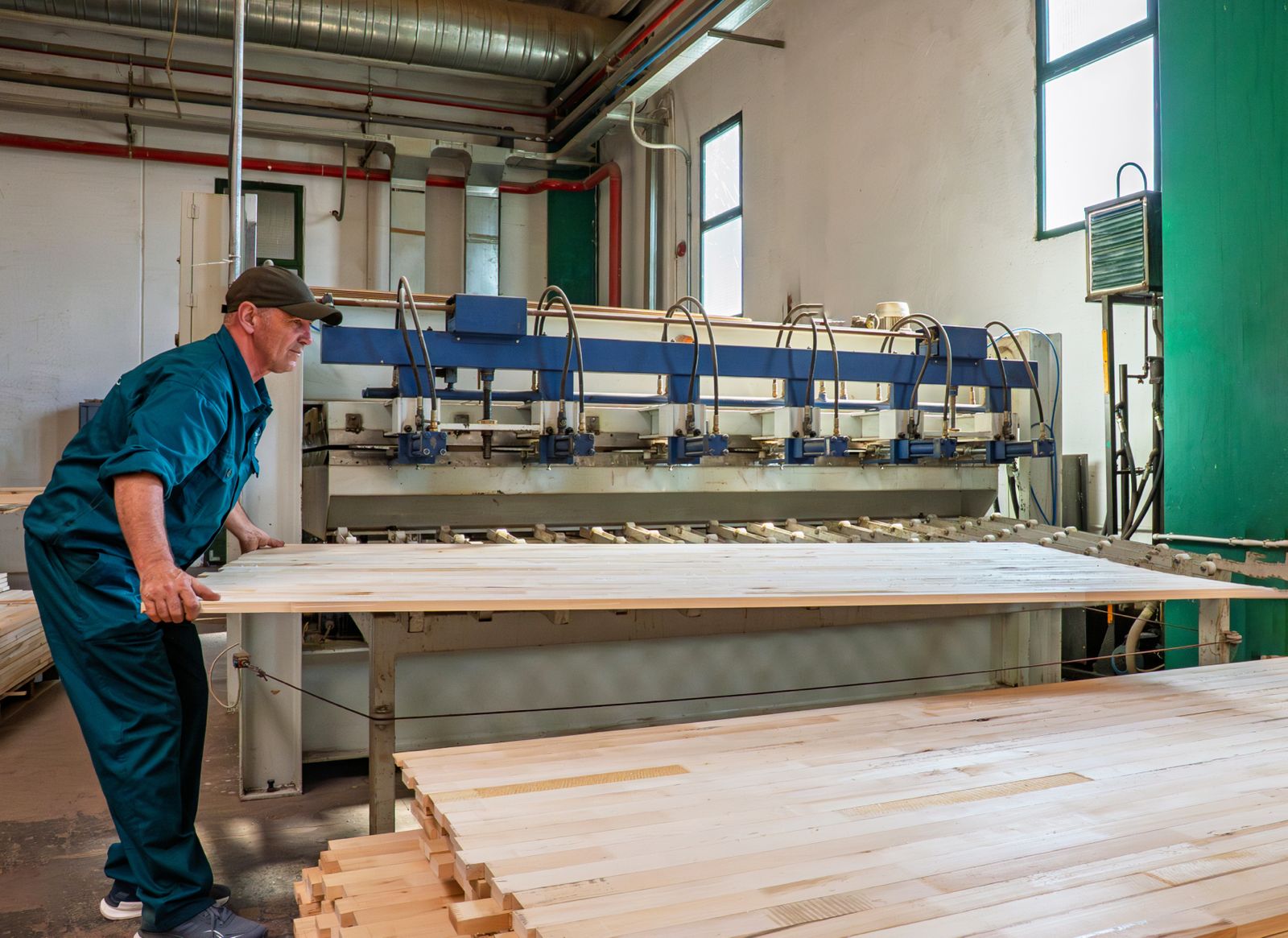
How we glue at SARAL
What to ask a supplier of glued panels or components
- Which adhesive and which class? Type (PVAc, cross-linked PVAc, MUF, PUR) and its EN 204 class, or the structural standard it meets.
- Is it formaldehyde-based? If yes, evidence of compliance with REACH entry 77 for the finished article.
- Moisture at gluing and at delivery, and how far apart the lamellas are allowed to be.
- Time between planing and gluing, especially for oak and other extractive-rich species.
- Pressure, press time and conditioning before sanding, or at least how the producer checks them.
- Glue-line quality limits, such as maximum glue-line thickness and open joints, written into the grade description.
- Heat resistance data, if relevant, stated as an EN 14257 value, not as "passes WATT 91".
Frequently asked questions
D3 or D4 wood glue: which should I use?
D3 for indoor furniture, kitchens, bathrooms and anywhere with occasional water or high humidity; D4 for parts that stay wet for long periods and for coated exterior joinery. Neither is a structural adhesive.1
Is D3 wood glue waterproof?
Water-resistant, not waterproof. A D3 joint must still hold 2 N/mm² after four days in cold water and recover 8 N/mm² after drying again, but it is not made for long immersion or weathering.1
What is the best wood glue for wooden chairs?
For indoor chairs, a good PVAc of class D3 on well-fitted, matched-moisture joints is the usual choice. Fit, moisture and pressure matter more than brand: chair joints carry repeated loads, and PVAc creeps under constant stress.1,3 Our chair manufacturing article covers how chair joints are tested.
How long does D3 glue need to dry?
For one D3/D4 PVAc, edge joints need at least 15 minutes in the press at 20 °C, and the final water resistance is reached after seven days.8 Check the data sheet of your glue, since times vary between products.