What a solid wood worktop is
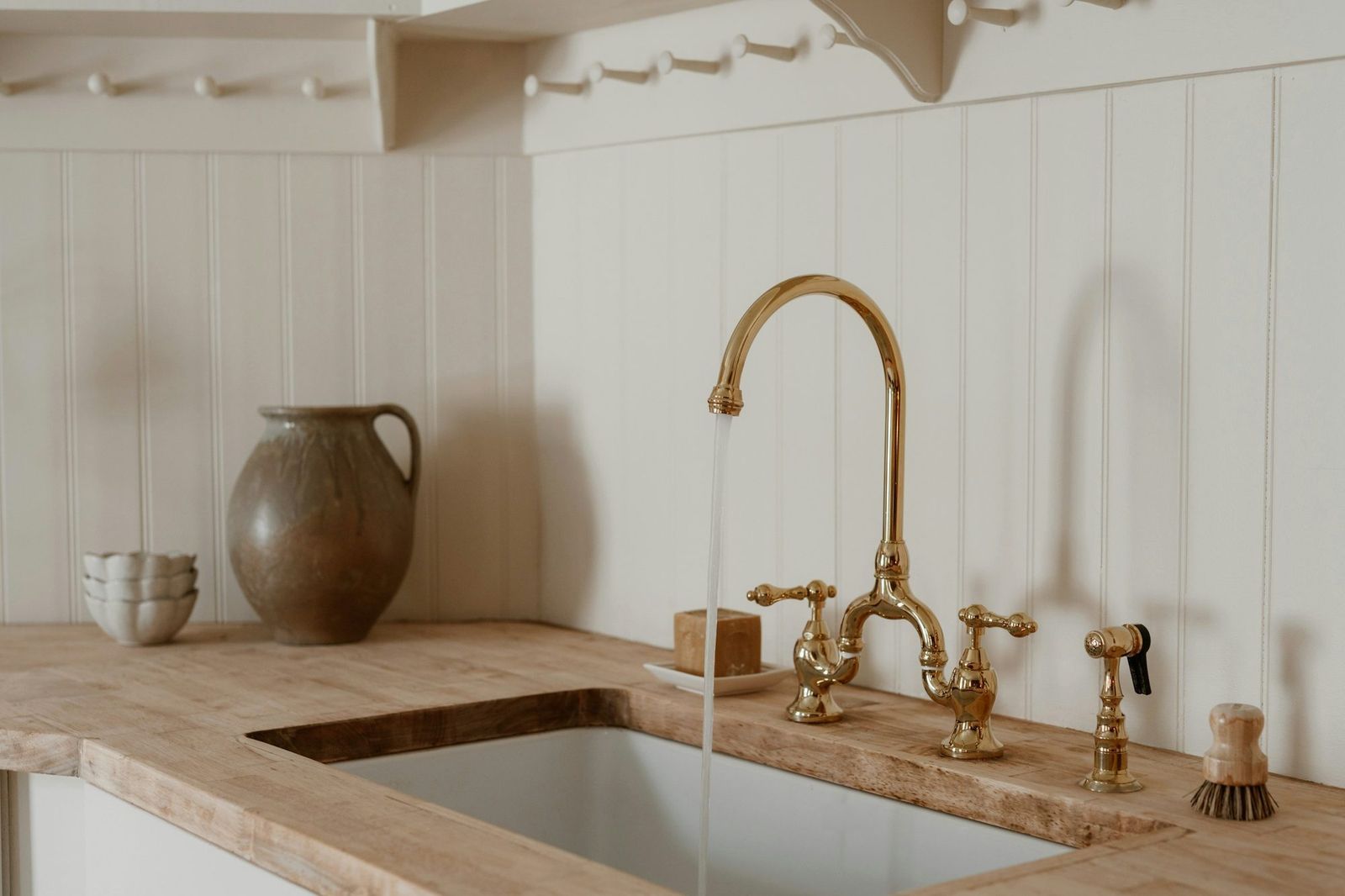
A solid wood worktop is a panel made of strips of one species, called lamellas, glued edge to edge. In European standards it is a single-layer solid wood panel, the same product family as the furniture panels described in our guide to edge-glued panels. It differs from a veneered or laminate top in one way that matters for its whole life: it is solid wood all the way through, so it can be sanded and refinished many times, and it moves with the humidity of the room.
The same panel becomes a kitchen worktop, a table top, a desk, a vanity top or a window board. What changes between those uses is how much water reaches the surface, how often the surface is cut and cleaned, and how the panel is fixed. Those three things decide the thickness, the species, the glue class and the finish.
How the lamellas are built
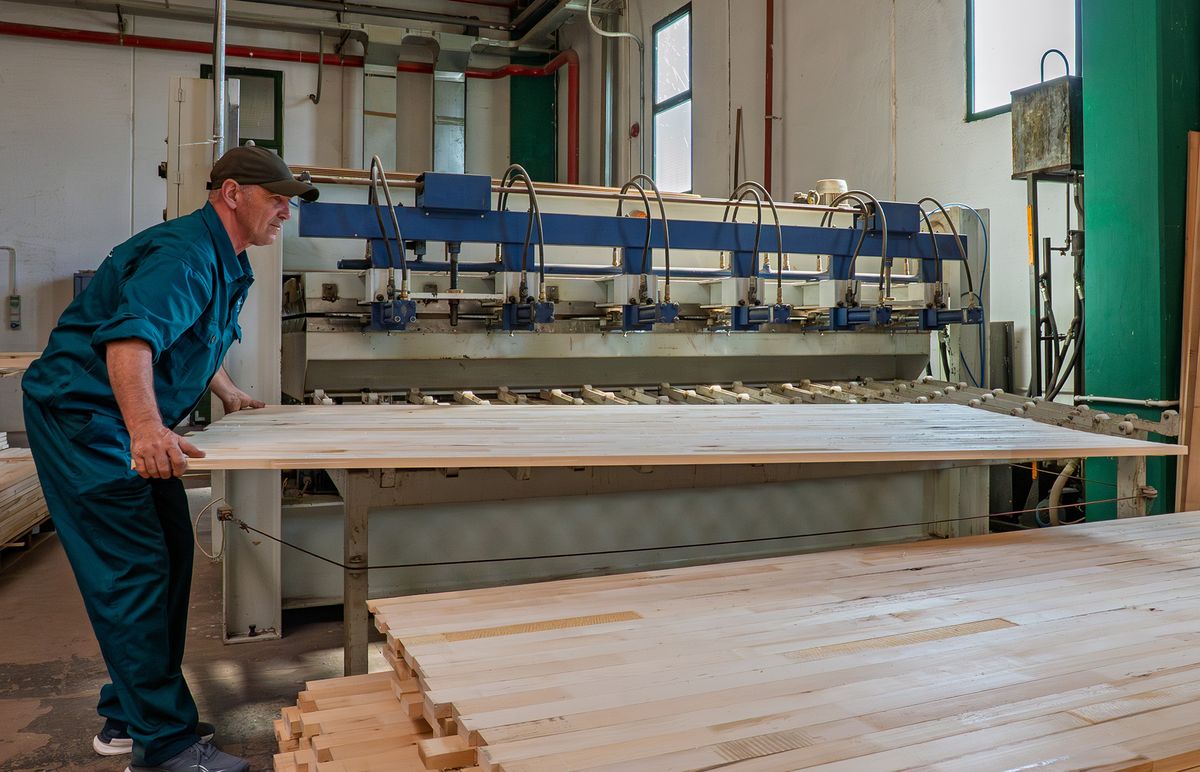
Worktop panels come in two builds. In a continuous-lamella panel every strip runs the full length; one German producer's European oak panel uses lamellas 30–45 mm wide and as long as the panel, up to 3,000 mm. In a finger-jointed panel each strip is made of short clear pieces joined end to end; the same producer's beech worktop panel uses pieces 200–600 mm long, with the joints cut so they do not show on the face.1,2 The finger-jointing article explains what those joints cost in strength, and why it rarely matters for a top supported by cabinets.
For a worktop the choice is mostly about looks and length. Continuous lamellas give long, calm grain, which suits an island or a table top that people see from above. Finger-jointed lamellas make long tops from shorter wood, sort more evenly for colour and cost less. In the data sheets we reviewed, both are bonded with polyvinyl acetate (PVAc) dispersion glue; what differs is the water-resistance class of that glue, which we come back to at the sink.1,2
Worktop thickness: 27, 38 or 40 mm?
There is no standard worktop thickness, but the market clusters around two groups. One producer sells continuous-lamella oak panels in 19, 26 and 40 mm, 600–1,210 mm wide and up to 3,000 mm long; its finger-jointed beech worktop panel comes in 27 and 38 mm, 630 mm wide and 4,100 mm long.1,2 German buyers search for "Arbeitsplatte Eiche massiv 40 mm" for a reason: 40 mm is the thickness most people picture when they think of a solid oak kitchen.
What extra thickness buys
Beam theory gives a clean answer. The bending strength of a rectangular section grows with the square of its thickness, and its stiffness with the cube.3 Going from 27 to 38 mm therefore makes a top about twice as strong and 2.8 times as stiff; going to 40 mm, about 2.2 times as strong and 3.3 times as stiff (our calculation, same species and support). That matters for overhangs, breakfast bars and long spans between supports. One worktop maker asks for overhangs of more than 200 mm to be supported by cabinets or legs, whatever the thickness.6
What thickness does not change
A thicker top does not move less. Wood shrinks and swells by a percentage of its width for each point of moisture content, so a 40 mm top changes depth exactly as much as a 27 mm one of the same species and cut.4 It simply moves with more force, which is why the fixings, not the thickness, decide whether it stays flat. Thickness also gives you more wood to sand away in future refinishing, and weight: a 40 mm top weighs about 50% more than a 27 mm one of the same wood (our calculation).
Oak, beech, ash or walnut: which wood for a worktop
Hardness is the first property people ask about, because a worktop is dented by pans, knives and dropped jars. The Janka test presses a steel ball halfway into the wood. On that test European ash and European beech are the hardest of the common worktop species, walnut sits in the middle and European oak is softest of the four.10,11,12,13
Hardness is not the whole story. On a worktop, how much the wood moves and how it reacts to water matter as much as how hard it is.
- Oak is the most common choice. It is less hard than beech or ash, but it moves less than beech and its heartwood has very good resistance to decay.10,4 Its tannins react with iron: steel wool or wet steel and cast iron can leave blue-black stains. FPL notes that the wood has to be wet, above about 16% MC, for the stain to form, which makes it mainly an outdoor problem, and a problem of the wet zone around a sink.5
- Beech is hard, even-grained and economical, and it is the classic butcher-block wood. It also moves most: its tangential swelling coefficient is about 20% higher than oak's.4 Beech tops need good fixing details and a well-maintained finish near the sink. Our beech guide explains red heart and steamed beech, which affect colour.
- Ash is as hard as beech, light in colour and moves less than both oak and beech.4,12 It suits pale Scandinavian-style kitchens. Like oak and walnut, it has large pores, which can soak up finish and leave thin spots in a film unless they are filled or oiled well.5
- Walnut (Juglans regia in Europe) is chosen for colour. It is softer than ash and beech and usually reserved for islands, table tops and short runs.13
The oak, beech and ash comparison covers density, strength and durability in detail.
How much a worktop moves
Wood takes up and gives off moisture until it is in balance with the air. At 20 °C, wood settles at about 7.5% moisture content (MC) in air at 40% relative humidity (RH), 9.1% at 50% and 10.9% at 60%.4 A kitchen swings between those levels with the seasons, and cooking, washing up and a dishwasher add short peaks of steam. The German adhesives association assumes about 8% MC for wood in living spaces.4
Across a worktop's depth, the movement depends on the species and on how the lamellas were sawn. Flat-sawn lamellas, with the growth rings lying flat, move the most; quarter-sawn lamellas, with the rings standing up, move about half as much. The chart applies published swelling coefficients to a 630 mm deep worktop moving from 40% to 60% RH at 20 °C, a change of 3.4 points of MC.
Show the data
| Flat-sawn lamellas | Quarter-sawn lamellas | |
|---|---|---|
| Beech | 8.8 mm | 4.3 mm |
| Oak | 7.3 mm | 3.9 mm |
| Walnut | 7.1 mm | 3.9 mm |
| Ash | 6.0 mm | 3.6 mm |
Real worktops mix both orientations and are finished, so they move less and more slowly than this upper bound. Source: Calculated by SARAL as 630 mm × differential swelling per 1% MC × 3.4. Coefficients (tangential / radial): beech 0.41/0.20, oak 0.34/0.18, walnut 0.33/0.18, ash 0.28/0.17 % per % MC; equilibrium moisture at 20 °C: IVK (2024), TKH-Merkblatt 3, annexes 1 and 2.
Most worktop panels mix both orientations, so real movement sits between the two bars. It is also smaller in practice, because a finish slows moisture exchange and the core of a 40 mm top lags behind the air. A finish cannot stop it, though: it changes how fast the wood reaches equilibrium, not where it ends up.5 The moisture content article has the full equilibrium table.
The design rule follows. A beech top that can move 8–9 mm across its depth needs fixings that let it slide towards the wall and a gap behind it that a tiled upstand or a strip can cover. One worktop maker specifies a 4 mm gap at the wall and an upstand fixed to the wall, not to the worktop, so that it hides the movement instead of restraining it.6 If you choose a species or cut that moves more, size the gap from the calculation, not from habit.
Installing a solid wood worktop: fixings, gaps and joints
Installation instructions from worktop makers are remarkably consistent. The rules below come from two of them: a UK kitchen supplier's guide for its engineered oak worktops and a German wholesaler's processing notes for solid wood and multi-layer panels.6,7
| Topic | UK supplier (engineered oak worktops) | German wholesaler (solid wood worktops) |
|---|---|---|
| Before fitting | Heating on for at least 2 weeks at 16–24 °C and 35–55% RH; wet trades finished | Acclimatise at least 2 days at 20 °C and 40–50% RH; measure moisture |
| Fixing | Slotted brackets; 8–10 mm oversized holes with large washers; no fixing blocks | Fitter must take measures against warping, shrinkage and swelling |
| Wall | 4 mm gap; upstand fixed to the wall, not the worktop | Not specified |
| Cut edges | Re-oil every trimmed edge and cut-out before installation | Treat all cut-out and side edges with parquet joint sealant or similar |
| Sink | Cut-outs at least 100 mm from ends and from each other; no undermount or Belfast sinks, no drainer grooves | Set sinks and other inserts in a sealing bed |
| Dishwasher | Moisture-barrier paper under the worktop | Moisture barrier on the underside plus a front deflector plate |
| Heat | At least 40 mm from a range cooker; solid wood strip across the end grain | At least 7 mm gap around the hob; cut-out lined with aluminium tape |
| Joints | Three worktop bolts per joint | Not specified |
| Care | Maintenance coat of worktop oil every 6–12 months | Not specified |
Source: Howdens, Engineered Oak Worktops: Installation Guidelines & Care Information (leaflet HD226012); ZEG Holz, Wichtige Hinweise zu Transport, Lagerung und Verarbeitung von Leimholz- und Mehrschichtplatten (document 0LEIHEV4500).
Acclimatise before you cut
The German notes recommend letting panels acclimatise for at least two days at about 20 °C and 40–50% RH before processing, and checking their moisture content first. The UK guide goes further: the room should be dry, wet trades finished, and the heating running for at least two weeks at 16–24 °C and 35–55% RH before the worktop goes in.7,6 A top fitted into a damp new-build kitchen will shrink in its first heating season, and the gaps will open.
Fix it so it can slide
Fix a solid top with slotted steel brackets, using the slot that runs from front to back so the top can move across its depth. Where a cabinet has a solid top, drill oversized holes of 8–10 mm and use a large washer under the screw head. Do not use fixing blocks and do not screw straight through the cabinet into the worktop.6 Table tops follow the same logic: buttons or slotted brackets, never a rigid batten glued across the grain.
Joints between lengths
Long runs and L-shaped kitchens need joints. The UK guide asks for three worktop bolts per joint and a mitre joint when the top has a radius on the front edge.6 Keep the joint dry: the end grain at a butt or mitre joint is exactly where water enters fastest, so seal it and the cut faces before the bolts go in.5
Sink cut-outs, hobs and the dishwasher
A solid wood worktop rarely fails in the middle. It fails at the edges of holes. Every cut-out exposes end grain, and liquid water can enter end grain 10 to 100 times faster than through the face of a board. FPL calls sealing end grain probably the single most valuable improvement in standard construction practice.5
The sink
The German processing notes require all cut-out edges and side edges of solid wood worktops to be treated with a parquet joint sealant or a similar product, and sinks and other inserts to be set in a sealing bed.7 The UK guide adds that sink and hob cut-outs should be at least 100 mm from the end of a worktop or from another cut-out, because a narrow web weakens the top.6 For its engineered oak worktops, that maker also rules out undermount and Belfast sinks and drainer grooves.6 Undermount sinks and routed drainer grooves are possible in solid wood, but they leave end grain permanently wet; if you want them, agree the finish system and the maintenance with the maker first.
Glue class near water
The glue lines between lamellas are also exposed at a sink. EN 204 classifies PVAc glues for non-structural use: D3 for interiors with frequent short exposure to running or condensed water or heavy exposure to high humidity, D4 for interiors with frequent long exposure to water and for exteriors with a suitable surface coating.14 Producers declare either: one German producer's beech worktop panel is bonded with a D4 glue, its continuous-lamella oak panel with D3.2,1 For a top with a sink, ask for D4 or for the producer's evidence that its D3 bond suits the job. The wood glue article explains the tests.
Above the dishwasher and around the hob
A dishwasher vents warm steam at the end of every cycle, straight into the underside of the worktop. The German notes require a moisture barrier on the underside of a wooden worktop above a dishwasher, plus a deflector plate at the front; the UK guide uses moisture-barrier paper above dishwashers, washing machines and microwaves.7,6 Around a hob, the German notes ask for a gap of at least 7 mm on all sides and heat-reflecting aluminium tape over the whole cut-out. Next to a range cooker such as an Aga, the UK guide asks for at least 40 mm and a solid wood strip fixed across the exposed end grain.7,6

Finishing a worktop: oil, hardwax oil or lacquer
Worktops are usually finished with oil or hardwax oil, because a worn patch can be cleaned and re-oiled locally. Lacquer gives a closed film that resists stains well but has to be sanded and recoated when it wears through at the sink. Our article on oil, hardwax oil and lacquer compares them in detail, including VOC limits and what each test on a data sheet means.
Two practical points are specific to worktops. First, the amount matters: one German worktop oil declares resistance to wine, beer, cola, coffee, tea, fruit juice, milk and water to DIN 68861-1A only when two coats of about 30–40 ml/m² are applied.15 Second, an oiled top needs maintenance. One worktop maker recommends a maintenance coat of worktop oil every 6–12 months, or sooner where the surface starts to look dull.6 Seal the underside and every cut edge too: an unfinished underside takes up and gives off moisture faster than the finished top, and the uneven moisture pulls the panel into a cup.5
Food contact and hygiene: what the rules actually say
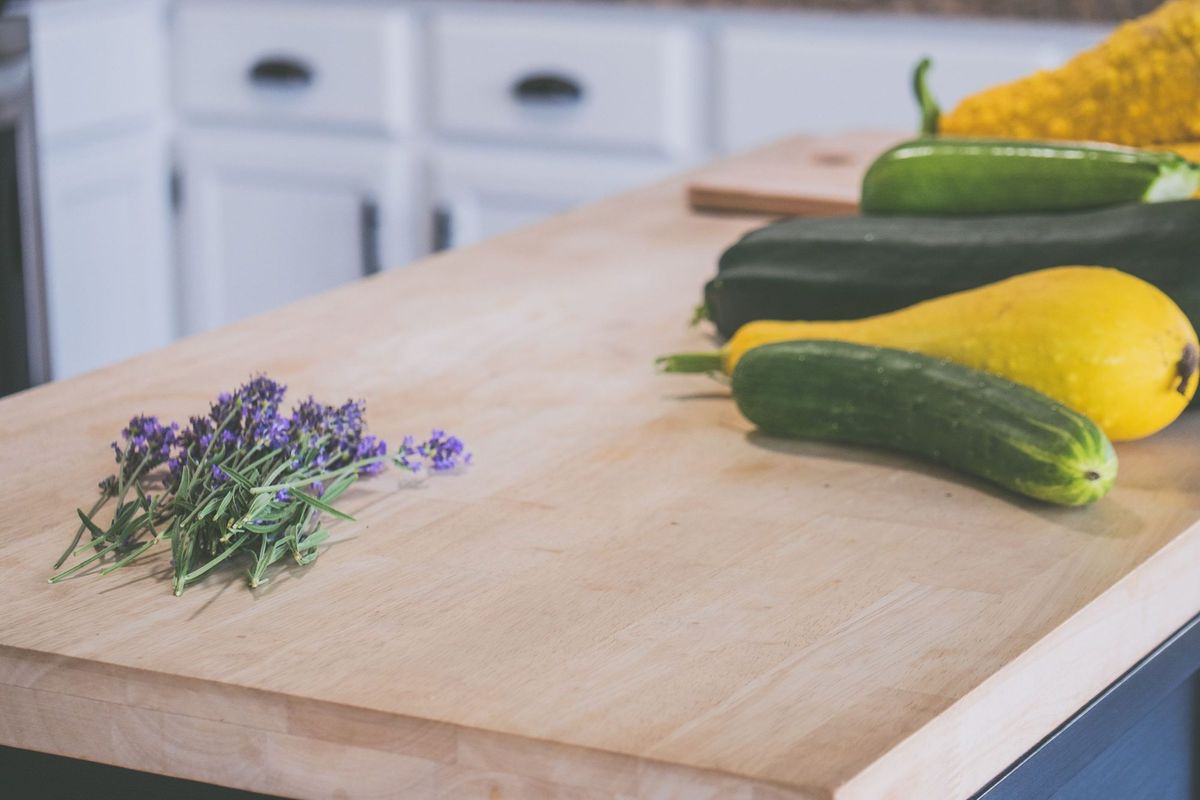
The EU framework is Regulation (EC) No 1935/2004. It applies to materials and articles that, in their finished state, are intended to come into contact with food or can reasonably be expected to do so under normal or foreseeable use.8 A chopping board clearly falls under it. A worktop on which food is prepared directly can reasonably be expected to touch food, which is the test the regulation uses. Article 3 then sets the general requirement: under normal use the material must not transfer its constituents to food in quantities that could endanger health, change the food's composition unacceptably or spoil its taste and smell.8
What the regulation does not do is list approved woods or approved finishes. Wood, and varnishes and coatings, are among the 17 material groups for which specific EU measures may be adopted. Neither has a material-specific measure yet, only substance rules such as the ban on bisphenol A, which also covers varnishes and coatings. Detailed material rules exist for plastics, ceramics, regenerated cellulose, recycled plastics and active and intelligent materials. Where no specific EU measure exists, member states may keep their own national rules.8,9 For a worktop, that means the general requirements, good manufacturing practice and the national law of the country where it is sold.
The claims on finish tins are therefore worth reading closely. The oil cited above declares saliva and sweat resistance to DIN 53160 and suitability for toys to EN 71-3.15 Those are useful tests, but neither is a food-contact test. Ask what a "food safe" claim is based on, and for which surface and curing time.
Is wood hygienic?
Wood is often questioned because it is porous. A 2016 review of 20 years of studies on wood in contact with food concluded the opposite: the porous nature of wood is not what limits its hygiene, it may even be an advantage, and wood can produce antimicrobial compounds that inhibit or limit the growth of pathogens.16 For a worktop, the practical lessons are simple: keep it clean and dry, use a chopping board for raw meat and fish, and keep the finish intact so water does not soak into the wood.
How we make worktops at SARAL
How to specify a solid wood worktop: a checklist
- Species and cut. Oak, beech, ash or walnut; flat-sawn, rift or quarter-sawn lamellas. For beech, say whether red heart is acceptable.
- Build. Continuous or finger-jointed lamellas, lamella width, and whether finger joints may show on the face.
- Dimensions. Thickness, depth and length, plus the overhangs and how they are supported.
- Moisture at delivery, with tolerance and measuring method, matched to a heated kitchen. Producers commonly declare 8 ± 2% or 10 ± 2%.7,1
- Glue class. D3 or D4 to EN 204, and D4 or written evidence of suitability where there is a sink.
- Machining. Sink, hob and tap cut-outs, joint pockets and bolt recesses to drawing, with cut-out edges sealed before delivery or a clear statement that you will seal them.
- Finish. Unfinished, oiled or lacquered; the product and the number of coats; underside and edges finished too; the maintenance product.
- Food-contact statement for the finished surface, and what it is based on.
- Packing. Film-wrapped, stored flat on enough bearers; one German supplier asks for at least one bearer per metre of length.7
Frequently asked questions
Is beech good for kitchen worktops?
Yes, if it is fixed and finished well. Beech is among the hardest common European hardwoods, but it moves more with humidity than oak or ash, so it needs slotted fixings, a wall gap and a maintained finish around the sink.11,4
Oak or beech worktop: which is better?
Beech is harder and cheaper; oak moves less, resists decay better and is the more common look. Near a sink, oak's main weakness is iron staining from wet steel or cast iron; beech's is movement.10,11,4,5
How thick should a solid wood worktop be?
Kitchen worktops are usually 26–27 mm or 38–40 mm.1,2 Choose 38–40 mm for long spans, overhangs and a heavier look; a 40 mm top is about 3.3 times as stiff as a 27 mm one (our calculation), but it moves just as much.3,4
How often should you oil a wooden worktop?
One worktop maker recommends a maintenance coat every 6–12 months, or whenever the surface looks dull in areas of heavy use.6 Around the sink you may need it more often.
Can you put an undermount sink in a solid wood worktop?
It can be done, but it keeps end grain permanently wet. Some makers exclude undermount and Belfast sinks and drainer grooves for their worktops; where they are allowed, seal every cut edge and set the sink in a sealing bed.6,7