Why hardwood has to be dried, and what "dry" actually means
A freshly sawn oak, beech or ash board is heavy with water: well over half of its dry weight, often much more. Wood gives that water up in two stages. First the free water in the cell cavities leaves, and nothing happens to the board's dimensions. Below the fibre saturation point, at around 30% moisture content (MC), the water bound in the cell walls starts to leave, and from that point on the wood shrinks, and does so more across the growth rings than along them. That uneven shrinkage is what makes drying a craft rather than a waiting game.
"Dry" is therefore not a feeling but a number, and the right number depends on where the wood will live. Kiln-dried hardwood for furniture, cabinetry and millwork is usually dried to 6–8% MC and can be specified free of drying stresses.2 That target is set by the equilibrium moisture content of a heated interior. Outdoor air in Central Europe holds timber at a much higher level, so a board that has spent a year under a roof in the yard is "air dry", not "furniture dry".
Air drying: free energy, paid for in time
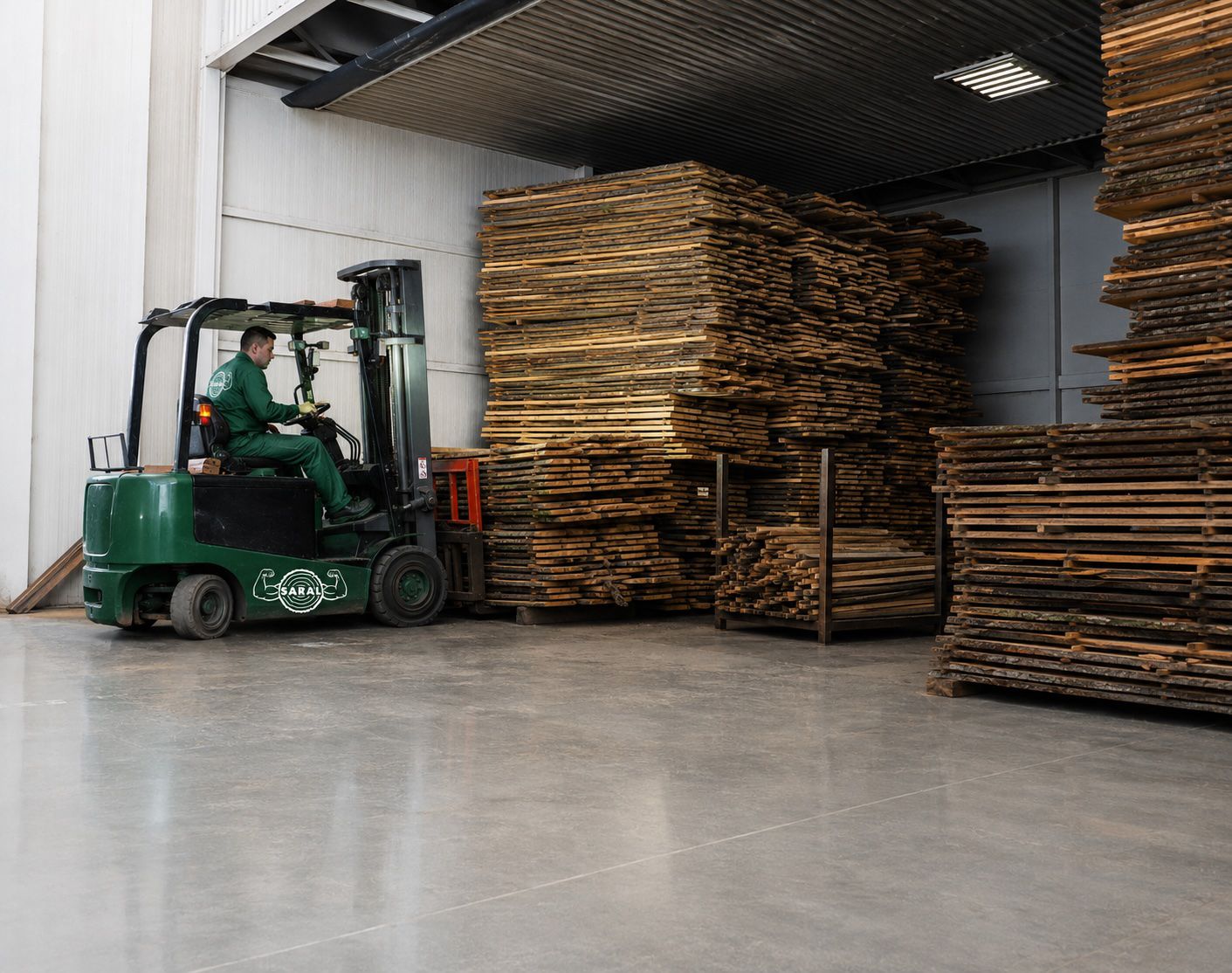
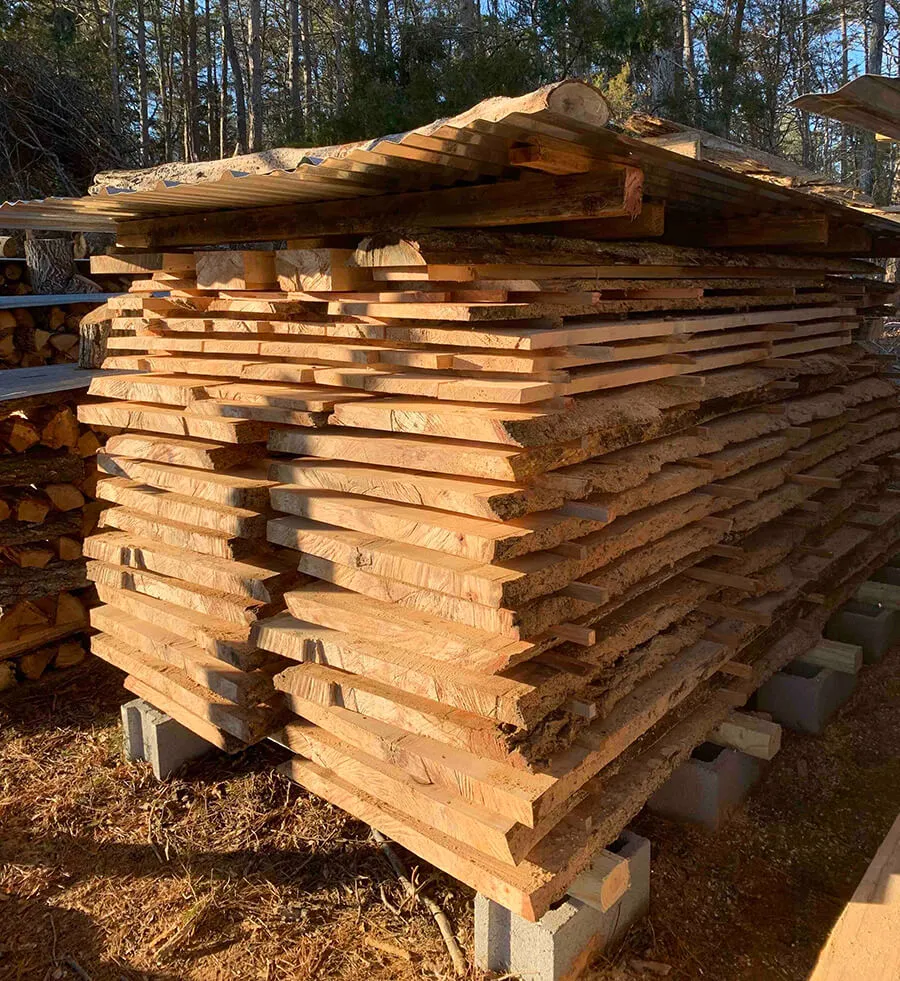
Air drying means stacking boards on stickers in the open or under a roof and letting the weather do the work. It costs almost no energy, which is why many hardwood mills still air dry before the kiln. The price is time and risk: the yard dictates the pace, not the operator.
How long does air drying really take?
The most detailed public data come from the US Forest Products Laboratory (FPL), whose handbook Drying Hardwood Lumber lists air-drying times by species, thickness and region. For green 25 mm (4/4) lumber dried to about 20% MC in a temperate climate comparable to much of Central Europe, the FPL gives 45–80 days for ash and beech and 50–90 days for upland oak. In a cooler northern climate, white oak can take up to 200 days to reach 25% MC. Double the thickness and the times explode: 50 mm (8/4) ash, beech and cherry need 180–230 days, and oak 190–250 days, yet still only reach 23–27% MC.1
Show the data
| Air drying to ~20% MC | Kiln, green to final | Kiln, from air-dried | |
|---|---|---|---|
| Beech | 62 days | 12 days | 5 days |
| Ash | 62 days | 10 days | 4 days |
| Cherry | 62 days | 10 days | 5 days |
| Basswood | 58 days | 8 days | 4 days |
| Red oak | 70 days | 21 days | 5 days |
| White oak | 70 days | 23 days | 5 days |
Air-drying ranges: beech, ash, cherry 45–80 days; basswood 40–75; oaks 50–90. Basswood kiln time 6–9 days depending on colour target. Source: Denig, Wengert & Simpson (2000), Drying Hardwood Lumber, USDA FPL-GTR-118, tables 4.2 and 7.25. American species.
Two caveats apply to the chart. The FPL data are for American species, so "beech" means American beech and "white oak" means Quercus alba. European oak (Quercus robur and Q. petraea) and European beech (Fagus sylvatica) are similarly "refractory", meaning they check easily, so the order of magnitude carries over. And the air-drying times stop at about 20% MC: every board still needs a kiln to get to 6–8%.
The "one year per inch" rule, and why it misleads
Every woodworker has heard that wood needs one year of air drying per inch (25 mm) of thickness. It is a rule of thumb, not a standard. The FPL figures show that 25 mm oak can reach about 20% MC in two to seven months, depending on climate and the season it was stacked, while 50 mm oak takes far longer than two years' worth of the first inch because moisture has to travel twice as far.1 The rule also hides the real limit: no amount of outdoor time takes wood below the moisture level of the outdoor air.2
What goes wrong in the yard
Air drying is a game of exposure. Sun and dry wind open surface checks and end splits on oak; warm, still, humid weeks invite fungal stain on light woods such as beech, ash and maple, where colour is part of the value. The FPL put a figure on it: degrade in conventional air drying can exceed US$75 per thousand board feet (about 2.36 m³), compared with as little as US$10 when the same lumber is pre-dried in a shed or warehouse dryer.1 The numbers are late-1990s dollars, but the ratio is the point.
Pre-drying: the middle road for oak and beech
Between the open yard and the kiln sits the pre-dryer: an enclosed building with fans and gentle heat, typically running at 27–38 °C and 65–85% relative humidity. Accelerated air drying in sheds with fans works on the same principle. For hard-to-dry species such as oak and beech, shed or warehouse pre-drying followed by kiln drying is rated "excellent" by the FPL.2
Pre-drying also saves kiln energy. Every percentage point of moisture removed before the kiln saves 50–85 Btu per board foot of later kiln energy, roughly 6–11 kWh per cubic metre for each point.1 Taking a load from green to 25% before it enters the kiln therefore saves hundreds of kilowatt-hours per cubic metre.
Inside a conventional kiln
A conventional kiln controls three things: temperature, humidity and air speed. Heating coils warm the air, fans push it through the stickered stack, vents release moist air and steam or water sprays add humidity when the wood is drying too fast. The operator does not simply choose a temperature and wait, but follows a schedule, a sequence of dry-bulb temperatures and humidities that tightens as the wood dries.
Hardwoods are dried on moisture-content-based schedules: the conditions change when the wettest kiln samples reach set MC levels, not after a fixed number of hours. A typical hardwood schedule starts at about 49 °C and 80% relative humidity on green lumber and reaches about 82 °C by the time the wood is down to 15% MC.2 Softwoods, by contrast, are usually dried on time-based schedules.
Kiln schedules decoded
The FPL code for a schedule looks cryptic but reads easily. In "T3-C2" the T-number is the temperature schedule, from T1 (mildest) to T14; the letter is the moisture class, tied to the green MC of the species; and the last number is the wet-bulb depression schedule, from 1 (mildest, most humid air) to 8 (most severe).1 Thicker stock gets a milder code, and 6/4 oak is dried on the 8/4 schedule.
| Species (American) | 25–38 mm | 50 mm |
|---|---|---|
| White oak | T3-C2 | T3-C1 |
| Red oak | T3-D2 | T3-D1 |
| Beech | T7-C2 | T5-C1 |
| White ash | T7-C3 | T5-C2 |
| Black cherry | T8-B4 | T5-B3 |
| Basswood | T11-E7 | T9-E6 |
Source: Denig, Wengert & Simpson (2000), Drying Hardwood Lumber, USDA FPL-GTR-118. 38 mm (6/4) oak is dried on the 50 mm schedule.
Oak versus beech, step by step
The schedules of oak and beech share the same humidity steps but start at different temperatures. Oak (T3) starts at about 43 °C with air close to saturation; beech (T7) starts about 11 °C hotter. Both get warmer and drier as the wood passes the fibre saturation point, when the risk of surface checking falls. Oak's schedule then ends with an equalising and a conditioning step at 77–82 °C.
Show the data
| Moisture stage | Beech, dry bulb | Oak, dry bulb | Oak, wet bulb |
|---|---|---|---|
| >40% | 54 °C | 43 °C | 41 °C |
| 40–35% | 54 °C | 43 °C | 41 °C |
| 35–30% | 54 °C | 43 °C | 39 °C |
| 30–25% | 60 °C | 49 °C | 41 °C |
| 25–20% | 66 °C | 54 °C | 38 °C |
| 20–15% | 71 °C | 60 °C | 35 °C |
| <15% | 71 °C | 71 °C | 46 °C |
| Equalise | – | 77 °C | 53 °C |
| Condition | – | 82 °C | 77 °C |
The wider the gap between dry and wet bulb, the drier the air. Source: Denig, Wengert & Simpson (2000), Drying Hardwood Lumber, USDA FPL-GTR-118, tables 7.4–7.7 and 7.13 (°F converted).
European practice for beech is often gentler and cooler than the American schedule. A study of Serbian beech kilns describes conventional vented kilns heated with water at about 90 °C, running from about 35 °C to about 60 °C and finishing with 20–40 hours of conditioning.3 Lower temperatures help keep beech's colour even, which matters for visible furniture parts; steamed and unsteamed beech are dried differently for the same reason.
Why oak cannot be rushed
The reason for oak's mild schedule shows clearly in the maximum safe drying rate while the wood is wet. A 25 mm white oak board should lose no more than about 2.5 percentage points of MC per day; red oak tolerates 3.8, beech 4.5 and white ash 10.4. At 50 mm the limits drop by more than half.1 Push faster and the surface dries, shrinks over a still-wet core and tears open: surface checks, and in the worst case internal honeycombing. The drying defects article covers these in detail.
Show the data
| 25 mm (4/4) | 50 mm (8/4) | |
|---|---|---|
| White oak | 2.5% | 1.0% |
| Red oak | 3.8% | 1.5% |
| Beech | 4.5% | 1.8% |
| Cherry | 5.8% | 2.3% |
| White ash | 10.4% | 4.1% |
Source: Denig, Wengert & Simpson (2000), Drying Hardwood Lumber, USDA FPL-GTR-118, table 8.6. American species.
Equalising and conditioning: the two steps that make kiln-dried wood usable
At the end of a kiln run, boards are never all at the same moisture: thin, sapwood-rich boards are drier than thick heartwood ones, and every board is drier on the surface than in the core. Two final steps fix that.
- Equalising narrows the spread between boards. It starts when the driest kiln sample is 2 points below the target MC, with the kiln held at an equilibrium moisture 2 points below the target (usually at 77 °C dry-bulb) until the wettest samples arrive.1
- Conditioning relieves the stress between shell and core, called case-hardening. The kiln is set to an equilibrium moisture about 4 points above the target, ideally about 6 °C hotter than during equalising, so the dried-out surface takes back a little moisture. The FPL recommends it for any lumber dried below 11% MC that will be resawn or ripped. Overdo it and you get the opposite problem, reverse case-hardening.1
The practical test is the prong (or "fork") test: a cross-section cut from a board is sawn into prongs and left to dry. If the outer prongs bend inwards, the board is still case-hardened and will bow or pinch the saw when it is ripped.1 For a furniture-parts maker this is not academic: unconditioned stock is a common cause of parts that move after machining.
How long kiln drying takes
With good air circulation, the FPL gives these approximate minimum times in a conventional kiln for 25 mm hardwood, from green to final MC: white oak 23 days, red oak 21, beech 12, ash 10, cherry 10 and basswood 6–9 days. Air-dried stock of the same species needs only 3–5 days. Poor kilns with air speeds under 1 m/s need several days to a week longer for green stock.1
These are minimums. Thicker boards, mixed loads, a schedule chosen for colour, and the equalising and conditioning steps all add time. A realistic charge of green oak furniture stock is measured in weeks, not days.
Energy per cubic metre
Drying is the most energy-hungry stage of sawn-wood production.1 For European beech, the Serbian study calculated about 435 kWh per m³ for 25 mm boards and about 480 kWh per m³ for 50 mm boards, dried from 80% to 8% MC in conventional vented kilns; older or smaller kilns can need about 20% more. The same paper cites 400–560 kWh/m³ for 60 mm beech, and notes that removing water below the fibre saturation point costs about twice as much energy per kilogram as removing the free water above it.3
That is why kilns sit next to sawmills that produce their own fuel. Bark, offcuts and sawdust from the saw line feed the boiler, so the most energy-intensive step runs largely on the mill's own residues.
Dehumidification, vacuum and continuous kilns
Conventional vented steam or hot-water kilns are the workhorse of hardwood drying, but they are not the only type.1,2
- Dehumidification (heat-pump) kilns condense water out of the kiln air instead of venting it. They run cooler, which suits refractory species and colour-sensitive woods, and are common in small operations.
- Vacuum kilns lower the boiling point of water so wood dries faster at moderate temperatures. They suit thick, valuable stock in small batches.
- Continuous (progressive) kilns move loads through zones of different conditions and suit large volumes of a single product.
No kiln type removes the basic limit: refractory hardwood such as oak can only dry as fast as moisture can move from its core to its surface without cracking it.
Quality control: how a kiln operator knows when the wood is dry
Moisture is controlled with kiln samples: short pieces cut from representative boards, weighed and oven-dried to calculate their MC, then weighed again during the run. The schedule steps follow the wettest samples, and equalising starts from the driest.1
In Europe, how moisture is measured is standardised. EN 13183-1 describes the oven-dry method, the reference method, and EN 13183-2 the electrical-resistance moisture meter.5 EN 14298 describes how to assess the drying quality of a batch of sawn timber, including the spread of moisture content between boards.6 A supplier who quotes those standards is telling you how the number was measured, not just what it is.
A kiln also kills insects in the wood. For wooden packaging moving between countries, the international standard ISPM 15 requires heat treatment to at least 56 °C for 30 continuous minutes throughout the wood, a level a hardwood kiln schedule passes comfortably.4
How we dry at SARAL
Buying kiln-dried hardwood: what to ask your supplier
- Target moisture content and tolerance. "Kiln dried" alone means little. For indoor furniture, ask for a target such as 8% and a tolerance band.
- How it was measured. Oven-dry samples or a calibrated meter, and to which standard.
- Whether the load was equalised and conditioned. This matters most if you will resaw, rip or machine the boards.
- Species and thickness of the charge. Mixed loads are dried to suit the slowest board.
- Storage after drying. Kiln-dried wood stored outdoors or in an unheated shed takes moisture back. Ask how it was stored and packed.
If you buy sawn timber or ready-cut components, these questions apply just the same: the moisture of a finished part is set at the kiln.
Frequently asked questions
How long does oak take to dry?
Air drying 25 mm oak to about 20% MC takes roughly two to seven months, depending on climate and season; 50 mm oak takes six months to a year to reach about 25%.1 Kiln drying green 25 mm oak to furniture moisture takes at least about three weeks; from air-dried stock, 3–5 days.1
Can you kiln dry oak straight from green?
Yes, on a mild schedule such as T3-C2 for 25 mm stock. Many mills pre-dry or air dry oak first because it lowers kiln time, energy and the risk of checks.1,2
Is air-dried wood good enough for furniture?
Not on its own for heated interiors. Air drying stops at roughly the moisture of the outdoor air, around 20% in practice, while furniture should be at 6–8%.1,2 Air-dried wood used indoors keeps shrinking.
Does kiln drying make wood weaker?
Correctly scheduled kiln drying does not. Most strength properties actually rise as wood dries below the fibre saturation point. Damage comes from schedules that are too severe for the species and thickness, which cause checks and internal splits.1