The brand and the product
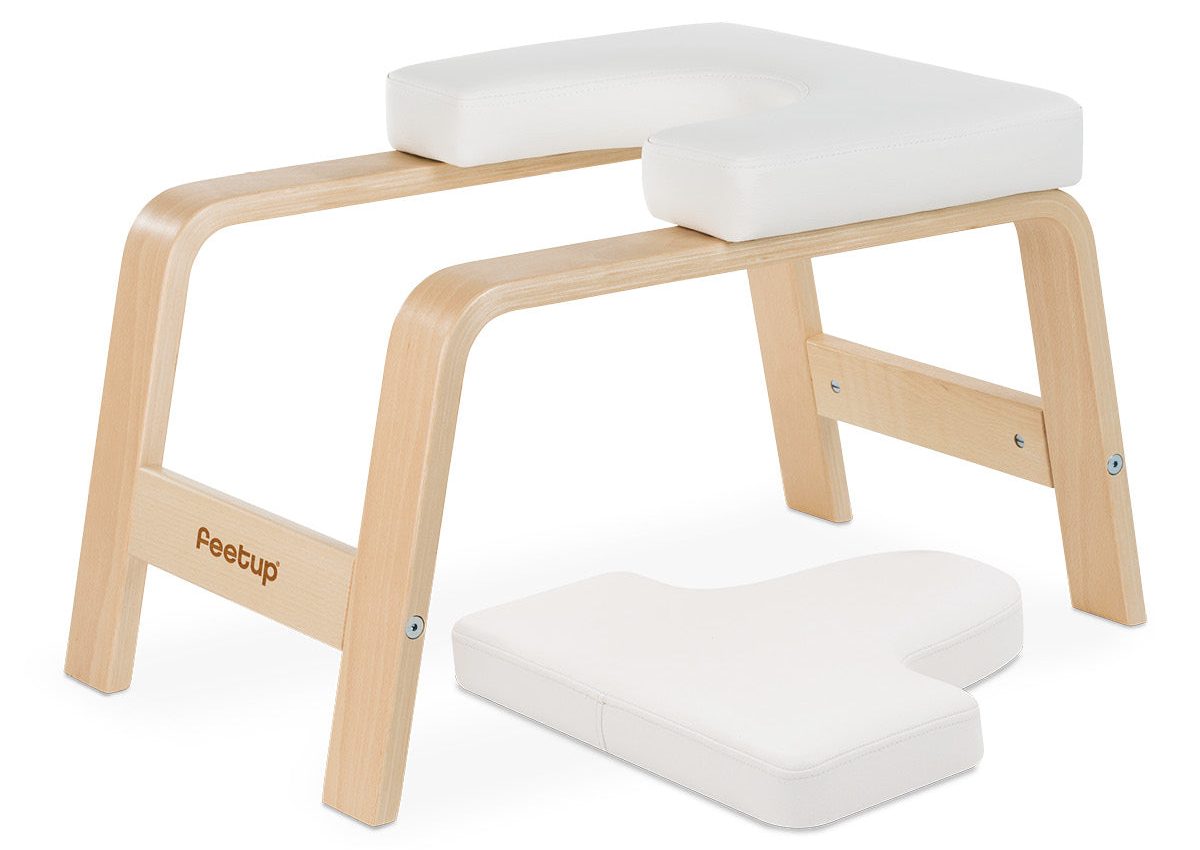
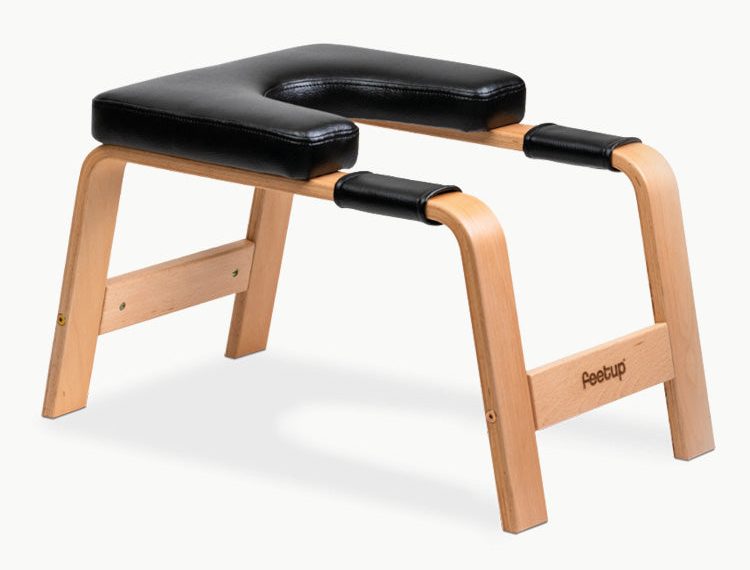
The FeetUp® Trainer is a yoga prop for inversions. It looks like a small, open stool with a U-shaped cushion on top: you put your shoulders on the cushion, your head hangs free through the opening and you hold the frame with both hands. The brand describes the idea simply: body weight is spread across the shoulders, so the head and neck carry nothing.2 The result is an object with a distinctly exotic look, closer to a piece of sculpture than to anything in a furniture catalogue.
According to the product page, the Trainer measures 64 × 40 × 40 cm and weighs about 5 kg. It arrives as a wooden frame, a vegan-leather cushion (a fabric cover on the Honey Chai models), a hardware kit for assembly in about five minutes, phone holders, a manual and an exercise poster.2 FeetUp® was founded by the German product designer Kilian Trenkle, who has also been one of SARAL's owners since 2018. This article covers the FeetUp® project as we ran it at our factory in Bălțați, Iași county.
The challenge: a frame made of moulded beech plywood
Most wooden furniture is built from straight parts. The Trainer is not. Each side of the frame is one continuous curved piece that forms the top rail and both legs, and it has to carry a person upside down. Sawing that shape out of solid wood would cut straight across the grain at every bend. Bending solid beech with steam is possible, but a single bent piece is more likely to change shape as the seasons change.3
The answer was moulded plywood: thin layers of beech, coated with adhesive and pressed in a mould at high temperature until the glue sets and the stack keeps the mould's curve. The challenge was not the principle, which is old, but doing it with 12 layers of 1.2 mm technical beech plywood, to the same shape every time, at a volume of thousands of frames a month. None of that existed at SARAL before the project. The process had to be built from scratch.
What we built: a production line in four months
Building the production line took four months. Every step was customised for this one product, and the line was laid out for very large quantities: more than 6,000 Trainers a month. In practice that means the work moves upstream. A moulded part is only as good as its mould, so most of the effort goes into tooling, fixtures and process settings before the first good frame comes out of the press.
How hot-pressed moulded plywood works
The US Forest Products Laboratory (FPL) describes the method in its Wood Handbook. Adhesive-coated veneers are assembled and pressed over or between curved forms; pressure, and often heat from steam or electrically heated forms, is applied until the adhesive sets and holds the assembly in shape. As in flat plywood, some layers usually run at 90° to others, and the grain of the thicker layers normally runs parallel to the axis of the bend to make bending easier.3
The FPL lists the advantages. Bending thin layers stresses the fibres only moderately, so no steaming is needed and the finished part is stronger than a single piece bent to the same curve. Laminated parts change shape less with moisture than bent solid wood, and thickness-to-radius ratios that are impossible in one piece become easy. Plywood bent and bonded in one operation also holds its curve better than flat plywood bent afterwards. Curved plywood shells for furniture are the textbook example.3
| Parameter | Value |
|---|---|
| Material | Technical beech plywood |
| Number of layers | 12 |
| Thickness per layer | 1.2 mm |
| Nominal stack thickness | 14.4 mm (12 × 1.2 mm) |
| Glue lines | 11 |
| Forming | Hot-pressed in moulds |
Source: SARAL production data. Stack thickness and number of glue lines are our arithmetic, before pressing.
From pressed blank to finished frame
A part that comes out of the press is a blank, not a finished component. It still has to be trimmed to its outline, drilled for the assembly hardware, sanded and finished, and the rails, cushion and hardware have to meet it within tight limits so that the frame assembles in minutes at the customer's home. Our guide to CNC machining of hardwood explains why consistent fixturing matters as much as the machine itself when every part must be identical.
Materials and joints
Beech was the natural choice. It is hard, strong and wear-resistant, it glues and finishes well, and it is one of the three species we process every day at SARAL. Our European beech guide covers its properties in detail. In moulded plywood the wood's natural movement is tamed by the layers themselves: thin veneers, glued in a stack, cannot swell and shrink as freely as a solid board.
The adhesive is part of the material in a moulded part. It fills every one of the eleven glue lines between twelve layers, and it decides how the part behaves in humidity and under repeated load. Our article on gluing hardwood explains the adhesive classes and the moisture rules that apply to any glued wood product.
The two moulded sides are joined by straight rails with the bolts and fittings of the hardware kit, which is why the Trainer ships flat and assembles in about five minutes.2 A knock-down joint like this has to be designed for the opposite of a glued furniture joint: it must be tight enough not to rack under a moving body, yet repeatable enough that any frame matches any set of rails. Anti-slip rubber feet, which the brand describes as patented, keep the frame from sliding on the floor.2
The shoulder cushion and SARAL's upholstery department
The cushion is the only part of the Trainer that touches the body, and it carries the full load. It is upholstered in eco-leather, a polyurethane-coated fabric often sold as faux or vegan leather. Strictly speaking it is not leather: the European standard EN 15987 sets out the key terms of the leather trade and how the word "leather" should be used.4 Coated fabrics of this kind are tested for abrasion on their coated surface with a Martindale method of their own, EN ISO 5470-2.5 Our article on upholstery for wooden chairs explains foam, covers and abrasion tests in more depth.
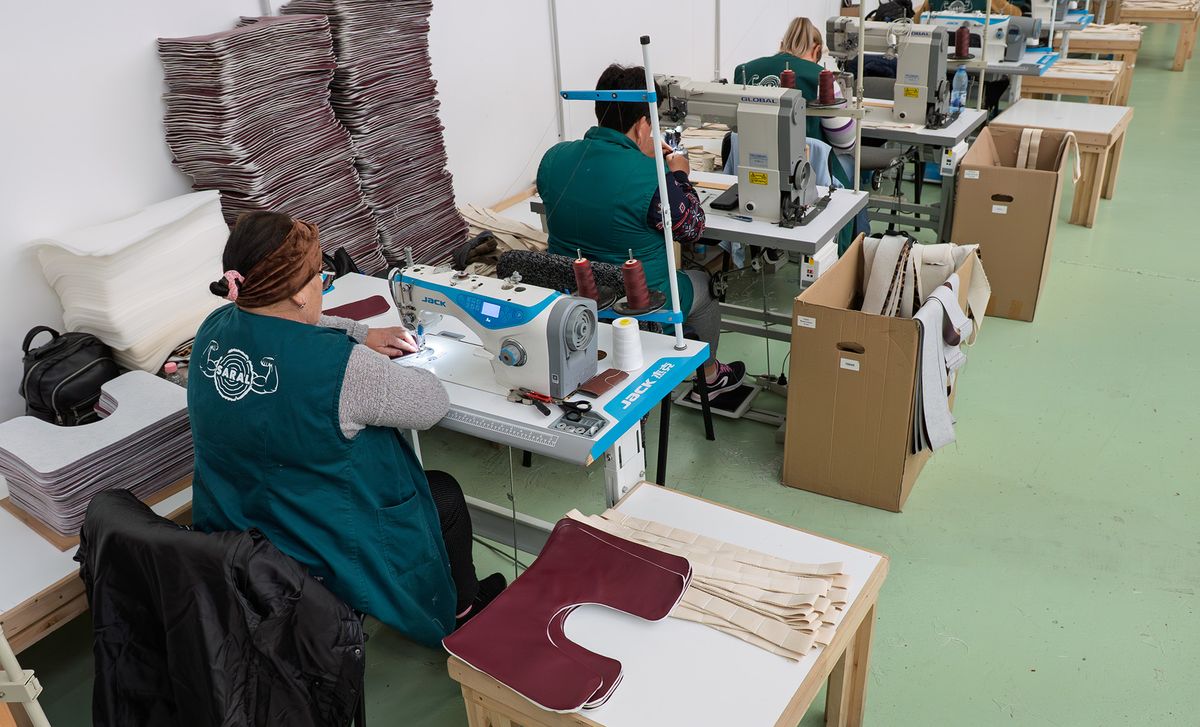
For the eco-leather shoulder cushion, SARAL built its own upholstery department, which went into operation in 2021. Doing it in-house meant the cushion base, the foam and the cover could be developed next to the frame they sit on, rather than at a supplier's. The brand also sells replacement cushions and handgrips, the latter made from the same material as the cushions.6 See our upholstery and stitching page.
Quality control and the 900 kg test
For a product that holds a person upside down, strength is not a selling point but the precondition. The Trainer was stress-tested at the Technical University of Braunschweig (TU Braunschweig) in Germany. It withstood more than 900 kg of force applied directly on the shoulder cushion: the load went through the cushion, the moulded frame and the joints at once, which is how the product is loaded in use.
To put that number in context, a study by researchers at the London School of Hygiene and Tropical Medicine and the World Health Organization estimated the average adult body mass at 70.8 kg in Europe, 80.7 kg in North America and 62.0 kg worldwide.1 The test load is about 13 times the European figure and 11 times the North American one.
The ratio is a margin, not a permitted user weight. A static test load is applied slowly, while a person kicking up into an inversion loads the frame dynamically, and repeated use adds fatigue. That is why furniture test methods such as EN 1728 combine static and durability tests for strength and durability of seating structures.7 The brand's own advice points the same way: it asks users to think about the direction and speed of their movement rather than a weight limit.2 For how static and fatigue tests work on chairs, see our article on contract chairs.
Packed, inserted, ready to ship
The Trainer does not leave SARAL as a set of parts. Every unit leaves in its final retail packaging, complete with its inserts, and ready to ship to the end customer: frame, cushion, hardware kit and the printed material and accessories listed on the product page.2 For the brand this removes a whole stage from the supply chain; for us it means the last station of the line is a packing station, not a pallet of components. Packaging lines, warehouse and logistics are part of our additional services.
Results in numbers
One more result is not a number but a department. The upholstery and stitching line that started with the Trainer cushion now works for other products too, including the cotton strap of the FlexBuddy®.
What we learned
- With moulded parts, quality is decided before the press closes. Moulds, veneer preparation and glue application set the result; inspection afterwards can only sort good parts from bad ones.
- Designing for volume changes the design questions. At thousands of units a month, a few seconds per operation and a fixture that never needs adjusting matter more than any single machine.
- Upholstery belongs next to the frame. Developing the cushion in the same building as the frame shortened every change loop, and gave us a department we use for far more than one product.
- An outside test gives a number everyone can check. A university test on the complete product, loaded where the user loads it, says more than any calculation on a single part.
If you have a product that needs its own process rather than an off-the-shelf one, our product design team works from CAD and parametric models through to the line.
Product list
The FeetUp® products that come from this project:
- FeetUp® Trainer
- FeetUp® Cushion
- FeetUp® Cushion 2.0
- FeetUp® Handgrips
- FeetUp® Coasters (phone holders)
Frequently asked questions
What is the FeetUp Trainer made of?
The side frames are moulded parts, hot-pressed from 12 layers of 1.2 mm technical beech plywood. The shoulder cushion is upholstered in eco-leather, a polyurethane-coated fabric, or in a fabric cover on some models.2
How much weight can the FeetUp Trainer hold?
In a test at TU Braunschweig the Trainer withstood more than 900 kg applied directly on the shoulder cushion. That is a static test load, about 13 times the average European adult body mass, not a user weight limit.1
How is moulded plywood made?
Thin veneers are coated with adhesive, stacked and pressed in a curved mould, usually with heat, until the adhesive sets. The part keeps the mould's shape and is more stable than solid wood bent to the same curve.3