What makes a chair a contract chair
"Contract" is the furniture trade's word for anything not sold for the home: seating for restaurants, cafés, hotels, event venues, canteens, offices and public buildings. In HoReCa, the hotel, restaurant and catering sector, a chair is sat on many times a day by people who lean back, drag it across tiles and stack it after service. The European standard that sets its strength, durability and safety is EN 16139, Furniture: safety, strength and durability, requirements and test methods for non-domestic seating.1
Its scope is wide: all types of non-domestic seating for adults weighing up to 110 kg, including office visitor chairs. It does not apply to ranked seating, office work chairs, chairs for educational institutions, outdoor seating or links for linked seating, which have their own standards, nor to industrial work chairs. And it leaves out three things a HoReCa buyer cares about: the durability of upholstery materials, resistance to ageing and degradation, and flammability.1 Those need separate specifications, covered later in this guide and in our guide to chair upholstery.
Domestic chairs are tested to EN 12520, whose 2024 edition excludes seating for non-domestic use.7 A dining chair that passes EN 12520 is therefore not a restaurant chair by definition. How solid wood chairs are made in general, from species to finishing, is the subject of our chair manufacturing guide; this article covers what changes when the chair goes to work.
EN 16139:2025: what changed from the 2013 edition
CEN approved EN 16139:2025 on 7 April 2025 and reissued a corrected version on 30 July 2025. National standards bodies had to adopt it, and withdraw conflicting national standards, by January 2026.1 In Estonia, for example, it has been valid since 1 August 2025.2 The foreword lists the significant technical changes against the 2013 edition.1
| Change | Where in the standard |
|---|---|
| Definition and requirements for single-column seating, with a seat side-to-side durability test | Term 3.7, Annex B (normative), rationale in Annex H |
| Test methods for finger entrapment and for shear and compression points | Annex A (normative) |
| Leg rest: new static requirement and durability test | Annex C (normative) |
| Backward fall test introduced | Strength and durability requirements |
| Seat loading point for seating with suspended flexible material | Annex D (normative) |
| Rolling resistance requirement for unloaded chairs removed | Was clause 4.4 in the 2013 edition |
| Recommended dimensions changed; annexes reordered, normative before informative | Annex G (informative) |
Source: EN 16139:2025, European foreword and contents, public preview of STN EN 16139:2025 (ÚNMS SR, 2025).
For wooden chairs, two changes stand out. The new backward fall test addresses what happens when a sitter tips a chair over backwards. And the finger entrapment and shear tests in Annex A matter for folding and stacking chairs with moving parts or gaps.1 The test loads and cycle counts sit in Table 1 of the standard, which is not part of the public preview. We have not seen the 2025 table, so the figures below come from the 2013 edition and are labelled as such. Ask your test laboratory which values apply to a new test.
Level L1 or L2: choosing the test severity
EN 16139 tests at two severity levels. In the 2013 edition, as reproduced in an accredited laboratory's report, they are defined like this:3
- L1, general use: areas where seating is used for mixed purposes, for short periods or several hours, under light to heavy loads. Examples: offices, showrooms, public halls, function rooms, cafés, restaurants, canteens, banks and bars.
- L2, extreme use: areas where seating is occasionally or repeatedly subject to extremely high loads because of its use or misuse. Examples: night clubs, police stations, transport terminals, sports changing rooms, prisons and barracks.
Nursing homes and public areas of hospitals fall under L1, but seating that may be moved while occupied should get the upward static load test on the arm rests at L2 severity.3 The 2025 edition keeps an informative annex on test severity in relation to applications.1
The difference shows most in the fatigue tests. Under the 2013 edition, the combined seat-and-back durability test runs 100,000 cycles at L1 and 200,000 at L2, with 1,000 N on the seat and 300 N on the back.3 On the rigs of the UK test house FIRA, 100,000 cycles take nine to ten days and 200,000 take fifteen to sixteen. For comparison, the domestic test under EN 12520:2015 ran 25,000 cycles, three to four days.8 Our chair manufacturing guide charts the seat, front-edge and arm-rest cycles side by side.
Legs, impacts and drops
Fatigue is only half of the test programme. The legs are pushed forwards and sideways while the seat is loaded, seat, back and arms go through impact tests, and stacking chairs are dropped.3 These are the tests that find weak leg joints, and they are where L2 asks for much more than L1.
| Test (EN 1728 clause) | L1 general use | L2 extreme use |
|---|---|---|
| Leg forward static load (6.15) | 500 N, seat load 1,000 N | 620 N, seat load 1,800 N |
| Leg sideways static load (6.16) | 400 N, seat load 1,000 N | 760 N, seat load 1,800 N |
| Seat impact (6.24), drop height | 240 mm | 300 mm |
| Back impact (6.25), height / angle | 210 mm / 38° | 330 mm / 48° |
| Arm impact (6.26), height / angle | 210 mm / 38° | 330 mm / 48° |
| Drop test for stacking seating (6.27.2, informative) | 150 mm | 200 mm |
| Drop from table height (6.27.3) | 600 mm | 600 mm |
| Backward fall (6.28) | 5 times | 5 times |
Values from the superseded 2013 edition. Check the 2025 values with your test laboratory. Source: Kinnarps Test and Verification Center (2023), report 23-TA29114, requirement tables of EN 16139:2013 including informative Annex A.1.
Joint design: where contract chairs fail
When a guest leans back, the chair frame works as a lever and the joints between legs and rails take the bending moment. A study of Scots pine chair frames built with mortise-and-tenon joints of nine sizes, analysed with finite element models, found that the front-leg-to-side-rail and back-leg-to-side-rail joints carried about 73% of the total moment under front-to-back loading.4 Those joints decide whether the chair passes.
The same study tested the frames to failure. Strength rose with both tenon width and tenon length, but length had the larger effect. The researchers then estimated cyclic strength as 56% of static strength and compared it with the acceptable design loads of the American Library Association specification: 1,335 N for light (domestic) service, 1,557 N for medium and 2,002 N for heavy service.4
Only the 40 × 50 mm and 50 × 50 mm tenons met the light service level, only the 50 × 50 mm tenon met medium service, and none of the nine sizes met heavy service.4 Two cautions apply. The chairs were Scots pine, with 21 mm thick members, glued with PVAc; beech and oak are denser and stronger, so the absolute numbers do not transfer. And the American library levels are not EN 16139 levels. The lesson does transfer: a contract chair needs generous tenons on the leg-to-rail joints, and joint size is a design decision to make before the first prototype, not after the first failed test.
What else strengthens a contract frame
- Stretchers and corner blocks. They share the racking load with the leg-to-rail joints and give the frame a second load path.
- Glue and moisture. A contract chair is glued once and loaded for years. Matched moisture content and a suitable glue class matter as much as joint geometry; the wood glue guide explains D3 and D4.
- Safe edges. In the 2013 edition, accessible corners and the edges a sitter touches must be rounded or chamfered, other edges free from burrs, and the ends of hollow components closed or capped.3
Stackable chairs: how many, and how to protect them
Banqueting and event chairs live in stacks. EN 16139:2013 includes an informative drop test for stacking seating, from 150 mm at L1 and 200 mm at L2, and a drop from table height of 600 mm.3 The 2025 edition keeps additional drop tests in an informative annex.1
The number of chairs per stack, however, is set by the buyer and declared by the maker, not by the standard. A UK town council's 2025 tender for 400 event chairs, for example, asked for a stack of at least 20 chairs on a dolly and 8–10 chairs stable and secure without one, together with compliance with EN 16139:2013 at level 2.9 For wooden stacking chairs, ask how the stack is guided, where the chairs touch each other and how those contact points are protected, because that is where the finish rubs.
Bistro and terrace chairs: indoor and outdoor rules
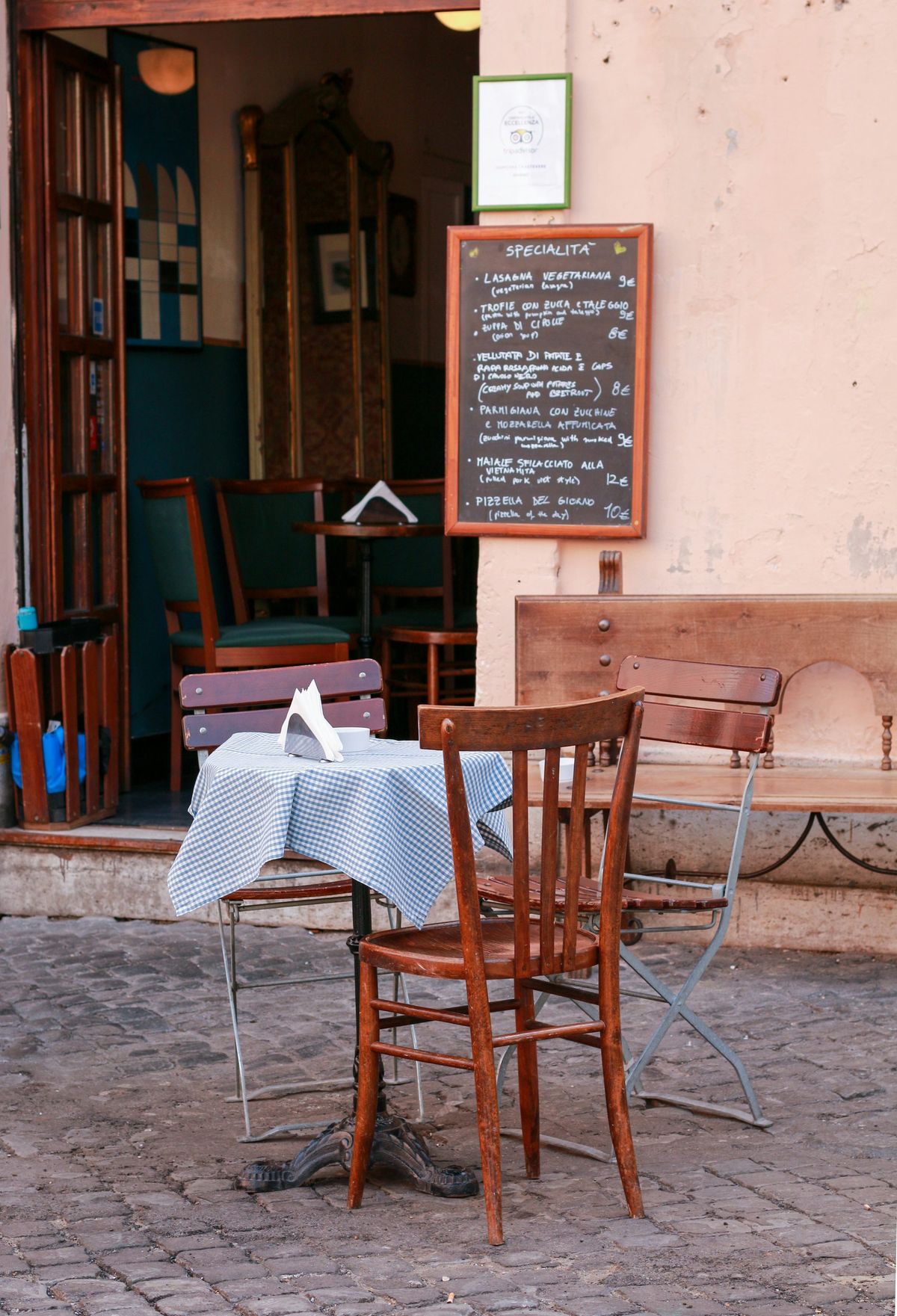
The bistro chair, light and often bentwood, is the classic café chair. Indoors it is a non-domestic chair under EN 16139. On the terrace it is not: EN 16139 excludes outdoor seating.1
Outdoor seating is covered by EN 581-2, Outdoor furniture: mechanical safety requirements and test methods, part 2: seating for camping, domestic and contract use. Its third edition was approved on 22 May 2026 and replaces the 2015 edition.5 It sets minimum requirements for general and structural safety, including strength, reliability and stability, for all types of outdoor seating for adults, for camping, domestic and contract use, regardless of materials. Like EN 16139 it is based on users up to 110 kg, and it does not cover removable upholstery.10
A wooden terrace chair also has to cope with rain, sun and frost. That is a question of species, heartwood, design for drainage and finish. Our article on oil versus lacquer compares the finishes.
Cleanability and finishes
Restaurant chairs are wiped many times a day, often with detergents and disinfectants. The test for this is EN 12720, the European method for assessing the resistance of rigid furniture surfaces to cold liquids. It does not apply to leather and textile surfaces, and the type and number of test liquids and the test periods are stated in requirement specifications or agreed between purchaser and supplier.11 That last point is the practical one: if a hotel group cleans with a particular product, name it in the specification and have the finish tested with it.
The same logic applies to wear. Chair backs rub against tables, legs against floors, and stacking chairs against each other. Ask for the finish system, its colour reference and the cleaning agents it has been tested with, and keep a reference sample.
Fire safety of upholstered contract seating
EN 16139 does not include requirements for flammability.1 Fire rules for contract seating are national, and they differ a great deal.
United Kingdom: BS 7176 and the hazard categories
In the UK, the fire safety of non-domestic furniture is regulated indirectly. The Regulatory Reform (Fire Safety) Order 2005 makes a designated "responsible person" accountable for the fire safety of the premises and its contents, and upholstered seating is specified to BS 7176, which sets ignition resistance by the hazard of the end use.6
| Hazard | Typical premises | Ignition sources | Test methods |
|---|---|---|---|
| Low | Offices, schools, colleges, universities, museums, exhibitions, day centres | Cigarette (0), match equivalent (1) | BS EN 1021-1, -2 |
| Medium | Restaurants, pubs and bars, hotel bedrooms, public halls, casinos, hospitals, hostels, places of entertainment, public buildings | 0, 1 and flame source 5 (wooden crib) | BS EN 1021-1, -2; BS 5852 clause 11 |
| High | Offshore installations; sleeping accommodation in certain hospital wards and hostels | 0, 1 and flame source 7 | BS EN 1021-1, -2; BS 5852 clause 11 |
| Very high | Prison cells, locked psychiatric accommodation | 0, 1 and source 7 for composites and complete items | BS EN 1021-1, -2; BS 5852 clause 11 or 12 |
Typical examples only: the fire risk assessment may place a product in a lower or higher category. Source: FIRA International (2010), Fire safety of furniture and furnishings in the non-domestic sector: a guide to the UK regulations, tables 2 and 5, describing BS 7176:2007.
Restaurants, pubs and bars, hotel bedrooms and public halls appear as typical medium-hazard premises. There, each upholstery composite, meaning the combination of cover and filling, must resist the smouldering cigarette, the match-flame equivalent and flame source 5, a wooden crib, tested in an L-shaped configuration. If seat, back and arms use different fillings, each composite is tested.6 The table gives typical examples only; the fire risk assessment may place a product higher or lower, and FIRA recommends getting the required category in writing from the specifier or responsible person.6
Even non-upholstered chairs are not automatically exempt. FIRA's guidance is that non-upholstered furniture can be assessed as a complete item under BS 5852 clause 12, with cigarette and match resistance for low-hazard areas and source 5 resistance added for medium-hazard areas.6
Germany and other countries
German building law handles the question through the regulations for places of assembly. In Bavaria's version, for example, the seats of places of assembly with more than 5,000 visitor places must be made of at least flame-retardant material, with a non-combustible substructure.12 Most restaurants are far smaller, so ask the operator or its fire protection planner what applies. Other countries have their own classifications. Before you quote, ask the specifier which national standard and class apply, and whether the test must be on the actual cover and filling combination.
Specifying contract chairs: the brief, the samples and the time
A good contract chair brief is short and exact. Name the use and the level, the edition of EN 16139 the test report must cover, the stack height, the finish and its cleaning agents, the cover and filling with their fire class, and the delivery format. The council tender above is a fair model of a compact specification: quantity, stack height with and without dolly, standard and level, frame material and a wipeable seat.9
Plan the time for evidence. If a new design needs a full EN 16139 test, the seat-and-back fatigue test alone takes nine to sixteen days on FIRA's rigs, depending on the level, before static, impact and stability tests are added.8 Samples, a pre-production approval and any fire test of the chosen upholstery composite come on top.
How we make contract chairs at SARAL
A buyer's checklist for HoReCa chairs
- Use and level. Indoor non-domestic (EN 16139, L1 or L2) or outdoor (EN 581-2).
- Edition. EN 16139:2025 or a report to the 2013 edition, and whether the tested sample matches the chair you buy, including species, joints and glue.
- Frame. Species, tenon or dowel sizes at the leg-to-rail joints, stretchers and corner blocks.
- Stacking. Number per stack with and without dolly, contact points and their protection.
- Finish. System, colour reference and resistance to the cleaning agents you use, assessed to EN 12720 with agreed liquids and times.
- Upholstery and fire. Cover and filling, abrasion resistance and the fire standard and class of your market, tested on the actual composite.
- Delivery. Assembled or knock-down, packing, pallet pattern and spare parts such as glides and seat pads.
Frequently asked questions
What is a contract chair?
A chair made for non-domestic use, such as restaurants, cafés, hotels, offices or event venues. In Europe its strength and durability are tested to EN 16139, which covers non-domestic seating for adults up to 110 kg.1
What does EN 16139 level 1 mean?
L1 is the "general use" severity level, for offices, cafés, restaurants, canteens, banks and bars. L2, "extreme use", is for places such as night clubs, transport terminals and prisons. Under the 2013 edition, L1 requires 100,000 seat-and-back cycles and L2 200,000.3
Are restaurant chairs different from dining chairs?
Yes. Dining chairs for the home are tested to EN 12520, which excludes non-domestic use, while restaurant chairs are tested to EN 16139 with far more fatigue cycles.3,7,8 Restaurant chairs also need a finish that withstands daily cleaning and, if upholstered, the fire class required where they are used.
Do restaurant chairs need to be fire rated?
It depends on the country. EN 16139 has no fire requirements. In the UK, upholstered seating for restaurants is typically specified to BS 7176 medium hazard; in Germany, specific seat requirements apply to large places of assembly.1,6,12