The brand and the product
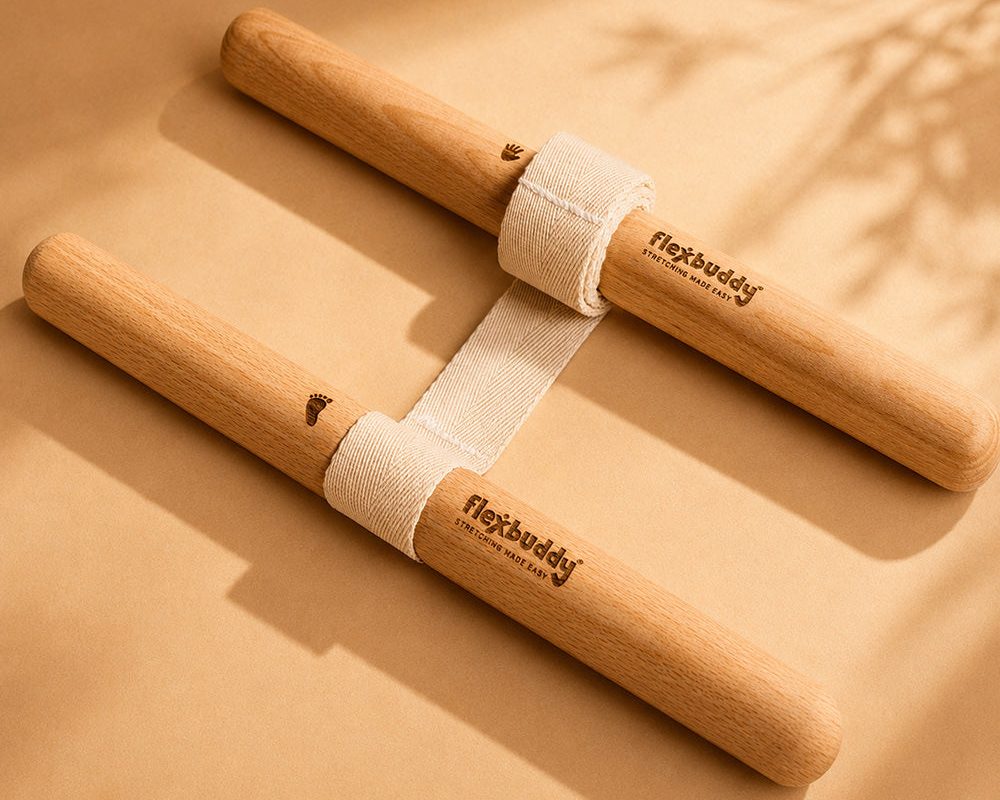
FlexBuddy® is a stretching aid sold under the FeetUp® umbrella. It consists of two short wooden bars connected by a strap. You place one bar under the soles of your feet, hold the other with both hands and adjust the length through the strap's loops; for finer adjustment you roll the hand bar so that the strap winds around it.1 The brand presents it as a device for stretching shoulders, back, hips and hamstrings in a couple of minutes a day, describes it as patented and sells it in two versions: the classic FlexBuddy and FlexBuddy Plus, which adds a loop for a wider range of exercises.1,3
The materials are spelled out by the brand. The bars are natural beech, and the strap is a cotton band made, in the brand's words, to its own recipe.2,3 The product images give its size as 32 × 7 × 5 cm, small enough for a backpack.3 This article covers the FlexBuddy® project as we ran it at our factory in Bălțați, Iași county.
The challenge: a simple object with three hard details
Two sticks and a strap would be easy to make once. Making them identical in series, so that every device feels the same in the hand and lasts as long as the brand promises, raises three problems.
- The wood. The bars are held in bare hands and pressed against bare feet. Every edge has to be rounded, every surface smooth, and the bar has to be strong enough not to flex or crack under the pull of two legs and two arms.
- The textile. The strap is not a bought-in belt. Its loops set the length steps of the device, so loop length and stitch position must repeat from one strap to the next.
- The interface. The strap must grip a round bar firmly enough to transmit the pull, yet let the user roll the bar to wind it up. That balance between hold and adjustment is the detail users notice first.
The brand also sells the device with a lifetime warranty and states that the quality of the stitches should hold for a lifetime.2 For a sewn product that is a strong promise, and it moves the focus of the whole project to the seams.
What SARAL built: wood and textile under one roof
FlexBuddy® is a product that only works if the woodworking and the sewing are planned together. The diameter of a bar decides the size of the loop that wraps it and how much strap a single roll takes up. At SARAL both sides are in the same factory, which is why the project could be developed as one product rather than as two parts from two suppliers.
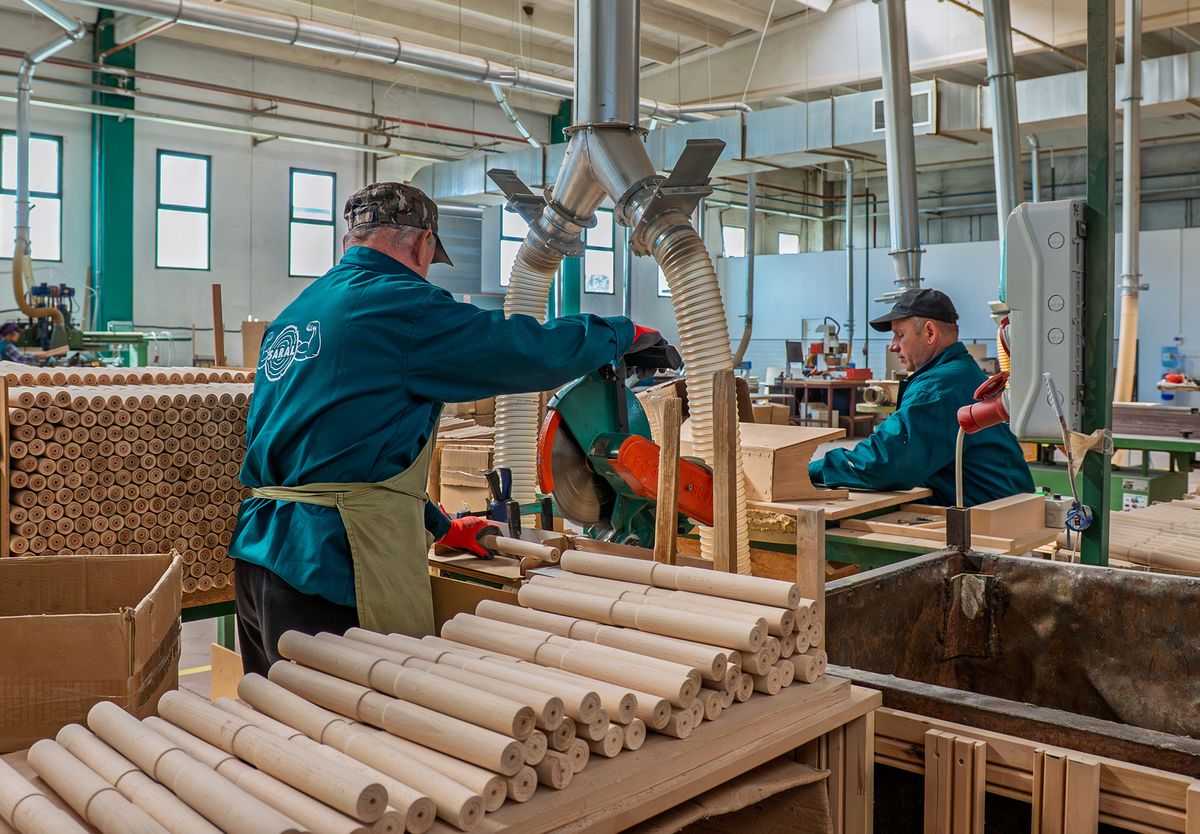
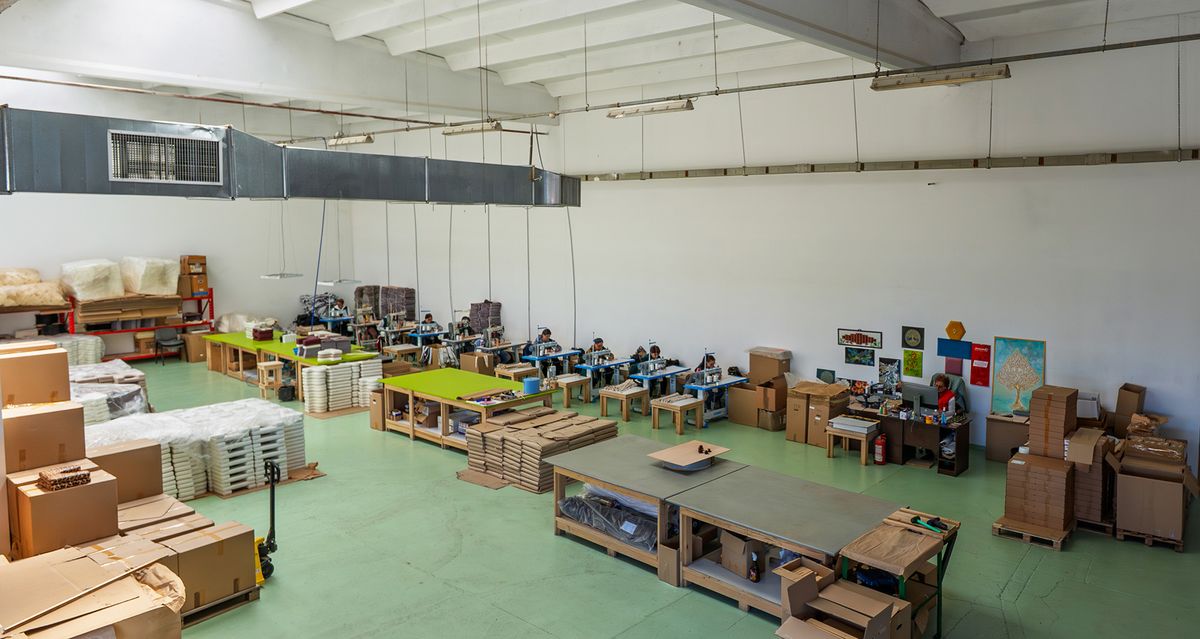
The wooden side draws on the same chain as our furniture components: kiln-dried hardwood, machining to size and, for logos and markings, our digitally controlled laser engraving. The textile side is the sewing department that SARAL built for the eco-leather cushion of the FeetUp® Trainer and that went into operation in 2021; the FeetUp® case study tells that part of the story.
Materials and joints
Beech suits the bars for the same reasons it suits chair legs and rails. It is hard, strong and wear-resistant, and it machines, finishes and turns well.4 Our European beech guide covers its properties and why it remains the classic wood for parts that are handled every day.
| Component | Material | Job in the device | Made at SARAL in |
|---|---|---|---|
| Foot bar | Natural beech | Sits under the soles of the feet | Wood production |
| Hand bar | Natural beech | Held in both hands; rolled to fine-tune the length | Wood production |
| Strap | Cotton band | Connects the bars; loops set the length in steps | Sewing department |
| Extra loop (Plus only) | Cotton band | Extends the range of exercises | Sewing department |
Source: FlexBuddy product pages and FAQ (materials, use, Plus loop), accessed 24 October 2026; SARAL (where each part is made).
There is no glued joint on a FlexBuddy®, and no screw. The "joint" is the strap itself: a loop sewn around each bar. That makes the seam the structural connection of the product, the equivalent of the mortise and tenon in a chair. A chair joint is tested for fatigue because it loosens a little with every load; a seam is no different. It has to keep its strength through thousands of stretches without the stitches pulling through the cotton.
The cotton strap and SARAL's sewing department
Cotton was the brand's choice for a strap that touches bare skin and feet. It is pleasant to hold, and it puts the weight of the design on the sewing: the seams have to spread the pull along their length rather than concentrate it at their ends. The FlexBuddy® strap is custom-sewn in SARAL's sewing department, the department that also sews our upholstery covers. Our upholstery and stitching page describes what the department makes.
In series production, two things make a sewn strap repeatable. The first is cutting and marking the band so that every loop comes out at the same length. The second is a fixed stitch pattern for each seam, with the same stitch length and the same number of passes on every strap, because a seam's strength depends on both. Our article on upholstery for wooden chairs explains how covers and fabrics are specified and tested; the same discipline applies to a strap.
Quality control and stress testing
FlexBuddy® is stress-tested. The figures are not yet released, so this section explains what such testing involves rather than the results.
Testing the strap and the seams
Textile tests are standardised. EN ISO 13934-1 measures the maximum force and elongation of a fabric with the strip method, on a constant-rate-of-extension testing machine; it is written mainly for woven fabrics.5 Seams have their own method: EN ISO 13935-2 measures the maximum force to seam rupture with the grab method, for straight seams in fabrics and made-up textile articles. The 2014 edition was replaced by a 2026 edition in May 2026.6 Tests of this kind show two things that matter for a strap: how much force the band itself carries, and whether a seam fails before the band does.
Testing the whole device
A device test loads the FlexBuddy® the way a user does: one bar held, the other pulled, the strap in between. A static pull checks that nothing tears, slips or cracks at a load well above what a person can apply; a cyclic test repeats a lower pull many times, which is how seams and wood actually wear. The same logic is used in furniture testing, where static tests are paired with fatigue tests. Our article on how solid wood chairs are made explains why.
Packed, inserted, ready to ship
FlexBuddy® does not leave SARAL as bars and straps. Every device leaves in its final retail packaging, complete with its inserts, and ready to ship to the end customer. For a small product sold online, that matters: the box that leaves our warehouse is the box the customer opens. Packaging lines, warehouse and logistics are part of our additional services.
Results in numbers
What we learned
- Simple products have nowhere to hide. With two bars and a strap, every edge, every seam and every millimetre of loop length is the product.
- A seam is a structural joint. The strap's stitching deserves the same care as a glued joint in a chair frame, in how it is laid out, sewn and tested.
- Wood and textile should be designed together. Bar diameter, loop width and how the strap winds are one design problem; solving it in one factory is faster than coordinating two suppliers.
- A department built for one product pays off on the next. The sewing department set up for the FeetUp® cushion gave FlexBuddy® its strap.
Product list
The FlexBuddy® products made at SARAL:
Frequently asked questions
What is FlexBuddy made of?
Two bars of natural beech wood and a cotton strap. The strap is custom-sewn at SARAL; FlexBuddy Plus adds an extra loop.2,3
How do you adjust a FlexBuddy?
For large steps you move the foot bar to another loop of the strap; for small steps you roll the hand bar so that the strap winds around it.1
How is a stretching strap tested?
The band is tested for maximum tensile force, for example with the strip method of EN ISO 13934-1, and the seams for force to rupture with the grab method of EN ISO 13935-2. The complete device is loaded statically and in cycles, the way it is used.5,6