How to read this article: measurements, inventories and models
Climate and forests produce many headlines and few clear numbers. This article separates three kinds of evidence. Annual surveys measure the condition of the same sample trees every summer. National inventories measure what grows, dies and is felled over ten years or so. Models project where a species' climate will be suitable under assumed emission scenarios. The first two describe what has happened; the third describes what could happen if the assumptions hold.
We use German data for much of the observed record because they are the most detailed public series for beech and oak in Central Europe. Romania's own data follow in a separate section, and our article on Romania's hardwood forests covers its inventory in depth.
| Source | Type | What it measures | Result used here |
|---|---|---|---|
| Germany's forest condition survey (WZE) | Observation, every year | Crown thinning of 46,531 sample trees on an 8 × 8 km grid | 2025: 38% of beech, 51% of oak with clear crown thinning |
| German national forest inventory (BWI 2022) | Inventory, about every 10 years | Area, volume, growth, felling and damage | Spruce area −17% since 2012; broadleaves 47% of timberland |
| ICP Forests crown survey | Observation, every year | Defoliation in national crown surveys | Romania 2024: 12.0% of broadleaves moderately to severely defoliated |
| Romanian forest inventory (IFN III) | Inventory, 2020–2025 | Area, volume, growth and harvest | Beech 35.8%, oaks 18.1% of the forest area |
| Climate envelope models | Projection under scenarios | Where a species' present climate will still exist | Beech envelope −58% to −82% by 2071–2100 in one study |
| Tree-ring growth models | Projection under scenarios | Future growth of beech | Growth −20% to more than −50% by 2090 |
Source: BMLEH (2026), Ergebnisse der Waldzustandserhebung 2025; BMEL/Thünen-Institut (2024), Bundeswaldinventur 2022; Michel et al. (2025), ICP Forests 2025 assessment, online supplement; IFN ciclul III; Illés & Móricz (2022); Martínez del Castillo et al. (2022).
The 2018–2022 droughts: what actually happened
In 2018, Central Europe had one of the most severe and longest summer droughts on record. Across Austria, Germany and Switzerland the mean air temperature from April to October was more than 3.3 °C above the long-term average and 1.2 °C warmer than in the 2003 drought. Most important tree species showed severe drought stress, including premature leaf shedding and unusual mortality, and the damage carried over into 2019.7
Satellite data put a figure on the loss. Between January 2018 and April 2021, Germany lost canopy cover on 501,000 ha of forest, with the largest losses in central Germany, where some districts lost up to two-thirds of their coniferous forest.8 Germany's fourth national forest inventory later recorded calamities, mainly the drought from 2018 and the bark-beetle outbreak that followed, on 2.0 million ha, or 19% of the timberland.2
Germany's forest condition survey: beech and oak since 2010
Every July and August, field teams in Germany estimate how much foliage each sample tree has lost compared with a fully leaved crown, in 5% steps. In 2025 the national result came from 1,889 sample points on an 8 × 8 km grid. Trees with more than 25% loss count as showing "clear crown thinning" (deutliche Kronenverlichtung).1 The method measures vitality, not timber quality, and heavy seed years (mast) also thin crowns, so a single year means little. The trend matters more.
Show the data
| Year | Beech | Oak | Spruce | All species |
|---|---|---|---|---|
| 2010 | 23.3% | 29.6% | 18.7% | 19.1% |
| 2011 | 30.4% | 26.3% | 19.1% | 20.4% |
| 2012 | 24.3% | 29.4% | 19.3% | 19.2% |
| 2013 | 23.6% | 27.0% | 18.8% | 19.3% |
| 2014 | 27.6% | 24.7% | 20.2% | 20.4% |
| 2015 | 23.3% | 24.1% | 20.6% | 20.0% |
| 2016 | 28.6% | 21.4% | 21.0% | 21.2% |
| 2017 | 22.5% | 22.9% | 19.7% | 19.7% |
| 2018 | 25.1% | 25.7% | 21.5% | 22.0% |
| 2019 | 28.6% | 28.2% | 23.9% | 25.1% |
| 2020 | 31.3% | 25.3% | 29.4% | 26.5% |
| 2021 | 28.1% | 26.9% | 29.8% | 25.7% |
| 2022 | 27.5% | 26.1% | 29.6% | 25.9% |
| 2023 | 28.5% | 27.6% | 28.6% | 25.9% |
| 2024 | 28.5% | 29.3% | 27.2% | 25.7% |
| 2025 | 25.6% | 30.1% | 25.2% | 25.2% |
Heavy seed years thin crowns too, so single years should not be over-read. Source: BMLEH (2026), Ergebnisse der Waldzustandserhebung 2025, table 2. Oak = pedunculate and sessile oak together.
Beech: better in 2025, still not back to pre-drought levels
Mean crown thinning of beech peaked at 31.3% in 2020 and fell to 25.6% in 2025, its lowest value since 2018. The share of beech with clear crown thinning dropped from 46% in 2024 to 38% in 2025. Part of the improvement reflects a weak mast year: only 29% of beech trees bore fruit in 2025.1 The inventory notes that beech showed clear drought and heat damage that had not yet been visible when its plots were measured.2
Oak: the most thinned of the main species
Oak (pedunculate and sessile oak, evaluated together) has shown more crown thinning than beech in most years since the 1990s, although beech was worse from 2019 to 2023. In 2025, its mean crown thinning rose to 30.1%, the highest of the main species, and the share with clear thinning stayed at 51%.1 The inventory reports mass infestations of the oak splendour beetle in some regions, with oaks dying and whole stands at risk.2
Mortality, on the other hand, has fallen. The share of sample trees that died in the year before the 2025 survey dropped from 0.86% to 0.3% across all species.1 The survey's own summary is that the forest's vitality has not recovered to its state before 2018–2020, but that new dying has slowed.1
Across Europe: the ICP Forests crown survey
National crown surveys across Europe are coordinated by ICP Forests under the UN air pollution convention. Its 2025 assessment covers data for 2024. Of the plots with at least three beech trees, 37.6% had a mean beech defoliation above 25%; for the temperate oaks the share was 55.1%.3 The chart compares three national series for broadleaved trees.
Show the data
| Year | Germany | Hungary | Romania |
|---|---|---|---|
| 2015 | 29.0% | 21.4% | 13.9% |
| 2016 | 35.7% | 32.5% | 14.2% |
| 2017 | 27.5% | 40.6% | 15.3% |
| 2018 | 37.1% | 46.8% | 15.8% |
| 2019 | 43.6% | 34.3% | 11.2% |
| 2020 | 43.2% | 35.5% | 12.1% |
| 2021 | 37.0% | 47.5% | 11.2% |
| 2022 | 38.0% | 68.3% | 12.4% |
| 2023 | 40.6% | 46.7% | 11.8% |
| 2024 | 41.1% | 47.1% | 12.0% |
Levels differ between countries partly because of national standards; ICP Forests states that trends within a country remain reliable. Source: Michel, A. et al. (eds.) (2025), Forest Condition in Europe: The 2025 Assessment, ICP Forests Technical Report, online supplement, table S2-5.
The levels between countries cannot be compared directly, because national teams partly use different standards; ICP Forests notes that this does not affect the trends within each country.3 The trends tell a clear story: Germany's share rose sharply after 2018 and has stayed high, Hungary peaked at 68.3% in the 2022 drought, and Romania's share has stayed at 11–16% throughout.
The spruce calamity and its knock-on effects
The species that suffered most from the drought was Norway spruce, a conifer, not beech or oak. Weakened trees were attacked by bark beetles on a massive scale. Germany's damaged-wood harvest (Schadholz) peaked at 60.1 million m³ in 2020, of which 43.3 million m³ was due to insects. By 2025 it had fallen for the fifth year in a row, to 12.7 million m³.9
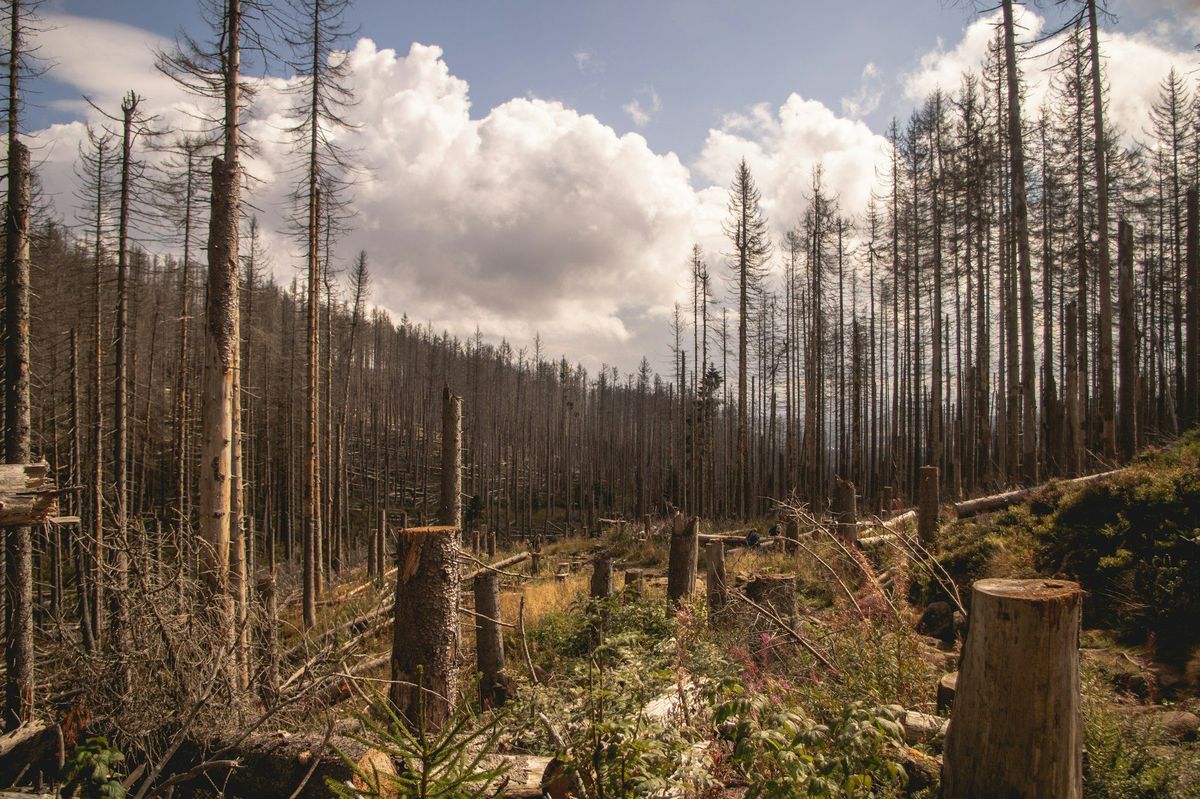
The fourth German forest inventory shows the result. Spruce lost 461,000 ha, 16.8% of its area, between 2012 and 2022, and 16% of its standing volume. For the first time in decades, the forest released more carbon than it absorbed: between 2017 and 2022 its carbon stock fell by 41.5 million tonnes, or 3%.2
For hardwood buyers, the effects are indirect. Salvage felling dominated forest work for years: from the winter of 2017/18 almost only calamity wood was cut, and thinning in undamaged stands was postponed.2 Spruce still dominates the German harvest. Of the 57.3 million m³ cut in 2025, 32.4 million m³ was spruce, fir, Douglas fir and other conifers, against 9.9 million m³ of beech and other broadleaves and 1.9 million m³ of oak.9,10 Our hardwood market report follows what happened to beech and oak log prices over the same years.
Where the forest is heading: broadleaves gain ground
While spruce shrank, broadleaves expanded. Broadleaved trees now cover 47% of Germany's timberland, against 43% in 2012. Beech grew by 130,000 ha (7.8%) to 1.8 million ha, or 16.6% of the forest; oak by 119,000 ha (10.6%) to 1.3 million ha, or 11.5%. The inventory attributes the increase mainly to active conversion to mixed forests for climate adaptation.2
The young forest points the same way. Mixed forest covers 79% of the area, 77% of stands have two or more layers, and 91% of the young trees grew from natural regeneration rather than planting.2 Beech and oak are therefore set to make up a larger share of Central Europe's forest, at the same time as both show drought stress. That is the tension the models try to resolve.
What the models project for beech and oak
Species distribution models link where a species grows today to the climate there, then ask where that climate will exist under future scenarios. They are useful for direction, and weak on detail, because they leave out soils, competition, management and the ability of trees to adapt. The results below are projections under named scenarios, not forecasts.
Beech: a "winner" in one model, a large loser in another
A widely cited study modelled 12 European tree species for 2061–2080 under three emission scenarios. It classed beech, ash, pedunculate oak, sessile oak and silver fir as "winners", mostly late-successional species, and birch, larch, spruce and Scots pine as "losers". The authors added that if species cannot migrate, most of them would lose a large part of their suitable area.5
A 2022 climate-envelope study came to a different result for beech. Compared with 1961–1990, it projected that by 2071–2100 beech could lose 58% of its climate envelope under the moderate RCP4.5 scenario and 82% under the high-emission RCP8.5. Sessile oak lost 31% and 48%, pedunculate oak 16% and 30%. Turkey oak gained 43% under RCP4.5, and downy oak gained under both scenarios.6
Show the data
| Moderate scenario (RCP4.5) | High-emission scenario (RCP8.5) | |
|---|---|---|
| Beech | 42% | 18% |
| Sessile oak | 69% | 52% |
| Pedunculate oak | 84% | 70% |
| Hungarian oak | 71% | 19% |
| Turkey oak | 143% | 94% |
| Downy oak | 147% | 159% |
| Norway spruce | 60% | 25% |
Projection, not a forecast: a climate envelope is where today's climate of a species will still occur, not where the species will actually grow. Source: Illés, G. Z. & Móricz, N. (2022), Climate envelope analyses suggests significant rearrangements in the distribution ranges of Central European tree species, Annals of Forest Science 79:35, table 4.
Growth is a separate question from range. A study of 5,800 beech trees on 324 sites across the species' range found growth declines over large areas in recent decades. It projects declines of 20% to more than 50% by 2090, depending on region and scenario, with the largest losses towards the southern edge of beech's range.11
Why the models disagree
The studies use different methods, data, climate models and assumptions about migration. The 2022 authors point out that a third study projected beech losses of 56% and 70% for 2061–2080, close to their own result, and that several studies expect sessile oak to keep producing timber even in drier areas, though with loss of vitality.6 The broad message holds across them: beech and spruce are more exposed than the oaks, and drought-tolerant southern oaks gain. How much and where remains uncertain.
What it could mean economically
A study in Nature Climate Change estimated that by 2100, depending on the scenario, 21–60% of Europe's forest land (mean 34%) could become suitable only for a Mediterranean oak forest type with low timber returns. Without countermeasures, it put the loss in value of European forest land at 14–50% of today's value.12 The study is a scenario analysis, and it assumes no effective adaptation; that assumption is exactly what forest owners are now trying to change.
Adaptation: mixed stands and assisted migration
Forest managers have two main levers. The first is mixing species, so that the failure of one does not empty a stand. Germany supports this through joint federal and state funding for climate-resilient mixed forests and the federal programme for climate-adapted forest management (Klimaangepasstes Waldmanagement).1
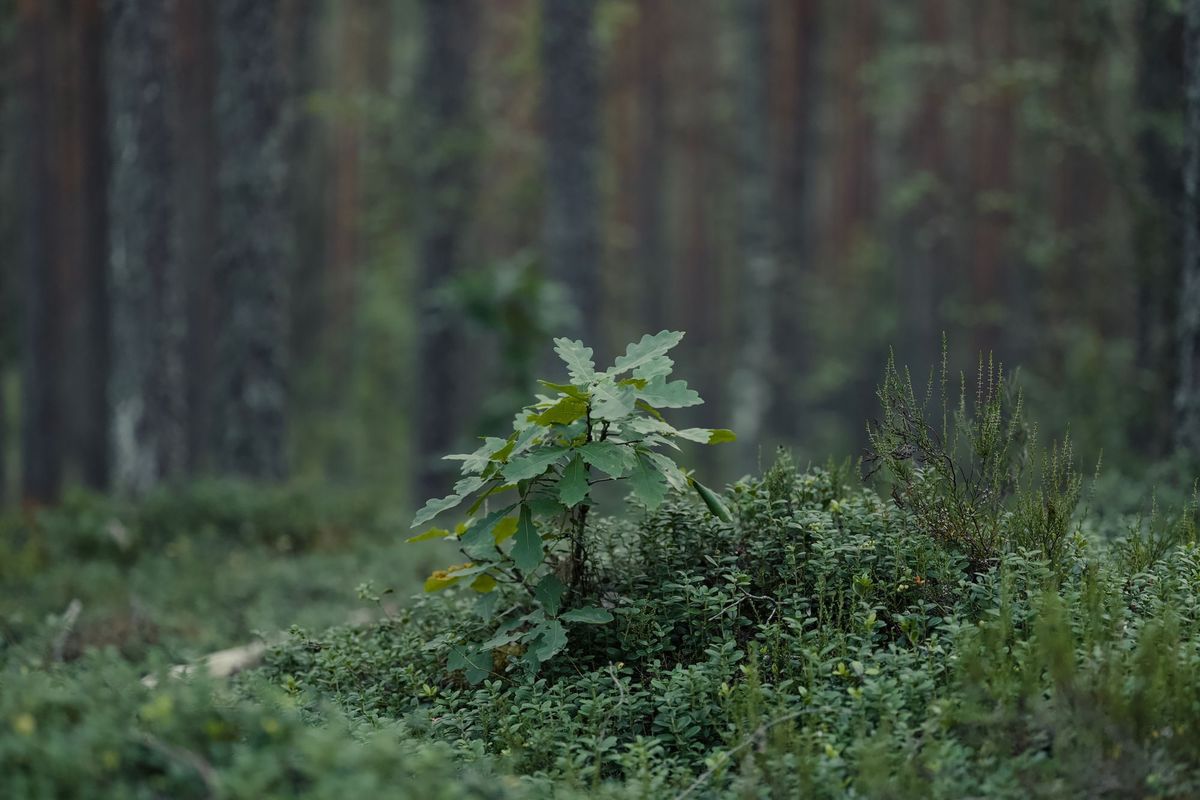
The second lever is seed origin. "Assisted migration" means planting seed sources, or species, from warmer and drier regions where the future climate is expected to resemble theirs. In the EU, the trade in seeds and seedlings for forestry is regulated. The new Regulation (EU) 2026/1392 on forest reproductive material was published in the Official Journal on 26 June 2026 and replaces the 1999 directive.13 During the legislative process, the proposal required basic material to be well adapted to climatic and ecological conditions, and allowed Member States to draw up contingency plans for seed supply after extreme weather, fires or pest outbreaks.14 How far the regulation will allow seed sources to move across regions in practice is something forest owners will learn as it is applied.
For the timber trade, the important point is the time lag. A beech or oak planted in 2026 reaches sawlog size late in this century. Decisions taken now shape supply in the 2080s and later, not in the next decade.
Romania's position: Carpathian beech, oak in the south and east
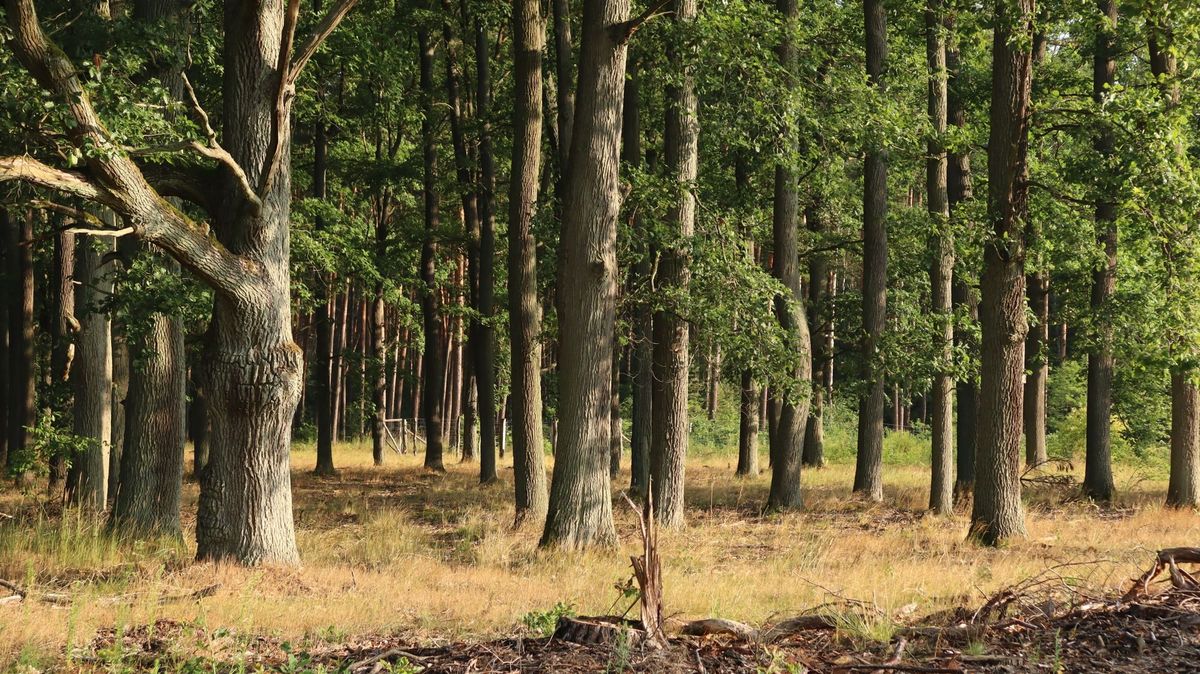
Romania is a beech-and-oak country. According to the third National Forest Inventory (IFN), beech covers 35.8% of the forest area and oaks 18.1%. Beech grows about 8.7 m³ per hectare a year and oaks about 6.3.15 Beech dominates the hills and mountains of the Carpathians; the oaks, including Turkey oak (cer) and Hungarian oak (gârniță), grow mainly in the plains and low hills.
The observed data so far are mixed. Romania's national crown survey, reported to ICP Forests, found 12.0% of broadleaved trees moderately to severely defoliated in 2024, against 13.9% in 2015.3 A 2026 comparison of Romanian and Serbian plots for 2020–2024 found mean defoliation of 15–16% in Romania, more crown damage in the dry years 2022 and 2024, and the highest defoliation among broadleaves in oaks and poplars, while beech proved more resilient.16
The climate is warming quickly. Romania's meteorological service reported 2024 as the warmest year since measurements began, with a mean of 12.99 °C, 2.72 °C above the 1991–2020 average; the five warmest years since 1900 were 2024, 2023, 2019, 2020 and 2022.17 In December 2025, a researcher from the national forestry research institute told the national news agency that the drying of trees had intensified in 2025. The most affected areas moved from the west in 2024 to the east and south in 2025, and in some counties the volume of drying trees reached 280,000 m³.4 These are reports, not yet inventory results; the next national surveys will show how large the effect is.
The model results above have a particular meaning for Romania. Turkey oak, common in Romania's lowland oak forests, gains climate space in the 2022 study under the moderate scenario, while Hungarian oak and beech lose.6
What it means for beech and oak supply over 10–30 years
No study we found forecasts hardwood timber supply or prices for 2035–2055, and we do not attempt one. What the evidence does support is a set of plausible directions, which buyers can watch.
- More broadleaved timber in the long run. Inventories in Germany show a growing broadleaf share, and young stands are more mixed.2 Over decades, that means more beech and oak in the wood supply, and less spruce.
- Uneven quality in the short run. Drought-damaged and salvaged trees reach the market earlier than planned. In Germany, damaged wood still made up about 22% of the 2025 harvest, by our calculation from the official figures, after the record of 2020.9 Ask how and when logs were harvested.
- Pressure on beech at the dry edge. Growth declines are projected to be largest at the southern and lower edges of beech's range.11 Beech from higher Carpathian sites is less exposed than beech at its dry limit.
- Oak remains scarce and valuable. Oak grows more slowly than beech, and the most valuable oak species are under stress too.1,15 Lower-value oaks such as Turkey oak may become a larger share of the oak supply in the south-east.6
- New uses for beech. With less spruce, engineered beech products are getting more attention. Our article on beech in construction covers LVL and glulam.
How we source beech and oak at SARAL
Buying beech and oak in a changing climate: what to ask your supplier
- Species and origin. Ask which species, for oak which oak (pedunculate, sessile, Turkey), and from which region. The EU Deforestation Regulation requires the geolocation of the harvest plots in any case; our article on EUDR compliance covers the details and dates.
- Harvest date and log storage. Logs from salvage felling or long storage can develop stain and decay before sawing. Ask when the logs were felled and how long they waited.
- Grading rules. Ask which grading rules apply and whether defects typical of stressed trees, such as dead knots, decay or discolouration, are limited.
- Moisture content and drying. Drying quality matters more when the raw material varies. Ask for target moisture, tolerance and measuring method.
- Alternatives. Ask whether a species switch, for example from beech to ash or from oak to another oak, would meet your technical requirements, and test it before you need it.
- Certification and traceability. Ask for FSC or PEFC claims on the invoice if your customers require them, and for the documents that trace the wood to the forest.
Frequently asked questions
Why are beech trees dying in Europe?
The main cause in recent years was drought combined with heat, above all in 2018–2020, which damaged the water transport of trees and weakened them against fungi and insects. In Germany, the share of beech with clear crown thinning reached 55% in 2020 and was 38% in 2025.1,7 Most beech trees are not dying: mortality across all species was 0.3% in 2025. Their vitality, however, is lower than before 2018.1
Is oak more resistant to climate change than beech?
Most models give oaks a better outlook than beech, and drought-tolerant oaks such as Turkey and downy oak gain climate space.5,6 Observed crown condition does not show oak as healthier, though: in Germany's 2025 survey oak had the highest crown thinning of the main species.1 Oak copes with drought better in the long run, but it is under stress now.
Are Romania's beech forests affected by climate change?
Romania's national crown survey shows broadleaf defoliation of about 12% in 2024, with no upward trend since 2015.3 Reports from 2024 and 2025 describe more drying in some regions, and 2024 was Romania's warmest year on record.4,17 Models expect beech to be most exposed at the lower, drier edge of its range.11
Will hardwood prices rise because of climate change?
No study we found forecasts hardwood prices from climate effects. What is documented is a shift in forest composition, from spruce to broadleaves, and a projected long-term loss in forest land value if forests are not adapted.2,12 Prices also depend on demand, energy and trade, which our market report covers.
What is the Waldzustandsbericht?
It is Germany's annual forest condition report, published by the federal agriculture ministry and calculated by the Thünen Institute. It has measured crown thinning on a national grid of sample trees since 1984. The 2025 report found mean crown thinning of 25.2% across all species.1