How a log becomes boards: the sawyer's choices
A sawyer cannot change what grew in the tree, but he decides how each board is cut from it. Turning the log against the blade sets the angle at which the growth rings meet the face of every board, and that angle decides how the board looks, how much it moves and how it behaves in the kiln.1 The same choices also decide how much of the log ends up as timber and how much as slabs, edgings and sawdust.
Two other terms come up in every order. Unedged boards keep the natural, often bark-covered edges of the log; edged boards have both edges sawn square. Live-sawn logs give mostly unedged boards, which are edged later or sold as they are. And boards that contain the pith, the centre of the tree, are a special case: wood near the pith often shrinks more along its length, which makes it prone to warp.7

Plain sawn, quarter sawn and rift sawn: definitions by ring angle
The US Forest Products Laboratory (FPL) defines the cuts by the angle between the growth rings and the wide face of the board. In commercial practice, lumber with rings at 0–45° to the wide face is plain sawn (also called flat sawn), and lumber with rings at 45–90° is quarter sawn. Hardwood with rings at 30–60° is sometimes called bastard sawn.1 Real boards are rarely pure: the FPL notes that the surfaces near the edges of a plain-sawn board are often far from tangential to the rings, and quarter-sawn lumber is not usually cut exactly parallel to the rays.1
Rift sawn in the grading rules
"Rift sawn" is a trade term rather than a scientific one, and its most precise definition comes from flooring. The US National Wood Flooring Association grading rules define quartered characteristics as rings at 45–90° to the face, mostly straight grain lines and ray flecks wider than 1.59 mm; rift characteristics are rings at 30–60°, straight grain and ray flecks narrower than 1.59 mm. Flooring sold as quarter sawn must show quartered character on at least 50% of each piece; rift sawn needs rift character on at least 75%. Plain sawn flooring may contain any mix.2 The FPL's Wood Handbook uses the same categories for US oak flooring.8
| Plain sawn (flat sawn) | Rift sawn | Quarter sawn | |
|---|---|---|---|
| Ring angle to the wide face | 0–45° | 30–60° | 45–90° |
| US flooring rule (NWFA) | Any mix of cuts | Rift character on ≥75% of each piece | Quartered character on ≥50% of each piece |
| Ray fleck in oak (NWFA) | – | Narrower than 1.59 mm | Wider than 1.59 mm |
| Shrinking and swelling in width | Largest | In between | Smallest |
| Shrinking and swelling in thickness | Smaller | In between | Larger |
| Cupping, surface checks, splits | More | In between | Less |
| Collapse in drying | Less susceptible | – | More susceptible |
| Figure | Growth-ring figure | Straight, even grain lines | Ray figure ("silver grain" in oak) |
| Cost | Lower: easy to obtain | Higher | Higher |
The FPL compares only plain and quarter sawn; the rift column's "in between" entries are inferred from geometry. The FPL calls 30–60° "bastard sawn". Source: Wiedenhoeft & Eberhardt (2021), Wood Handbook FPL-GTR-282, chapter 3 and Table 3-1; NWFA/NOFMA (2018), International Standards for Unfinished Solid Wood Flooring, oak grain descriptions.
Ray fleck and silver grain in oak
Oak has unusually large rays, ribbons of cells that run from the pith towards the bark. When a board is cut close to the radius, the saw slices along these rays and they appear on the face as bright flakes, the "silver grain" or ray figure of quarter-sawn oak. The FPL lists ray figure among the advantages of quarter sawing; plain sawing instead brings out the figure of the growth rings.1 In a rift-sawn board the rays are cut at an angle, so the fleck is reduced to narrow streaks, which is exactly how the flooring rules separate the two.2
The same cuts in German and Romanian
Terminology does not translate one to one. In German, a Riftschnitt is a radial cut with the rings standing nearly perpendicular to the face, which corresponds to English quarter sawn; Halbrift describes the intermediate angles that English calls rift; and Fladerschnitt is plain sawn.9 Romanian uses debitare radială for quarter sawn, semiradială for rift and tangențială for plain sawn. When you order across languages, specify the ring angle, not just the name.
Stability: why quarter-sawn timber moves about half as much in width
Wood shrinks and swells about twice as much along the growth rings (tangentially) as across them (radially).10 In a plain-sawn board the width runs roughly along the rings, so the width moves with the larger, tangential coefficient. In a quarter-sawn board the width runs across the rings and moves with the smaller, radial one.
The Bavarian State Institute of Forestry (LWF) gives the change per percentage point of moisture content for European species: beech 0.41% tangential and 0.20% radial, oak 0.36% and 0.16%, ash 0.38% and 0.21%.3,11 For a 300 mm wide board, a common width for a stair tread or a table lamella, going from 8% to 12% moisture content between a heated winter and a humid summer, that gives:
Rift-sawn stock falls in between. The FPL adds that plain-sawn lumber has its own advantage: it shrinks and swells less in thickness.1 Our article on wood moisture content and EMC shows how to calculate movement for any width and climate.
Drying behaviour
The cut also changes how a board dries. Moisture moves somewhat faster in the radial direction than in the tangential one, which is why plain-sawn lumber generally dries faster than quarter-sawn.12 But plain-sawn faces are where drying checks open, because the junction between rays and fibres is weak on the tangential face and tangential shrinkage is greatest. Quarter-sawn lumber cups, surface-checks and splits less in seasoning and in use, while plain-sawn lumber is less susceptible to collapse.1,7 The drying defects article explains these mechanisms.
Sawing patterns: live, cant and quarter sawing
Ring angles describe single boards. A sawing pattern describes how a whole log is broken down, and therefore which mix of angles it produces.4
- Live sawing (through-and-through) slices the whole log in parallel cuts. It is simple and often gives the highest volume of lumber, but the boards are a mix: those from the middle of the log have steep rings over much of their width, those from the outside are plain sawn and prone to distortion.
- Cant sawing first saws the log into a square-edged block, the cant, and then cuts the cant into boards. In a study of beech logs summarised by Marčeta and colleagues, cant sawing gave the highest quantitative yield, 84%.
- Quarter sawing first splits the log radially, then cuts boards from each quarter. In the same beech study it gave the highest qualitative yield, up to 62.7% radial wood, at the cost of volume and labour.
- Hybrid methods such as the Croatian "Slavonian method", a modified quarter sawing for oak, aim to maximise radial boards; compared with live sawing on lower-grade oak logs, it gave less raw volume but better quality and value recovery.4
Sawing parallel to the bark helps too: lumber sawn that way is less likely to bow and twist than lumber cut at an angle to the bark, and boards with off-centre rings are more prone to crook.7
Yield: how much of a log becomes lumber
Hardwood sawmilling recovers less of the log than softwood sawmilling, because hardwood logs are less regular and defects have to be cut out. For oak, published recovery rates generally range from about 40% to 60% of log volume, depending on log quality, sawing pattern and technology; a review by Pramreiter and colleagues found an average of about 46% for dried and planed lumber, with drying losses of about 6% and planing losses of about 13%.4
Log diameter and quality
Larger and better logs give more lumber. In a Serbian study of 90 European beech logs, each 4 m long, quantitative yield rose with both diameter and quality class, from about 49–53% for logs of 30–34 cm to 62–65% for logs of 40–49 cm.6
Show the data
| Log diameter | Quality class I | Quality class II | Quality class III |
|---|---|---|---|
| 30–34 cm | 52.7% | 49.6% | 49.4% |
| 35–39 cm | 57.7% | 54.7% | 52.0% |
| 40–49 cm | 65.2% | 64.5% | 62.0% |
Source: Popadić, Furtula & Milić (2019), BioResources 14(3), 6331–6340, Table 1 (yield based on Huber log volume).
Volume yield and value yield
Volume is only half the story. Researchers distinguish quantitative yield, the share of log volume that becomes lumber, from qualitative and value yield, the share that meets a grade and the share of the log's potential value actually realised.4 Two oak studies show the trade-off:
- Live sawing of pedunculate oak on a modern vertical band saw line gave about 57.3% volume yield, about 88% quality yield, but only about 50% value yield, because part of the volume ended up in lower grades.4
- Mainly quarter-sawn Galician oak gave about 47.6% recovery by volume; the authors argued that the added value of quarter-sawn timber justified the loss.4
The two studies used different logs and methods, so the gap between them is an illustration, not a measured penalty. A trade figure that is often quoted comes from wood technologist Gene Wengert, who reported that quarter sawing lowers lumber yield from the log by 15% or more and can increase sawing time by about 20%.13 Finished products are lower still: in a modern Bosnian oak flooring mill with a band headrig and CNC optimiser, overall product recovery was about 30% of the debarked log volume, with about 70% residues.4
Why the saw matters: band saw, circular saw and frame saw
Every cut turns a strip of wood the width of the kerf into sawdust. The narrower the kerf, the more timber a log gives, and the difference adds up quickly because a log is cut many times.
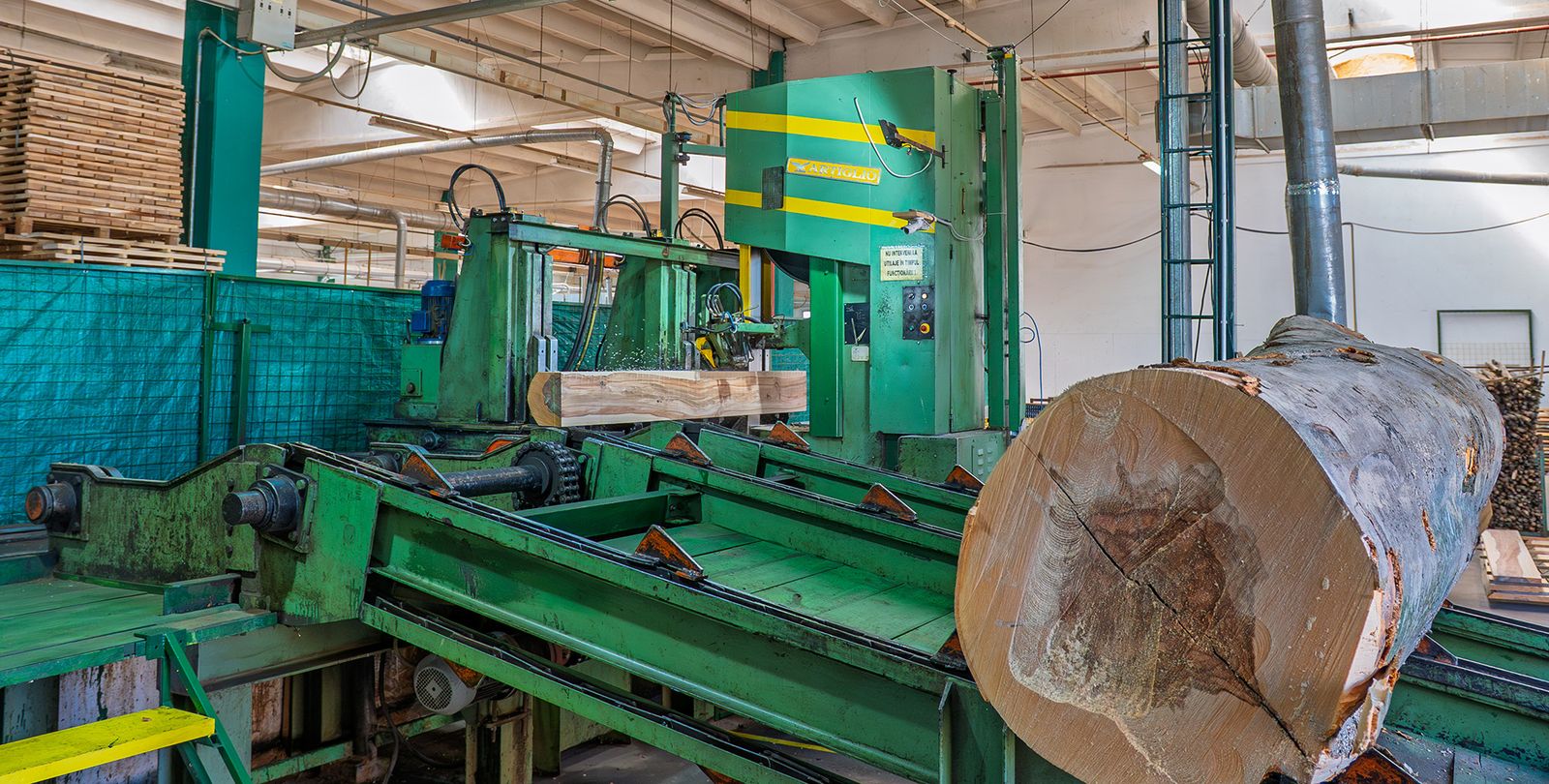
A 2026 review of oak sawmilling gives typical kerf widths: about 1.5–2 mm for modern thin-kerf band saws, 2.5–4.2 mm for frame saws (gang saws) and 3–5.5 mm for circular saws, the widest. Band sawmills also allow flexible log orientation and can handle large diameters, which the authors describe as ideal for high-quality oak.4 Note that the 1.5–2 mm figure is for thin-kerf bands; ask a sawmill what kerf its own line actually runs.
The US Forest Service put numbers on the same effect in the mid-1990s: a typical circular sawmill converted about 50% of the log into lumber, against about 57% for band mills, and kerf took about 21% of the log in circular mills against as little as 12% in high-production band mills. Sawing 28.6 mm boards with a 7.6 mm kerf turns about a fifth of the wood into sawdust; switching to a 3.6 mm band kerf raised recovery by about 10%.5
The saw also affects quality. A dull saw tears the surface and makes boards more likely to check in drying: in an FPL experiment, red oak planed before drying had 18 times less checking than rough-sawn boards.7
Price: why quarter-sawn and rift-sawn timber cost more
The FPL's comparison ends with a plain statement: plain-sawn lumber costs less because it is easy to obtain.1 Quarter-sawn and rift-sawn boards cost more for three reasons that follow from the sections above. A log yields less volume when it is quartered. Each log needs more turning and more cuts, so the saw line produces less per hour. And only part of the output meets the definition, so the boards have to be sorted by ring angle. Rift-sawn lumber, which needs steady 30–60° rings on most of each piece, comes only from a limited part of each log.2,4,13 We have found no reliable published European price premium, so compare quotes on a like-for-like specification.
Which cut for which product
- Table tops and wide panels. Width movement is the main risk, so quarter- or rift-sawn lamellas give the calmest tops. Plain-sawn lamellas show the strongest grain figure. In an edge-glued panel, mixed orientation is common; its movement falls between the two.
- Stair treads and flooring. Quarter- and rift-sawn boards move less in width, and raised grain caused by separation of the annual rings is less pronounced on them, which matters on a walking surface.1
- Chair parts and legs. Straight grain matters more than figure, and rift- and quarter-sawn stock is defined by grain lines that run mostly parallel to the length of the piece.2
- Cladding and lambriu. Plain-sawn boards are usually fine and show the most figure; profiles and fixings should allow for the larger width movement.
- Visible oak furniture. Choose between ray figure (quarter sawn) and growth-ring figure (plain sawn) as a design decision, and specify it.
How we saw at SARAL
How to specify the cut: a checklist for buyers
- Ring angle, not only the name. Write "rings at 45–90° to the face" or "30–60°" rather than "quarter" or "rift", especially when the order crosses languages.
- Share of each piece. Say how much of each piece must meet the angle, for example the NWFA's 50% for quartered and 75% for rift character.
- Ray fleck. For oak, say whether you want the silver grain or want to avoid it.
- Edged or unedged, and pith. State whether boards should be edged, and whether boxed pith is acceptable.
- Grade and moisture content. Name the appearance grade and the target moisture content with a tolerance. Ring orientation does not replace either.
- Volume and lead time. Quarter- and rift-sawn stock yields less per log. Larger, early orders are easier to fill.
Frequently asked questions
What is the difference between rift sawn and quarter sawn?
The ring angle. Quarter-sawn boards have rings at 45–90° to the face and, in oak, wide ray fleck; rift-sawn boards have rings at about 30–60° and only narrow fleck, which gives a straighter, more uniform grain.2 In German, "Rift" means quarter sawn and "Halbrift" means rift sawn.9
Is quarter-sawn oak more stable?
Yes, in width. Quarter-sawn oak shrinks and swells less in width and cups, checks and splits less in drying and use.1 With European values, its width movement is less than half that of plain-sawn oak for the same change in moisture content.3
Why is quarter-sawn oak more expensive?
Because a quartered log gives less volume, takes longer to saw and has to be sorted by ring angle. Plain-sawn lumber costs less because it is easy to obtain.1,4,13
Band saw or circular saw: which sawmill gives more timber?
Usually the band saw, because its kerf is narrower. US Forest Service figures from the 1990s show about 57% of the log converted to lumber in band mills against about 50% in circular mills.5 Band mills can also turn and handle large logs flexibly.4