

Oak, beech or ash? The short answer by application
If you only need the conclusion, here it is. Beech (Fagus sylvatica) is hard, strong, stiff, even-grained and bends beautifully with steam, but it moves a lot with changes in humidity and has no natural resistance to decay. Ash (Fraxinus excelsior) is just as hard, very tough and shock-resistant, with a bold grain that resembles oak. Oak (Quercus robur and Q. petraea) is a little softer on the standard hardness tests, but it is the only one of the three whose heartwood resists rot, and it moves less than beech.1,2,3,6
That gives a simple rule of thumb. For chairs, frames and bent parts, beech or ash. For stair treads, tables and pieces where the grain is the design, oak, ash or beech depending on the look. For anything that may get wet, oak heartwood. Lime and cherry are specialists: lime for carving and turning, cherry for fine furniture with a warm colour. The rest of this article shows the data behind those choices.
Side by side: density, hardness, strength, movement and durability
The table below collects the main properties of the five European species. Most values come from The Wood Database, which gives one consistent set of figures per species at 12% moisture content (MC). German readers will know the DIN tables, published by the Bavarian forestry institute LWF and the timber trade portal Holz vom Fach; their values sit close to the Wood Database figures and fill in the Brinell hardness and in-service movement that the American-style data lack.1,4,8
| Property | Oak | Beech | Ash | Lime | Cherry |
|---|---|---|---|---|---|
| Density (kg/m³) | 675 | 710 | 680 | 535 | 600 |
| Janka hardness (N) | 4,980 | 6,460 | 6,580 | 3,100 | 5,120 |
| Brinell hardness ⊥ grain (N/mm²) | 34–41 | 34 | 28–40 | 13–20 | 31 |
| Bending strength, MOR (MPa) | 97.1 | 110.1 | 103.6 | 85.4 | 103.3 |
| Stiffness, MOE (GPa) | 10.6 | 14.3 | 12.3 | 11.7 | 10.6 |
| Tangential shrinkage, green to oven-dry (%) | 8.4 | 11.7 | 9.6 | 7.5 | 8.4 |
| Movement per 1% MC, tangential (%) | 0.36 | 0.41 | 0.27–0.38 | 0.24–0.32 | 0.26–0.33 |
| EN 350 durability class (heartwood) | 2 (–4) | 5 | 5 | 5 | 3–4 |
Source: Density, Janka, MOR, MOE and total shrinkage: Meier, The Wood Database (oak = Quercus robur, lime = Tilia × europaea, cherry = Prunus avium). Brinell and movement per 1% MC: DIN 68364 and DIN 68100 values via LWF Bayern (oak, beech, cherry) and Holz vom Fach (ash, lime). EN 350 classes: Holz vom Fach; cherry: LWF Bayern, 'in the literature'.
Two cautions. Wood is a natural material, so every one of these numbers is an average with a wide spread: Holz vom Fach gives the density of ash as 0.45–0.86 g/cm³, with a mean of 0.69.8 And the Wood Database figures for "European oak" are for Quercus robur, pedunculate oak. Sessile oak (Q. petraea) is traded as the same timber and German sources describe the two together.1,6
Density and hardness: Janka and Brinell explained
Beech is the densest of the three at about 710 kg/m³, with ash at 680 and oak at 675. Cherry (600) and lime (535) are noticeably lighter.1,2,3,10,11 Density is the best single predictor of hardness and strength, but it is not the whole story, as oak shows.
Two hardness tests are in common use, and their numbers must never be mixed:
- Janka, the North American test, records the force needed to press a steel ball 11.28 mm in diameter halfway into the wood. The result is a force in newtons or pounds-force.12
- Brinell, used in German and European tables, presses a ball into the wood and divides the force by the area of the dent. The result is in N/mm², and it is quoted separately along and across the grain.4
On Janka, ash (6,580 N) and beech (6,460 N) are about 30% harder than oak (4,980 N); even cherry (5,120 N) edges ahead of it.1,2,3,11 On the German Brinell values, measured across the grain, beech scores 34 N/mm² and oak 34–41, so the two are level, with cherry at 31.4 Holz vom Fach gives 28–40 N/mm² for ash and 23–42 for oak.6,8 Lime, at 13–20 N/mm², is roughly half as hard as the other species.9
The practical point: "oak because it is the hardest" is a myth. If dent resistance is the deciding factor, for a table top that will take a lot of knocks or a busy stair, beech and ash are at least as good. Oak's case rests on other properties.
Bending strength and stiffness: why beech and ash win for chairs
A chair leg or a back rail is loaded in bending. Here beech leads: the Wood Database gives it a bending strength (modulus of rupture, MOR) of 110 MPa and a stiffness (modulus of elasticity, MOE) of 14.3 GPa, against 104 MPa and 12.3 GPa for ash and 97 MPa and 10.6 GPa for oak.1,2,3 The German DIN 68364 values point the same way: a bending strength of 120 N/mm² for beech against 95 N/mm² for oak, and a stiffness of 14,000 against 13,000 N/mm².13
Ash adds toughness. The Wood Database calls it shock resistant with good strength for its weight, and Holz vom Fach lists the typical uses that need exactly that: sports equipment, tool handles, ladders and oars.3,8 For a slim chair spindle, a bentwood rail or a part that will be knocked repeatedly, beech and ash are the engineering choice; oak is chosen for those parts mainly for its look.
Movement and stability: why beech moves most
Every hardwood shrinks as it dries and swells as it takes up moisture, and it does so about twice as much across the growth rings (tangentially) as along the radius. From green to oven-dry, beech shrinks 11.7% tangentially, ash 9.6% and oak 8.4%; cherry matches oak and lime shrinks least at 7.5%.1,2,3,10,11
Show the data
| Tangential | Radial | |
|---|---|---|
| European beech | 11.7% | 5.8% |
| European ash | 9.6% | 5.7% |
| European oak (Q. robur) | 8.4% | 4.7% |
| Sweet cherry | 8.4% | 5.1% |
| European lime | 7.5% | 5.0% |
Source: Meier, The Wood Database, species pages. German DIN 68100 values (via LWF Bayern) give beech 11.8 / 5.8% and oak 7.8–10.0 / 4.0–4.6%.
Total shrinkage matters in the kiln. In the finished piece, what counts is the movement per percentage point of moisture change in the range of normal use (5–20% MC). DIN 68100 gives beech 0.41% per point tangentially and 0.20% radially, against 0.36% and 0.16% for oak.4 Holz vom Fach gives ash 0.27–0.38% tangentially and lime 0.24–0.32%.8,9
Those small numbers add up. US guidance for interior woodwork aims at an average of 8% MC, with individual pieces anywhere between 6% and 10%.14 A four-point swing between a humid summer and a heated winter is therefore realistic. Take a 200 mm flat-sawn board through it and the difference between species becomes visible.
Show the data
| Width change | |
|---|---|
| Beech | 3.3 mm |
| Oak | 2.9 mm |
| Ash | 2.6 mm |
| Cherry | 2.4 mm |
| Lime | 2.2 mm |
Ranges taken at their midpoint. Real boards are rarely perfectly flat-sawn, so actual movement is usually a little smaller. Source: Calculated as 200 mm × tangential movement per 1% MC × 4. Coefficients from DIN 68100 via LWF Bayern (beech 0.41, oak 0.36, cherry 0.26–0.33) and Holz vom Fach (ash 0.27–0.38, lime 0.24–0.32).
Beech is not unstable, but it needs more care: dry it to the right moisture content, allow for movement in table tops and panels, and prefer quarter-sawn or narrow lamellas for wide glued surfaces. The beech guide goes into the details.
Durability: EN 350 classes and why only oak heartwood goes outside
The European standard EN 350 rates the natural durability of wood against decay fungi on five classes, from 1 (very durable) to 5 (not durable).15 The classes apply to heartwood. For the species in this article, Holz vom Fach gives:
- Oak heartwood: class 2 (–4). Durable, but with a spread that can reach class 4. White oak is suitable for structural outdoor use.6
- Beech: class 5, including its red heart. Outdoors it needs preservative treatment or modification, such as thermo-beech.7
- Ash: class 5. Thermally modified ash (thermo-ash) gains enough durability and stability for outdoor use.8
- Lime: class 5.9 Cherry is put in class 3–4 in the literature.4
Is EN 350 changing? A revised draft, prEN 350:2026, was published in Germany as E DIN EN 350:2026-08 on 10 July 2026 for public enquiry. Its contents page shows the same structure as today: durability classes against fungi, beetles, termites and marine borers, and an informative annex with tables of heartwood durability for traded softwoods and hardwoods.16 Whether any individual species rating changes cannot be checked from public sources, because the draft text is sold, not published. Until the revision is adopted, EN 350:2016 applies, and the classes above are the current ones as of October 2026.
Workability, steam bending and gluing
All three main species work well with hand and machine tools, glue well and take finishes well, according to the Wood Database.1,2,3 The differences are in the details.
Steam bending
Beech responds "superbly" to steam bending in the Wood Database's words; ash and oak respond well.1,2,3 The most famous proof is Michael Thonet's chair No. 14 of 1859: six pieces of steam-bent beech, ten screws and two nuts, shipped in parts. By 1930, 50 million had been sold.5
Splitting, fastening and gluing
Oak splits easily, so holes for nails and screws should be pre-drilled.6 Beech and ash glue and machine cleanly.2,3 Lime is easy to carve but glues only moderately well because of its fat content, according to Holz vom Fach.9
Appearance, staining and finishing
Each species has its own look, and it often decides the choice before any number does.
- Oak is light to medium brown with an olive cast and a coarse texture. Quarter-sawn faces show the broad ray fleck ("silver grain") that makes oak instantly recognisable.1
- Ash is light to medium brown with a coarse texture similar to oak, and dark streaked heartwood is sometimes sold as olive ash.3 Stained, ash can pass for oak, but it lacks oak's wide visible rays. Look at a quarter-sawn face or the end grain if you need to know which is which.
- Beech is a pale straw colour with a fine, uniform texture, sometimes with a pink or brown hue; steamed beech is warmer and darker.2 Red heart, a coloured core that forms in older trees, is common and is graded separately.7
The iron-tannin trap with oak
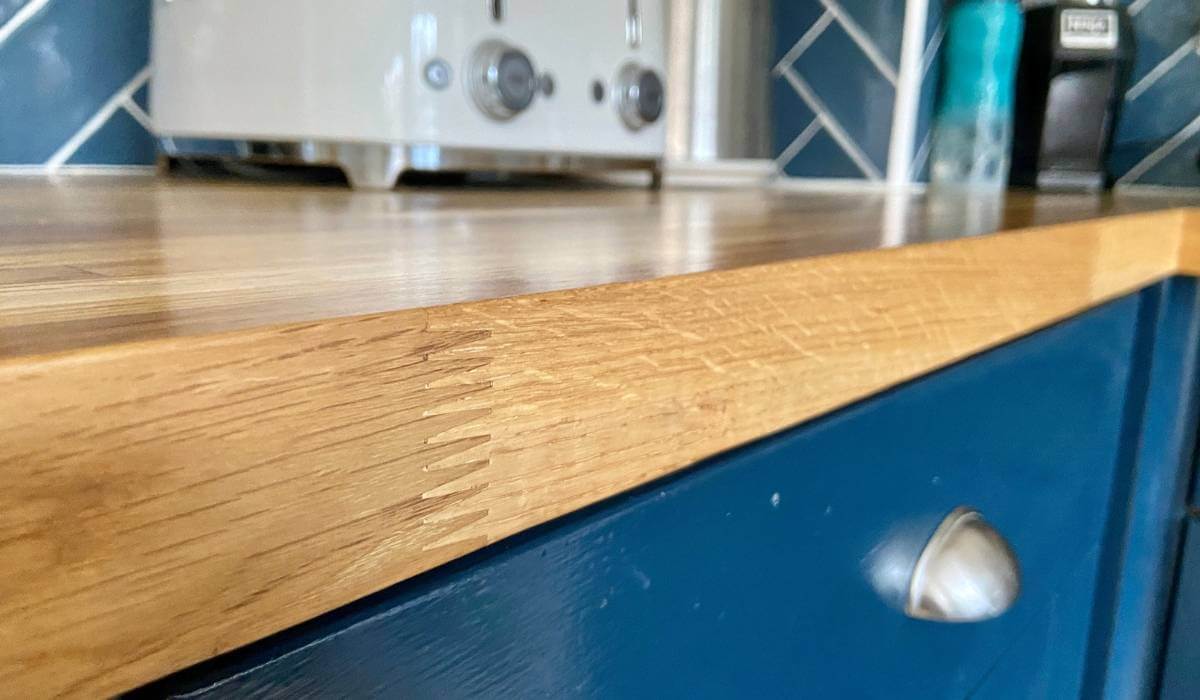
Oak is rich in tannins. When wet oak touches iron, the two react and leave blue-black stains, and the fasteners corrode.1,6 That matters for worktops near a sink, for outdoor oak, and in the workshop: steel wool on a water-based finish, wet steel clamps or iron filings are enough. Use stainless or coated fasteners and keep iron away from wet oak.
Where lime and cherry fit in
Lime (also called linden, Tilia) is the lightest and softest wood here, with a fine, even texture. That is exactly why carvers prefer it, and Holz vom Fach notes that in Europe it is used almost only for sculpture and carving.9,10 It is not a furniture wood for surfaces that take wear. Our linden carving guide compares it with American basswood.
Cherry (Prunus avium) is about as hard as oak on Janka (5,120 N), slightly softer on Brinell (31 N/mm²), moves about as much as oak and has a warm reddish colour.4,11 It is a fine-furniture wood rather than a structural one.
Typical uses: furniture, chairs, stairs, flooring and worktops
Chairs and bent parts
Beech first, ash second. Both have the bending strength, stiffness and steam-bending response that thin chair parts need, and both machine to crisp profiles. Oak chairs are common too, chosen mostly for their look and colour.
Tables and case furniture
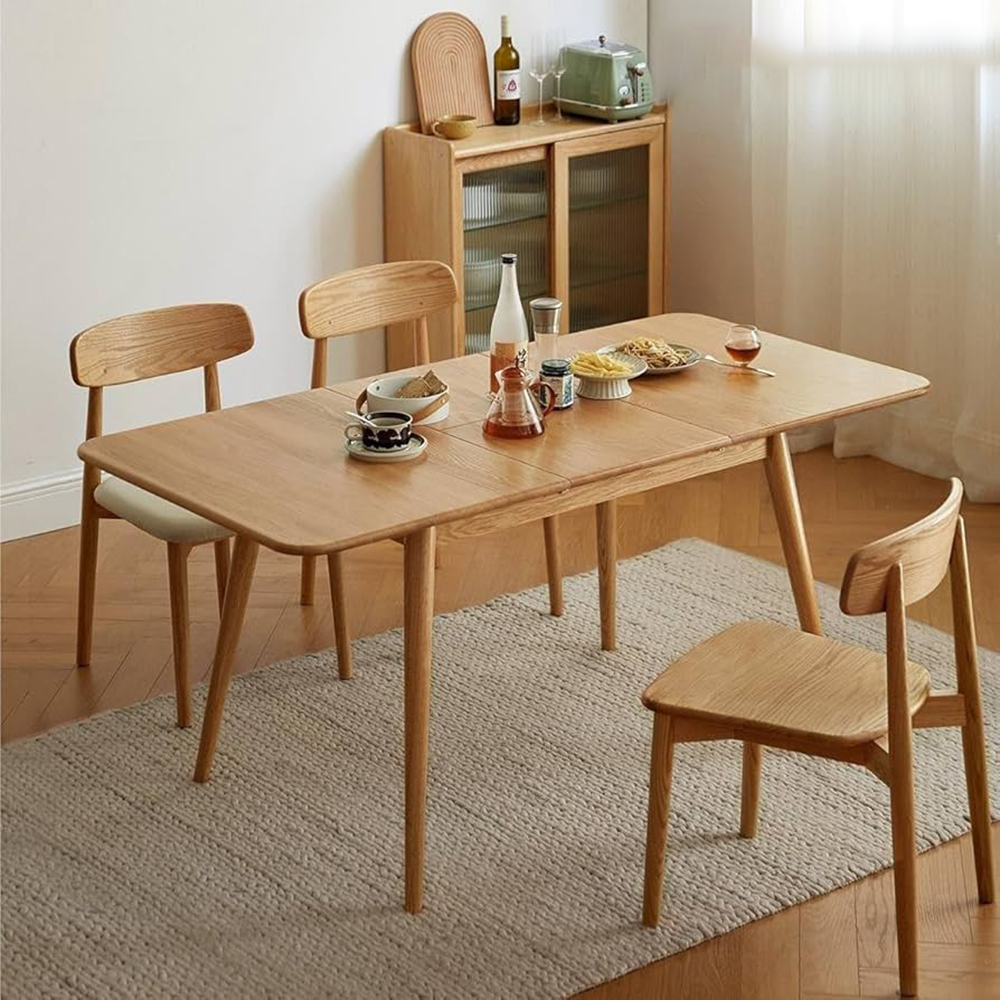
All three work. Oak gives the strongest grain and the least movement; beech gives a calm, even surface and the highest hardness, but wide beech tops need careful moisture control; ash gives an oak-like look with more hardness.
Stairs and flooring
Hardness favours beech and ash; stability and tradition favour oak. Oak's lower movement is an advantage in wide treads that sit next to a heated wall. Our article on solid oak stair treads covers thicknesses and finishes.
Worktops: oak or beech?
Beech is the harder surface. Oak copes better with moisture and moves less, but its tannins need iron kept away. Both need a sealed finish and regular care around the sink.
Outdoors
Oak heartwood only, or thermo-treated ash or beech. Untreated beech and ash have no place outdoors.6,7,8
Availability and price in Europe
For buyers in Central and Eastern Europe, availability follows the forest. In Romania, the third cycle of the National Forest Inventory (2020–2025) puts beech on 35.8% of the forest area and the oaks on 18.1%; ash belongs to the "other hard broadleaves" group with 16.4%, and lime to the soft broadleaves with 4.5%.17 Beech is therefore the most plentiful hardwood by far, which keeps it the economical choice.
No reliable public price list compares the species, and prices depend heavily on grade, thickness and drying. Two indicators help. The Wood Database expects ash to cost about the same as oak.3 And the German producer price index for state-forest logs (2015 = 100) stood at 129.2 for oak and 127.5 for beech in 2025: both well above 2015, and moving together.18 Ash supply is under pressure from ash dieback and, since 2026, the emerald ash borer, which the ash guide explains.
How we choose between oak, beech and ash at SARAL
Specifying the right species: a checklist
- Name the species, not just the colour. "Oak" should mean Quercus robur or Q. petraea, not red oak or stained ash. Ask for the botanical name on the delivery note.
- State the use. Indoor or outdoor, heated or unheated, and whether the part is loaded in bending. That decides between beech, ash and oak more than appearance does.
- Specify the moisture content and tolerance. Especially for beech. Ask how it was measured.
- Specify the cut. Quarter-sawn or rift-sawn lamellas move about half as much in width as flat-sawn ones, which matters for wide beech surfaces.4
- Agree the colour rules. Is red heart in beech allowed? Brown heart in ash? Sapwood in oak? These affect price as much as species does.
- For anything exposed to moisture, ask whether the supplier can guarantee heartwood oak or a thermally modified product, and keep iron away from oak.
Frequently asked questions
Is oak harder than beech?
No. On the Janka test European beech (6,460 N) is about 30% harder than European oak (4,980 N), and on German Brinell tables, across the grain, the two are about equal (beech 34 N/mm², oak 34–41 N/mm²).1,2,4
Is oak better than ash?
It depends on the job. Ash is harder (Janka 6,580 N against 4,980 N), stronger in bending and tougher, so it suits chairs, handles and bent parts. Oak heartwood is durable (EN 350 class 2) where ash is class 5, and oak moves a little less, so oak is better for anything that may get wet.1,3,6,8
Oak or beech for a worktop?
Beech gives a harder, more uniform surface; oak moves less and resists moisture better but stains black if wet oak meets iron. Both need a sealed finish. For a kitchen with a lot of water around the sink, oak is the safer choice.4,6
Oak vs ash for furniture: which looks more expensive?
Ash has a coarse texture similar to oak, and stained ash can pass for oak, but only oak shows broad ray fleck on quarter-sawn faces.1,3 Price in Europe is broadly similar.3