Linden, lime, basswood, tei, Linde: one genus, many names
The wood that carvers call lime in Britain, linden in much of Europe and basswood in North America comes from trees of the genus Tilia. In Romanian it is tei, in German Linde. The Wood Database notes that the genus is usually called lime or linden in Europe and basswood in the United States.2
Three species matter for timber:
- Small-leaved lime (Tilia cordata), the main timber lime of Central European forests.
- Large-leaved lime (Tilia platyphyllos). German research finds no significant difference in properties between the two, and their wood cannot be reliably told apart, so the trade does not distinguish them.1
- American basswood (Tilia americana), the North American species, which is lighter and softer.3
The Wood Database's "European lime" entry is for Tilia × europaea, a hybrid of the two European species.2 German foresters treat that hybrid mainly as a street and park tree, not a timber source, so in practice the lime you buy in Central Europe is mostly small-leaved lime.1 In Romania, lime is counted among the soft broadleaves, with poplar, willow, alder and birch, which together cover 4.5% of the forest area.7
Why carvers love linden: a fine, even, diffuse-porous wood
Lime is a plain, light-coloured wood, whitish to yellowish, sometimes with a reddish or light brown tint. Its sapwood and heartwood have the same colour, its pores are fine (70–90 µm across) and evenly spread through the growth ring, and the growth rings themselves are only weakly marked.1 For a carver that means one thing: the wood behaves the same everywhere. There are no hard latewood bands to deflect the gouge and no open pores to tear out.
The German forestry institute LWF sums it up: lime can be sawn and planed with no effort, and above all it can be carved and turned excellently in every direction.1 Holz vom Fach adds that it cuts well even across the grain, and that in Europe it is used almost only for sculpture and carving.5 The Wood Database calls European lime perhaps one of the most suitable species for hand carving.2
The numbers: density, hardness, strength and shrinkage
German DIN values put the mean density of lime at 530 kg/m³ (range 350–600) at 12–15% moisture, which makes it a medium-weight hardwood. It is tough but not very elastic, and of low strength.1 Its hardness is the key figure for carvers: 13–20 N/mm² across the grain on the Brinell scale, against 34–41 for oak and 34 for beech.1,4 On the North American Janka test, which measures the force needed to press a steel ball halfway into the wood, European lime scores 3,100 N.2,8
Lime shrinks quite a lot as it dries: from green to oven-dry, 5.5% radially, 9.1% tangentially and 14.4–14.9% in volume according to the DIN tables.1 The good news is the small difference between the radial and tangential values. Because of it, LWF notes, lime has good dimensional stability once it is dry and moves little with changes in humidity.1 Holz vom Fach is more cautious and rates its stability as rather moderate, because of its relatively high swelling and shrinkage values.5 In practice: dry it properly and it will stay put.
Five centuries of limewood masterpieces
Many of the most famous works of late Gothic sculpture, from the mid-15th to the mid-16th century, were carved in lime, above all by Tilman Riemenschneider and Veit Stoss. Lime was used so regularly for crucifixes and figures of saints that it was called lignum sacrum, holy wood.1
Riemenschneider and Veit Stoss
Riemenschneider's relief Mary Salome and Zebedee, carved around 1505–10 and now in the Victoria and Albert Museum, is limewood, mostly from a single piece. Instead of painting it in colours, the sculptor covered it with a translucent monochrome glaze, a treatment he used on many altarpieces.9 Veit Stoss's high altar in St Mary's Basilica in Kraków, 13 m high and 11 m wide and described by LWF as the largest medieval high altar, was carved from lime trees up to 500 years old; each of its shrine figures, up to 2.70 m tall, was made from a single trunk.1
Grinling Gibbons and the layered blank
In England, Grinling Gibbons made limewood famous for a different style: cascades of leaves, fruit and flowers. His overdoor from Cassiobury Park, carved around 1675–77 and also in the V&A, is limewood. The museum notes that lime's grain suits curved leaves, fruit and thin stems, and that the wood is soft but "elastic", uniform in structure and easier to cut across the grain than other hardwoods. Cassiobury was one of the earliest English houses decorated with limewood foliage instead of oak, and the carvings are built up from two or three layers of wood.10 That is the historical precedent for today's glued-up carving blanks.
The tradition continues. LWF lists nativity figures, carnival masks of the Swabian-Alemannic Fastnacht, marionettes, the carved fronts of cuckoo clocks and relief carving as current uses. It also notes older estimates of annual lime consumption of up to 5,000 m³ and says demand is clearly higher, so carvers often turn to Weymouth pine and Swiss stone pine instead.1
European lime vs American basswood: what changes for the carver
If you follow American carving books or videos, the wood in them is basswood. It is the same genus as European lime, but not the same material. The Wood Database gives basswood an average density of 415 kg/m³ and a Janka hardness of 1,820 N, against 535 kg/m³ and 3,100 N for European lime: lime is about 30% heavier and 70% harder on that test. Basswood is also weaker in bending (60 against 85 MPa) and shrinks more from green (9.3% against 7.5% tangentially).2,3
| Property | European lime (T. × europaea) | Basswood (T. americana) | Small-leaved lime (T. cordata), DIN |
|---|---|---|---|
| Density (kg/m³) | 535 | 415 | 530 (350–600) |
| Janka hardness (N) | 3,100 | 1,820 | – |
| Brinell hardness across / along grain (N/mm²) | – | – | 13–20 / 37–41 |
| Bending strength (MPa) | 85.4 | 60.0 | 90–106 |
| Stiffness, MOE (GPa) | 11.7 | 10.1 | 7.4 |
| Compression along grain (MPa) | 44.8 | 32.6 | 44–52 |
| Shrinkage green to oven-dry, radial / tangential / volumetric (%) | 5.0 / 7.5 / 12.0 | 6.6 / 9.3 / 15.8 | 5.5 / 9.1 / 14.4–14.9 |
| Tangential-to-radial ratio | 1.5 | 1.4 | about 1.6 |
| Natural durability | Non-durable | Non-durable | EN 350 class 5 |
The stiffness values differ widely between sources; treat them as indicative. Source: Meier, The Wood Database (European Lime, Basswood); Grosser & Ehmcke, LWF Wissen 78, tables 1–3 (DIN 68364:2003, Grosser & Zimmer 1998). T/R ratio for DIN column is for differential shrinkage.
What does that mean in the workshop?
- Tool pressure. Expect European lime to need a little more force and a keener edge than the basswood in an American tutorial.
- Detail. The firmer wood holds fine, crisp detail well, which is what Gibbons exploited.10
- Surface. Both are soft enough to leave a fuzzy surface with blunt tools; the Wood Database recommends sharp cutters for European lime for exactly that reason.2
Linden vs alder, pine, cherry, walnut and oak for carving
Lime sits at the soft end of the hardwoods. On the Janka test it is harder than basswood, Scots pine and European alder, and much softer than oak, cherry and walnut.2,3,11 The German Brinell figures tell the same story.1,4
Harder woods are not worse for carving, but they ask more of the carver and the tools. Oak is coarse and splits easily; walnut and cherry carve beautifully but are denser and harder.11 Lime's combination of softness, even texture and clean cuts in all directions is why LWF concludes it is offered wherever a light, soft, cleanly workable or easily coloured wood is needed.1 In period furniture, lime is even carved and coloured to imitate walnut and cherry for mouldings, leaf carvings and panels.1 For the structural species, see our comparison of oak, beech and ash.
Drying linden without stains and checks
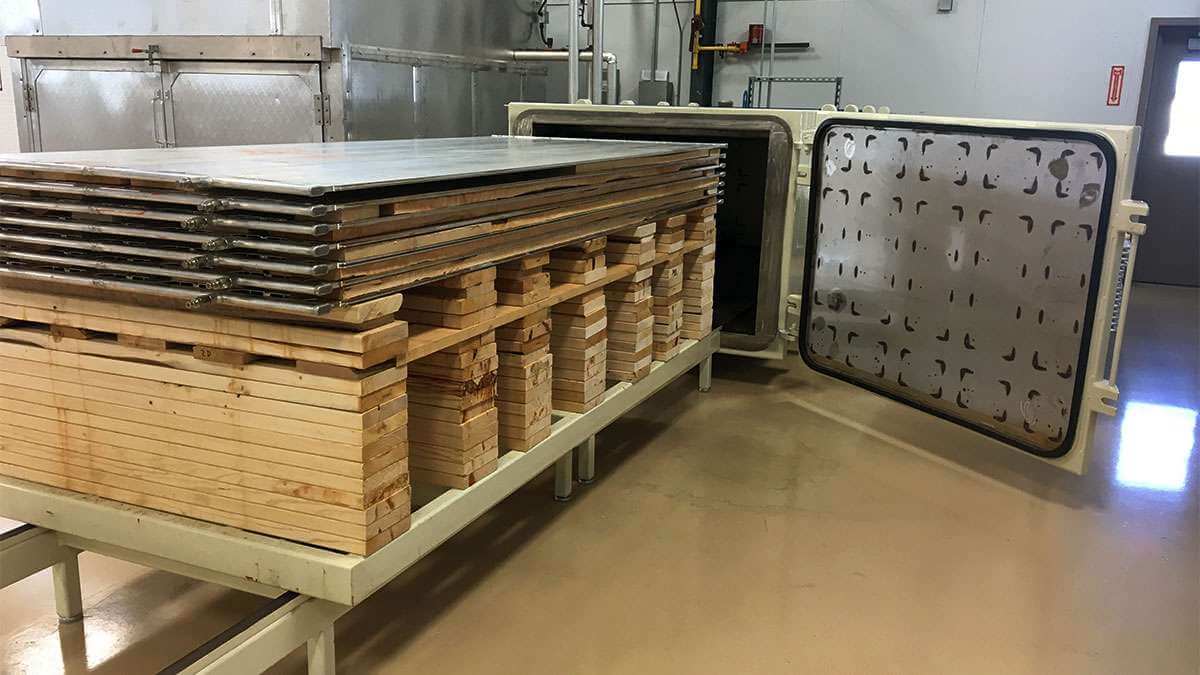
Lime is an easy wood to dry. The US drying manual for hardwoods lists basswood among the easy-to-dry species and says low-density woods like it dry with few or no serious defects.12 Holz vom Fach confirms that lime generally dries well, but warns that it tends relatively easily to checks and stains.5 Both are true, and they point to the two risks to manage.
Stain: keep it moving, keep it cool
Lime is a "white" wood, and its value lies in its pale colour. In warm, humid, still air, white woods discolour. The US manual notes that in most pre-dryers the conditions needed to keep basswood, maple and ash white cannot be reached in summer, that white woods are dried with higher air speeds, and that lower kiln temperatures give brighter, whiter wood.12 For green 25 mm American basswood it gives a minimum of about 6 days in a conventional kiln on a schedule that allows slight browning, and about 9 days on a gentler schedule for light colour.12 Lime also stains grey-black where it touches iron while damp, so keep steel stickers, clamps and filings away.1,5
Checks: thick blanks need patience
Thick carving blocks dry slowly from the outside in, and the dry shell shrinks over a wet core. That is when end and surface checks open. Seal the end grain, stack with stickers, keep the pile out of sun and wind, and give thick blocks time. Our kiln drying guide explains drying rates and schedules in detail.
Choosing and preparing carving blanks
Moisture content
A carving dried only in the yard keeps shrinking indoors. US guidance for interior woodwork aims at an average of 8% moisture content, with individual pieces between 6% and 10%.6 Ask for blanks dried to the moisture of the room where the piece will live, and let them acclimatise in your workshop before you start. Our article on wood moisture content explains how to measure and specify it.
Grain orientation
Lime's ratio of tangential to radial shrinkage is low, about 1.5 to 1.6, so it distorts less than beech or oak when it dries.1,2 Even so, avoid the pith, which tends to split, and orient the blank so that thin, projecting details run along the grain.
Glued-up blanks
For large figures, laminated blocks reduce the risk of checks in the core and save wood, as Gibbons' layered carvings show.10 Be careful with the glue, though: LWF describes lime's bond strength as partly unsatisfactory, and Holz vom Fach rates its gluing as only moderate because of its fat content.1,5 Plane surfaces fresh before gluing and test the adhesive on offcuts.
Beyond carving: turning, toys, models and laser work
Lime's evenness serves many other trades. LWF lists turning, marionettes, architectural models, picture and mirror frames, toys, drawing boards, hat blocks, and the inner frames of beehives, where its low movement and softness are the point.1 The Wood Database adds veneer, plywood, cutting boards and turned objects.2
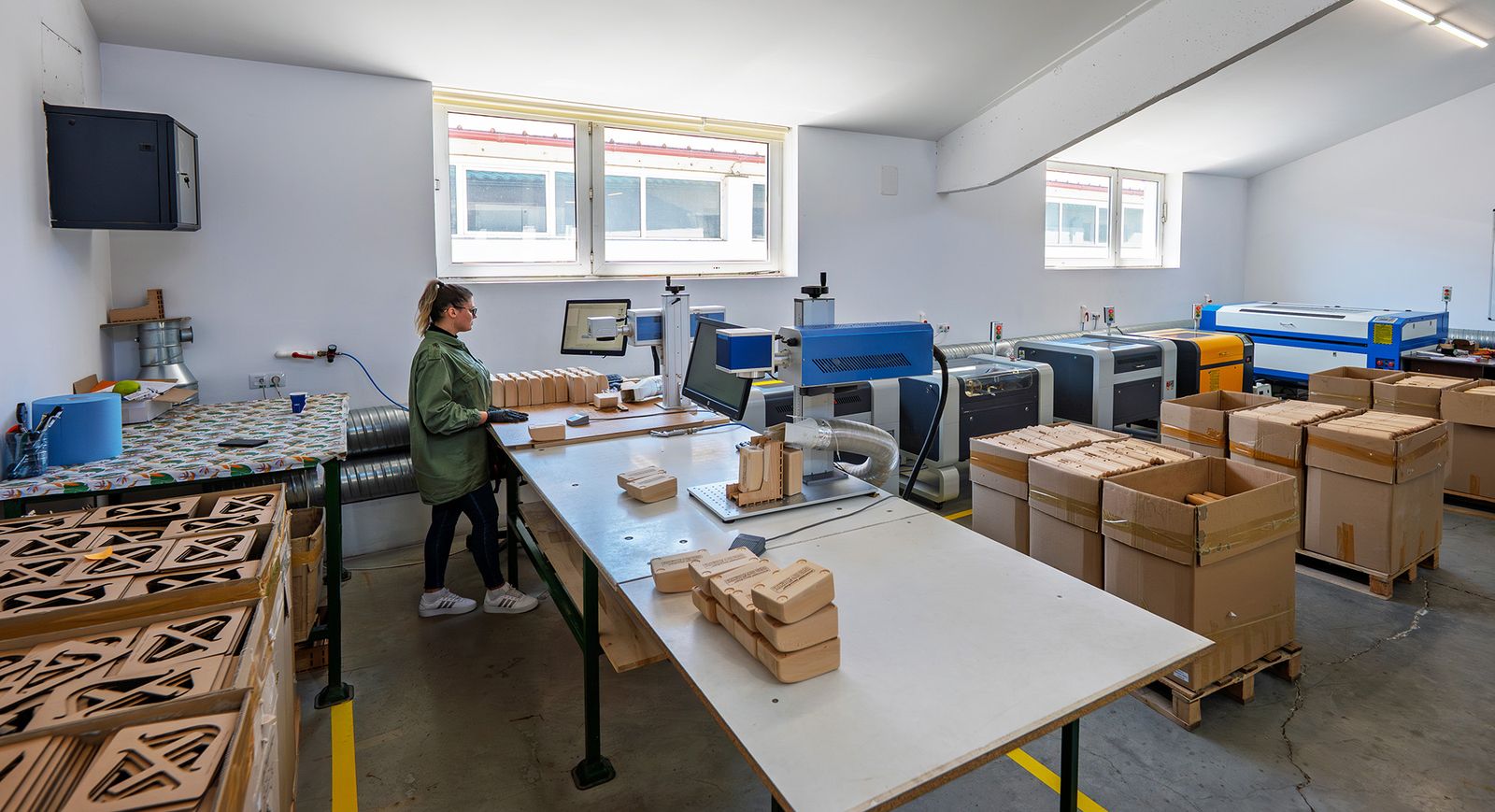
Laser engraving is another way to decorate wood. At SARAL we offer laser cutting and engraving and CNC machining for client projects, but we have not published comparative test data for linden. Results depend on the material and on the machine settings, so the reliable route is a test on offcuts of the actual material before a series is cut.
Finishing linden carvings
Lime takes finishes easily. LWF says it polishes without problems, colours and stains excellently and takes lacquers well; Holz vom Fach rates it very good for staining, glazing and lacquering.1,5 Riemenschneider's translucent glaze is the classic example of a finish that colours the wood without hiding it.9
Protect the finished work. Lime is EN 350 durability class 5 and very susceptible to wood-boring beetles, especially the common furniture beetle; LWF notes that old sacred carvings without woodworm damage are rare.1 Keep carvings indoors, dry and sealed, and inspect older pieces for flight holes.
How we can help carvers and makers at SARAL
Buying linden blanks and panels: a checklist
- Species. European lime (Tilia cordata or T. platyphyllos) or American basswood? They behave differently.2,3
- Moisture content. Ask for the measured value and the method; for indoor work, aim near 8%.6
- Colour. Pale and even, with no grey or blue stain and no iron marks.1,5
- Checks and pith. Look at both ends; reject blocks with the pith running through detail areas.
- Grain. Straight, without spiral grain or large knots in the carving area.
- Glued-up blocks. Ask which adhesive was used and how the joints were tested, since lime can be difficult to glue.1
Frequently asked questions
Is basswood the same as linden?
Same genus, different species. Basswood is Tilia americana from North America; European lime or linden is mainly Tilia cordata and T. platyphyllos. European lime is about 30% heavier and, on the Janka test, about 70% harder (3,100 N against 1,820 N).1,2,3
What is the best wood for carving?
For most figure and relief carving, lime: it is soft, even and cuts cleanly in every direction, which is why European sculptors have used it for five centuries. Harder woods such as walnut, cherry or oak suit carvers who want a stronger grain and accept more effort.1,2,11
Why does linden crack or stain when drying?
Thick blanks crack when the outside dries and shrinks over a wet core; stain develops in warm, humid, still air and where damp lime touches iron. Seal the ends, sticker the pile, keep air moving and keep iron away.1,5,12
How dry should lime wood be for carving?
As dry as the room where the carving will live. For heated interiors that means around 8% moisture content, with individual pieces between 6% and 10%.6