What an EPD is
An Environmental Product Declaration is a standardised, third-party verified report of the environmental impacts of a product over its life cycle. In the ISO terminology it is a Type III declaration: it does not award a label or a grade, it publishes numbers calculated by fixed rules so that products can be compared and used in building assessments. For construction products in Europe the core rules are set by EN 15804, currently in the version EN 15804:2012+A2:2019.1
The A2 amendment changed EPDs in three ways that matter for wood. It made the end-of-life modules (C1–C4) and the benefits beyond the system boundary (module D) mandatory alongside the production stage (A1–A3), with only a few exceptions. It split the single global warming indicator into four: GWP-total, GWP-fossil, GWP-biogenic and GWP-luluc (land use and land use change). And it requires the biogenic carbon content of the product and its packaging to be declared.10 The German programme operator IBU has accepted only EN 15804+A2 declarations since the transition period ended in October 2022.11
EN 16485: the wood rules
EN 15804 is generic. Each product family adds its own product category rules (PCR). For wood and wood-based products used in construction, that is EN 16485, prepared by CEN/TC 175 (round and sawn timber). The new edition, EN 16485:2026, has been valid since 15 April 2026. It complements EN 15804 and sets system boundaries, rules for modelling wood-specific characteristics such as stored carbon, allocation for sawmills that produce several outputs, and the treatment of reuse, recycling and energy recovery.2,12
Programme operators are adapting their own documents. EPD International published version 2.0.0 of its complementary PCR for wood on 6 July 2026, aligned to EN 16485:2026, and keeps the previous version available until 6 January 2027.12 An EPD you receive this year may therefore follow either edition. Check which one is named on the cover.
The life-cycle modules in plain terms
- A1–A3, production: forestry and log supply (A1), transport to the mill (A2), sawing, drying, machining and packaging (A3).
- A4–A5, construction: transport to site and installation, including disposal of packaging.
- B1–B7, use: maintenance, repair, replacement, and energy and water used in service.
- C1–C4, end of life: demolition, transport, waste processing and disposal. For wood this is where stored carbon leaves the system.
- D, beyond the system boundary: credits and loads from reuse, recycling or energy recovery, reported separately and never added to A–C.
Biogenic carbon: the −1/+1 rule
A tree takes carbon dioxide from the air while it grows. Under EN 16485, that removal is counted in module A1 with a characterisation factor of −1 kg CO₂e per kg of CO₂. When the carbon leaves the product, by burning, decay or transfer to another product system, it is counted as +1.3 The 2014 edition allowed the −1 only for wood from forests in countries that account for forest management under Article 3.4 of the Kyoto Protocol, or from forests under an established certification scheme for sustainable forest management.3 Our guide to FSC and PEFC certification and chain of custody explains how to check such a claim.
The consequence is easy to miss. Over a full life cycle, the biogenic carbon of a wood product nets to zero: what was counted as a removal in A1 comes back as an emission in C3 or C4. A cradle-to-gate EPD that reports only A1–A3 will show a large negative GWP-total, and that figure is not the carbon footprint of the product. It is the fossil emissions minus the carbon temporarily stored in the wood. Read GWP-fossil for the emissions, and GWP-biogenic for the storage, and check that module C is declared.
A worked example: kiln-dried hardwood lumber
The German database ÖKOBAUDAT publishes representative EN 15804+A2 datasets for wood products, calculated by the Thünen Institute and independently reviewed. The dataset for kiln-dried hardwood lumber (German average, reference year 2023, valid to 2028) declares 1 m³ of hardwood at 12% moisture content with a density of 761.6 kg/m³ and a biogenic carbon content of 340 kg.4 Its global warming results by module are below.
| Module | What it covers | GWP-fossil | GWP-biogenic | GWP-total |
|---|---|---|---|---|
| A1 | Fresh-sawn lumber and its supply chain | 12.3 | −1,246.7 | −1,234.4 |
| A2 | Transport to the drying plant | 11.1 | 0.0 | 11.1 |
| A3 | Kiln drying, stacking, packing | 92.8 | −5.7 | 87.1 |
| A1–A3 | Product stage, total | 116.3 | −1,252.4 | −1,136.1 |
| A5 | Disposal of packaging | 0.7 | 5.7 | 6.4 |
| C2 | Transport at end of life | 1.0 | 0.0 | 1.0 |
| C3 | Waste processing: stored carbon released | 10.0 | 1,246.7 | 1,256.6 |
| D | Energy recovery scenario | −452.0 | 0.0 | −452.0 |
| D | Material recycling scenario | −20.4 | 0.0 | −20.4 |
Module D is reported beyond the system boundary and is not added to A–C. The two D rows are alternative scenarios. GWP-luluc is not declared. Source: Thünen-Institut, ÖKOBAUDAT dataset "Laubschnittholz, getrocknet (Durchschnitt DE)", version 00.00.036, reference year 2023. Values rounded to one decimal.
Three things stand out. The biogenic carbon taken up in A1 (−1,247 kg CO₂e) reappears almost exactly in C3 (+1,247 kg CO₂e). The fossil emissions from raw material to gate are 116 kg CO₂e per m³, about a tenth of the carbon stored in the same cubic metre. And module D shows a credit of −452 kg CO₂e if the wood is burned for energy at end of life and replaces fossil fuel. That credit is real information, but it belongs to the next product system and is reported outside the A–C total.4
Where the fossil emissions come from
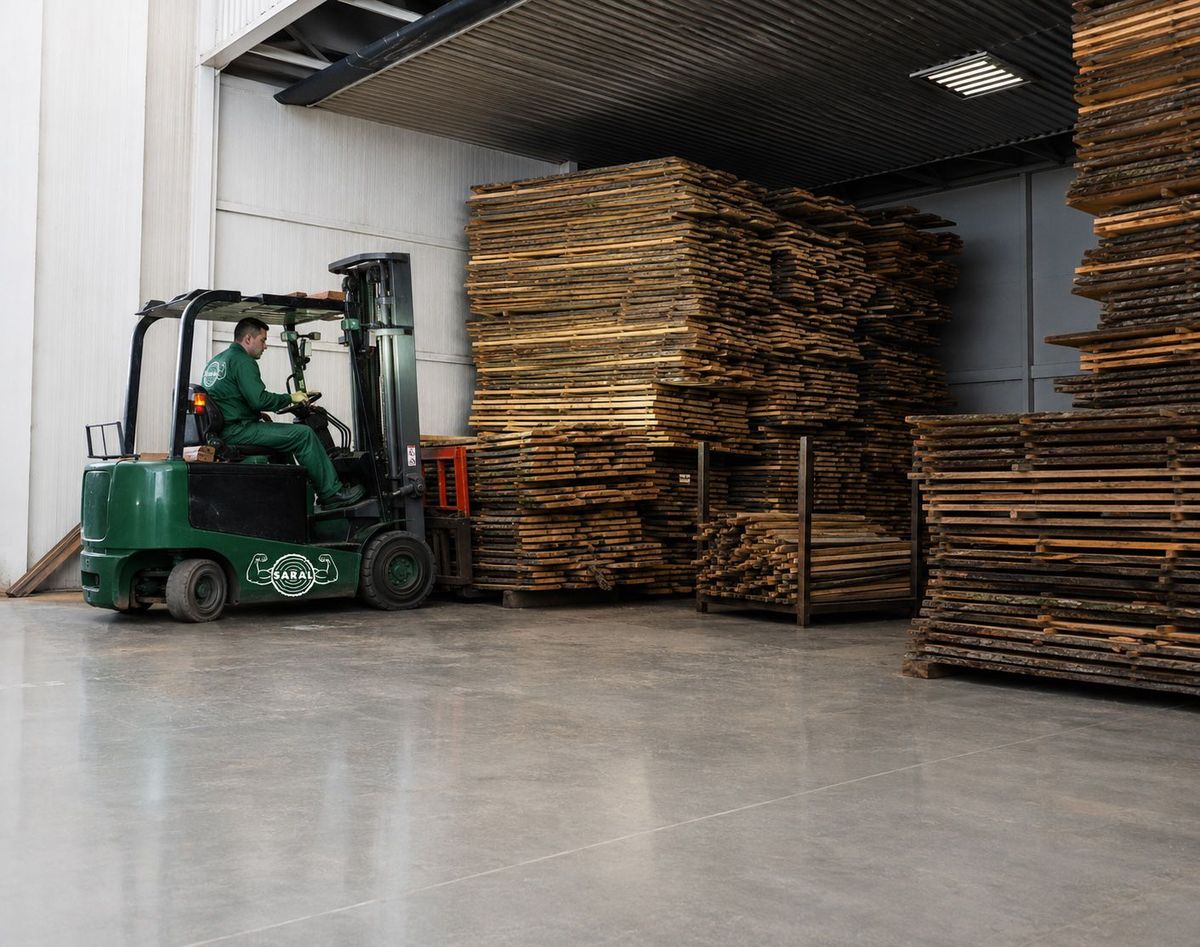
Of the 116 kg, 12 kg are in A1 (the fresh-sawn lumber and its supply chain), 11 kg in A2 (transport) and 93 kg in A3.4 The dataset describes A3 as bundling fresh hardwood lumber and drying it in conventional fresh-air and exhaust-air kilns, then stacking and packing it.4 Kiln drying is therefore the hotspot of a hardwood board's fossil footprint, and the fuel behind the kiln heat decides most of the result. Our article on kiln drying versus air drying hardwood explains why oak and beech need long, gentle schedules, which is also why their drying energy per cubic metre is high.
A German average is a starting point, not a value for every mill. A sawmill that heats its kilns with its own sawdust and offcuts, uses a different electricity mix or ships logs over shorter distances will differ. Only a product-specific EPD shows that. Where none exists, ÖKOBAUDAT recommends using its average dataset.4
How hardwood lumber compares with other wood products
The same Thünen series covers other wood products on a consistent basis, which allows a fair comparison of fossil emissions per cubic metre from raw material to gate.
Per cubic metre, kiln-dried hardwood sits between softwood lumber and the glued products. Softwood lumber is lighter: 485 kg/m³ in its dataset.13 Glulam, three- and five-layer solid wood panels, particleboard and plywood add adhesive, more processing and, for plywood, veneer peeling and pressing.14,15,16,17 Per tonne the order changes, because hardwood is dense: our calculation gives about 153 kg CO₂e per tonne for hardwood lumber against 114 kg for softwood lumber, 289 kg for solid wood panels and 405 kg for plywood.4,13,15,17 Furniture components made from solid hardwood therefore start from a low fossil base. Gluing, finishing and long-distance transport add to it.
A word of caution on furniture: the ESPR furniture study analysed 203 furniture EPDs (55 for storage, 71 for tables, 77 for seating) and found them useful for bills of materials but not statistically representative of the EU market.18 Comparing two chairs on EPD numbers alone only works when both follow the same rules and the same functional unit.
Carbon stored in wood: the EN 16449 calculation
EN 16449:2014 is the European standard for calculating how much atmospheric CO₂ is held in a piece of wood. It takes the carbon fraction of dry wood as 0.5, uses the atomic weights of carbon (12) and CO₂ (44), and corrects the density for moisture. The formula is:
PCO₂ = 44/12 × cf × (ρω × Vω) / (1 + ω/100)
where cf is the carbon fraction (0.5), ρω the density at moisture content ω, Vω the volume at that moisture content, and ω the moisture content in percent. Without product-specific data, the standard allows 12% moisture content and tabulated species densities as defaults.5
We applied it to the main species we work with, using the average densities at 12% moisture from The Wood Database.
Two worked examples, both our calculation. An oak table top of 1,800 × 900 × 40 mm is 0.0648 m³. At 675 kg/m³ and 12% moisture it holds about 72 kg of CO₂. A beech worktop of 3,000 × 620 × 40 mm is 0.0744 m³ and holds about 87 kg.5,6,7 The same formula reproduces the ÖKOBAUDAT dataset: 761.6 kg/m³ at 12% gives 340 kg of carbon and 1,247 kg of CO₂, exactly the A1 figure in the table above.4,5
Our article comparing solid wood, veneer, MDF and chipboard uses a slightly lower IPCC default carbon fraction and therefore arrives at a slightly lower figure for oak. Both are legitimate; EN 16449 is the one used in EPDs. Either way, stored carbon is storage, not an offset. It stays out of the atmosphere for as long as the product is in use, which is a strong argument for durable, repairable furniture, but it is released when the wood is burned or rots.
Why buyers are asking now
Requests for EPDs and carbon data reach component suppliers through several regulations at once. The table sums up their status as of October 2026.
| Rule | What it requires | Key date | Status |
|---|---|---|---|
| CSRD after Omnibus I (EU 2026/470) | Sustainability report for companies > 1,000 employees and > EUR 450 m turnover; suppliers ≤ 1,000 employees protected | Transposition by 19 Mar 2027; ESRS 2026 from FY 2027 | Adopted |
| EPBD recast (EU 2024/1275) | Life-cycle GWP of new buildings calculated and disclosed | 1 Jan 2028 (> 1,000 m²), 1 Jan 2030 (all new) | Adopted, transposition |
| Denmark, building regulation | Average limit 7.1 kg CO₂e/m²/year, plus 1.5 for the construction process | July 2025; tightening 2027 and 2029 | In force |
| France, RE2020 | Embodied-carbon thresholds, about 15% lower from 1 Jan 2025, lowered every three years | To 2031 | In force |
| Construction Products Regulation (EU 2024/3110) | Four GWP indicators in the declaration of performance and conformity | From 8 Jan 2026, as harmonised specifications are adopted | Adopted, phasing in |
| ESPR furniture act | Carbon or environmental footprint in the product passport (draft field) | Indicative adoption 2028 | Planned |
Source: Directives (EU) 2026/470 and 2024/1275; Regulation (EU) 2024/3110; EEA and DI Byggeri (Denmark); FFB (France); PwC (ESRS); ESPR furniture study draft DPP report.
The CSRD after the 2026 Omnibus
The Corporate Sustainability Reporting Directive was narrowed twice. The "stop-the-clock" Directive (EU) 2025/794 of April 2025 postponed reporting for the second and third waves of companies by two years.19 Then the Omnibus I Directive (EU) 2026/470, published on 26 February 2026, cut the scope to undertakings with more than 1,000 employees and more than EUR 450 million net turnover. Member states must transpose it by 19 March 2027.8
The Omnibus also protects suppliers. Companies in the value chain with up to 1,000 employees can decline requests for sustainability information that go beyond a voluntary reporting standard, and reporting companies must not demand more by contract.8 The Commission adopted that voluntary standard, together with simplified European Sustainability Reporting Standards, on 3 July 2026. The simplified ESRS apply to financial years starting on or after 1 January 2027, subject to scrutiny by Parliament and Council.20 For most Romanian hardwood suppliers this means fewer mandatory questionnaires, but large customers will still ask for carbon data where they can.
Building rules: the stronger driver
Buildings create the most concrete demand for EPDs. The recast Energy Performance of Buildings Directive (EU) 2024/1275 requires member states to calculate the life-cycle global warming potential of new buildings and disclose it in the energy performance certificate: from 1 January 2028 for new buildings over 1,000 m², and from 1 January 2030 for all new buildings. The calculation runs over 50 years under EN 15978, with the scope of building elements taken from indicator 1.2 of the EU's Level(s) framework. By 1 January 2027 every member state must publish a roadmap towards limit values from 2030.9

Some countries already set limits. Denmark agreed in May 2024 on an average limit of 7.1 kg CO₂e per m² per year for new buildings, differentiated by building type.21 It took effect in July 2025, with a separate 1.5 kg CO₂e per m² per year for the construction process and further tightening planned for 2027 and 2029.22 France's RE2020 lowered its embodied-carbon thresholds for all building types by about 15% on 1 January 2025 and keeps lowering them every three years until 2031; the French construction federation notes that environmental declarations must follow NF EN 15804+A2 by the end of 2025.23 Stair treads, cladding, flooring, doors and windows count in these calculations. Loose furniture usually does not.
Construction products and the passport
The new Construction Products Regulation (EU) 2024/3110 brings the same four GWP indicators into the declaration of performance and conformity, phased in from 8 January 2026 as products move to harmonised specifications under the new regime.24 For furniture, the route is the ESPR. The draft data list for a furniture product passport includes a carbon footprint and an environmental footprint, with the method still to be decided.25 Our article on the ESPR and the digital product passport for furniture follows that process.
How a supplier gets an EPD
- Choose the programme operator and the PCR. In Europe the large operators for wood include IBU in Germany, EPD International in Sweden and EPD-Norge in Norway. For wood the PCR is EN 16485 plus the operator's own complementary rules.2,12
- Collect a year of data. Log intake and species, transport distances, electricity and heat per process, kiln fuel, yields, adhesives and finishes, packaging and waste flows.
- Commission the LCA. An LCA practitioner models the product and writes the background report.
- Independent verification. A verifier approved by the programme operator checks the report and the EPD.
- Publish. The operator registers the EPD. A standard validity period is five years.18
Programme fees are public; LCA and verification fees are not. EPD International, for example, charges EUR 1,000 to register an organisation's first EPD in a calendar year, EUR 500 each for the second to fourth, and an annual fee of EUR 515 for a micro-enterprise, EUR 1,030 for an SME and EUR 2,575 for a large company.26 The LCA work and the verification are priced separately by the practitioners and are usually the larger part of the cost. An industry-average EPD shared by several producers, or a product carbon footprint to ISO 14067, can be cheaper first steps, but buyers who need EN 15804 data for building assessments will ask for an EPD.
How we approach this at SARAL
Checklist: how to read an EPD for wood
- Declared unit, density and moisture. Per m³, per tonne or per piece? At which density and moisture content? Two EPDs are only comparable on the same basis.
- Standard and PCR. EN 15804+A2, and EN 16485 in the 2014 or 2026 edition.2
- Modules declared. A1–A3 alone is not enough for wood. Check that C1–C4 and D are declared and that the biogenic carbon in A1 reappears in C.
- GWP-fossil versus GWP-total. Use GWP-fossil for emissions; read GWP-biogenic as storage.
- Module D scenario. Energy recovery or recycling? The credit differs by a factor of more than 20 in the hardwood dataset above.4
- Specific or average. A manufacturer EPD, an association EPD or a generic database value?
- Validity and verification. Issue date, valid-until date, programme operator and verifier.
- Geography and energy. Which electricity mix and which kiln fuel were modelled?
Frequently asked questions
What is an EPD for wood products?
A verified Environmental Product Declaration calculated under EN 15804+A2 and the wood product category rules of EN 16485. It reports climate and other impacts by life-cycle module, and declares the biogenic carbon stored in the product.1,2,10
How much CO₂ does one cubic metre of wood store?
It depends on density and moisture. With the EN 16449 formula, our calculation gives about 1,160 kg of CO₂ for beech, 1,113 kg for ash and 1,105 kg for oak, per m³ at 12% moisture.5,6,7,27
Is wood carbon negative?
Not over its full life. The carbon counted as a removal in production is counted as an emission at end of life. What remains are the fossil emissions of harvesting, transport, drying and processing, about 116 kg CO₂e per m³ for German average kiln-dried hardwood lumber.3,4
What is the difference between an EPD and a product carbon footprint?
A product carbon footprint covers climate impact only and is often made to ISO 14067. An EPD under EN 15804+A2 reports a fixed set of indicators across defined modules, is verified by a third party and is published by a programme operator, which is what building assessments use.1,10
Does the CSRD still apply to my company after the Omnibus?
Only if it has more than 1,000 employees and more than EUR 450 million net turnover. Value-chain partners with up to 1,000 employees can decline information requests that go beyond the voluntary standard.8