Why beech left construction, and why it is coming back
For most of the twentieth century, building with wood meant building with softwood. Pollmeier, the German company that makes beech laminated veneer lumber (LVL), puts the softwood share of construction timber at roughly 99% and lists the reasons from a sawmiller's point of view: spruce grows long and straight, while beech is less straight, has more knots, is harder to cut and machine, and is more difficult to dry. Building products made from hardwood were simply too expensive to compete.1
The rules followed the market. The European glulam standard, EN 14080, applies to glulam made of listed coniferous species or poplar; glulam from specific hardwoods may be produced under some of its provisions, but then Annex ZA, the part that links it to CE marking, does not apply.3 Add low natural durability, class 5 under EN 350 even for beech LVL, and large movement with moisture.2 Most of the beech harvested in Germany has gone into furniture, paper and pulp, or fuel, rather than beams.1 Our beech wood guide covers the species itself.
The forest is changing the argument
What changed is the forest. Germany has been converting spruce and pine monocultures into mixed and broadleaved stands since the 1980s. Pollmeier, citing the 2012 national forest inventory, notes that German forests were then 44% broadleaved, while the young trees growing under them were 73% broadleaved, with beech the main beneficiary. The same inventory recorded 18.3 million m³ of beech growing each year against 10.9 million m³ harvested, and more than 548 million m³ of beech standing.1 Those are 2012 figures and manufacturer-quoted, but the direction is clear: Central Europe will have more beech and less spruce to build with.
The second change is technology. Peeling beech into veneers, or sorting and finger-jointing sawn lamellas by machine, removes most of the knots and crooked grain that made beech beams uneconomic. The result is two families of products: beech LVL and beech glulam.
Beech LVL: how BauBuche is made
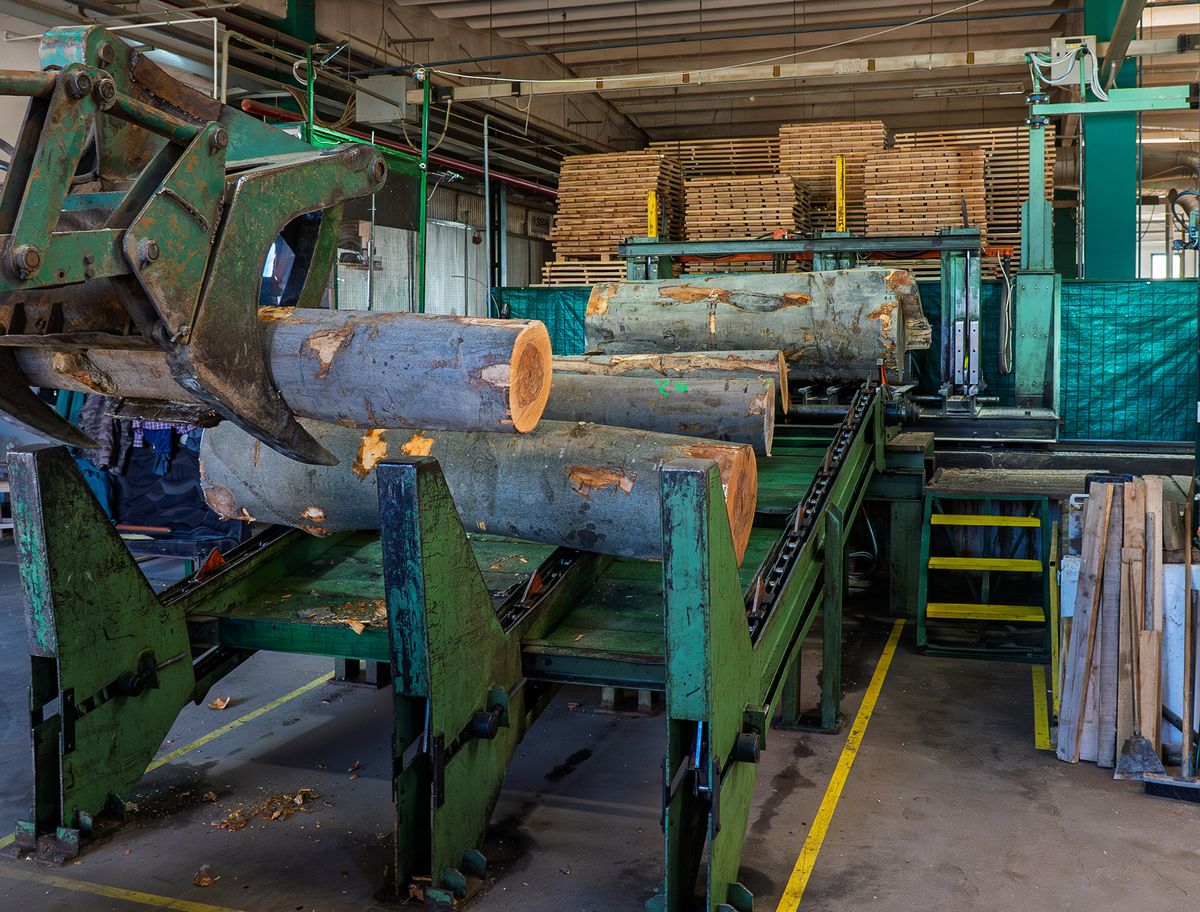
Laminated veneer lumber is made from veneers peeled off a rotating log, dried, graded and glued back together, mostly with the grain in one direction. EN 14374 sets the requirements for LVL for structural use; it does not cover LVL treated against biological attack or fire.10 Pollmeier's line runs from debarking and steaming the beech logs through rotary peeling, drying, scanner-assisted sorting, gluing and continuous pressing to cutting to size.11
The product comes in three forms:11,12
- Board and beam BauBuche S: all veneers in the same direction. Boards 40 and 60 mm thick, up to 1,820 mm wide and up to 18 m long, cut into narrow strips for ribs and beams.
- Board BauBuche Q: the same board with some veneers laid crosswise.
- Beam BauBuche GL75: glulam made from 40 mm BauBuche S strips glued face to face, 100–300 mm wide and 80–1,360 mm high in the standard range, up to 18 m long.
A fourth version, BauBuche Panel, turns the veneers on edge for table tops, stairs and furniture.11 The material leaves the factory at about 6 ± 2% moisture content, well below the moisture it will reach in a heated building, which matters for the swelling discussed below.12
How strong is beech compared with spruce?
Characteristic values, the 5% lower bounds that engineers design with, show the gap. Spruce glulam GL24h, the everyday class, has a characteristic bending strength of 24 N/mm².6 German beech glulam made from sawn lamellas starts at GL28h and goes up to GL48c.5 Beam BauBuche GL75 is assessed at 75 N/mm² in bending, with a size factor for beam height.4
Bending is not the only difference, and not always the biggest. The figure that changes connection design most is compression perpendicular to the grain, the property that governs bearings and supports. Spruce glulam GL24h has 2.5 N/mm²; beech glulam 8.4 N/mm²; BauBuche GL75 14.8 N/mm² in service class 1.4,5,6
Show the data
| Spruce glulam GL24h | Beech glulam GL48c | BauBuche GL75 | |
|---|---|---|---|
| Tension along the grain | 19.2 N/mm² | 21.0 N/mm² | 60.0 N/mm² |
| Compression along the grain | 24.0 N/mm² | 25.0 N/mm² | 59.4 N/mm² |
| Compression across the grain | 2.5 N/mm² | 8.4 N/mm² | 14.8 N/mm² |
| Shear | 3.5 N/mm² | 3.4 N/mm² | 4.5 N/mm² |
Beech glulam tension, compression and shear values are the same for all its classes. BauBuche compression along the grain falls to 49.5 N/mm² in service class 2. Source: Rubner Holzindustrie, declaration of performance 01-BSH-2023; DIBt Z-9.1-679 (2024), table 4; OIB ETA-14/0354 (2024), annex 2.
Two cautions keep the comparison honest. Beech is about twice as heavy as spruce for the same volume, so the advantage per kilogram is smaller than per cubic metre. And stiffness rises less than strength: 16,800 against 11,500 N/mm² is about 46% more, so long, slender beech beams are often governed by deflection, not by strength.4,6 The percentage is our calculation from the two mean values.
Approvals: what ETA-14/0354 actually says
Because EN 14080 does not cover hardwood glulam with CE marking, BauBuche GL75 is placed on the market with a European Technical Assessment (ETA) instead. ETA-14/0354, issued by the Austrian Institute of Construction Engineering (OIB), was first issued in 2015 and amended most recently on 22 July 2024, under the European Assessment Document EAD 130010-01-0304 for glued laminated timber made of hardwood from beech LVL.4 Its rules give a good picture of what structural beech demands:4
- Lamellas are beech LVL to EN 14374, 40–50 mm thick, with a bending strength of at least 80 N/mm² and a moisture content of 5 ± 3% at gluing, without finger joints in the individual lamellas.
- Surfaces are sanded no earlier than 24 hours before bonding, or stored clean for up to four weeks.
- Adhesive is PRF to EN 301 or PUR to EN 15425, type I, pressed at a minimum of 1.0 N/mm² in a room at 20 °C or more.
- Use is limited to static and quasi-static loads in service classes 1 and 2, with an assumed working life of 50 years.
- Sizes run to 600 × 300 mm and 18 m for regular beams, and to 2,500 × 600 mm and 36 m for XXL members.
- Fasteners follow Eurocode 5 with extra rules: dowel-type fasteners of 8 mm and more lose 20% of embedment strength in the edge faces, and screws must be predrilled beyond set threaded lengths.
The assessment also records that the beams pass the bonding-quality tests and meet formaldehyde class E1.4 For engineers, the second generation of Eurocode 5 now lists glued laminated veneer lumber with reference to EADs, and glulam with reference to both EN 14080 and an EAD.13 BS EN 1995-1-1:2025 is already current in the UK; BSI will withdraw the first-generation Eurocodes on 30 March 2028.14
Beech glulam from sawn lamellas
The second route keeps the sawmill. In Germany, glulam from sawn beech lamellas, and hybrid beams with beech outer layers and a softwood core, are covered by a general building approval held by the glulam makers' association: Z-9.1-679, renewed on 19 September 2024 and valid until 19 September 2029.5 It reads like a specification for careful hardwood processing:5
- Lamellas are visually graded to DIN 4074-5, at most 30 mm thick, 160 mm wide and 4,800 mm² in cross-section; the higher classes add a dynamic modulus of elasticity measured on every lamella.
- Finger joints are at least 15 mm long, with characteristic bending strengths from 47 N/mm² for GL28h to 69 N/mm² for GL48c.
- Lamellas are planed no more than 6 hours before gluing, at 9–12% moisture content, in a room of at least 20 °C, by a factory holding a certificate for gluing load-bearing timber.
- Beams are limited to 600 mm high and 160 mm wide; hybrid beams to 900 mm high.
- Use is limited to service class 1, and openings through the beam are not allowed.
| Product | Basis | Classes | Service class | Largest section | Adhesive |
|---|---|---|---|---|---|
| BauBuche S and Q boards (beech LVL) | EN 14374, declaration of performance | S: 75 N/mm² edgewise bending | 1 and 2 | 40/60 mm × 1,820 mm, up to 18 m | – |
| BauBuche GL75 beam | ETA-14/0354 (EAD 130010) | GL75 | 1 and 2 | 600 × 300 mm, 18 m; XXL 2,500 × 600 mm, 36 m | PRF (EN 301) or PUR (EN 15425 type I) |
| Beech glulam (BS-Holz aus Buche) | abZ Z-9.1-679, valid to 19.9.2029 | GL28h to GL48c | 1 only | 600 × 160 mm | Adhesives deposited with DIBt |
| Beech-softwood hybrid beam | abZ Z-9.1-679 | GL28 hyb to GL48 hyb | 1 only | 900 × 160 mm | Adhesives deposited with DIBt |
| Beech and ash glulam (Switzerland) | Manufacturer's declaration | – | Per national rules | – | PUR (EN 15425 type I) with primer |
Source: Pollmeier brochures 01, 03 and 04; OIB ETA-14/0354 (2024); DIBt Z-9.1-679 (2024); neue Holzbau AG, manufacturer's declaration for ash and beech glulam.
Why bonding beech is the bottleneck
Every one of those rules points at the glue line. Beech is dense, moves a lot with moisture and does not take every adhesive equally well. The German approval for one structural PUR range admits beech with only one adhesive grade, a compulsory primer, a waiting time of 10–30 minutes, at least 1.2 N/mm² of pressure and at least 150 minutes in the press, against 90 minutes for spruce with the same glue.8 A Swiss producer of beech and ash glulam declares exactly that combination: PUR to EN 15425 type I with primer.15 Our PUR adhesives article explains the chemistry and the primer, and the finger-jointing article shows what the joint geometry does to beech lamellas.
Hardwood CLT: still in the lab
Cross-laminated timber (CLT) in Europe and North America is made mostly from spruce, fir, pine and larch.16 Research on hardwood CLT shows why. In a study of all-beech and beech-spruce CLT, none of the adhesives tested met the delamination limits written for softwood CLT; plain PUR did worst in all-beech panels and needed a primer to approach MUF.16,17 Lighter hardwoods do better: birch and aspen CLT bonded with PUR had bond shear strengths of 3.9 and 3.3 N/mm², against 1.9 N/mm² for spruce, met the 70% wood-failure requirement and narrowly failed the 10% limit for total delamination.16 The same paper notes that mixed-species panels often perform better than single hardwood species, and that the main interest is in using underused, low-value hardwoods.16
The practical reading for 2026: beech-spruce hybrids and beech in individual layers are realistic research topics, but all-beech CLT is not yet a standard building product.
Moisture and durability: where beech can and cannot go
Beech is a dry-climate material in construction. Pollmeier's own documents give BauBuche natural durability class 5, "not durable", and limit it to service classes 1 and 2 of Eurocode 5: heated or unheated interiors where wood moisture stays at or below about 12%, and covered outdoor spaces where it stays below about 20%, each exceeded only for a few weeks a year.2 Under the German wood-protection standard DIN 68800, Pollmeier recommends use classes 0–1, advises against class 2 and does not permit classes 3–5.7 Sawn-beech glulam under Z-9.1-679 is narrower still: service class 1 only.5
Movement is the second limit. Pollmeier gives BauBuche a swelling and shrinkage of 0.40–0.45% per percentage point of moisture across the veneers and 0.01% along them, and works through an example: a 600 mm high beam moving from 7% to 10% moisture grows 8.1 mm in height.2 It also warns that BauBuche swells and shrinks more than standard softwood and that wet end grain can swell markedly, so it recommends a protective coating during transport and erection.7 Thünen Institute researchers found an extra, irreversible spring-back of about 2 mm on 50 mm, or 4%, the first time BauBuche is moistened after production, before it settles into the swelling behaviour of solid beech.18
Even measuring moisture is different. ETH Zurich researchers found that the calibration curves of resistance moisture meters for solid beech cannot be used on beech LVL, and published separate curves for BauBuche S and Q.19 The moisture content article explains the equilibrium moisture behind these numbers.
Fire: beech chars a little faster than you might expect
Beech products sit in the same reaction-to-fire class as softwood glulam. BauBuche GL75 is Euroclass D-s2, d0, and its ETA gives charring rates of 0.65 mm/min for one-dimensional and 0.70 mm/min for notional charring.4 A German glulam maker declares the same Euroclass for its spruce glulam.20
The second-generation Eurocode for fire design, EN 1995-1-2, gives separate basic design charring rates for several hardwoods. Beech chars faster than softwood in that table, beech LVL as fast as softwood, and ash and oak more slowly:13
In practice that means a beech section does not gain fire resistance from its density alone. Its advantage in fire is indirect: higher strength allows smaller sections at normal temperature, so the designer has to check whether the remaining section after charring still carries the load.
Carbon stored in beech products
Wood stores the carbon its tree took from the air, and denser wood stores more of it per cubic metre. Pollmeier quotes its environmental product declaration (EPD) for BauBuche at 1,338.9 kg of CO₂ stored per cubic metre.1 Because beech members can be smaller than spruce ones for the same load, the carbon stored per beam is closer than the per-cubic-metre figure suggests. Compare products by their EPDs for the declared unit and life-cycle modules you need, not by a single headline number.
What it means for Romania's beech
Romania is a beech country. The national forest inventory puts beech at 35.8% of the forest area and 912.9 million m³ of standing timber, 37.2% of the national total.21 In 2025, certified harvesting companies reported 5.58 million m³ of beech round wood, 32.1% of all round wood harvested. Across all species, 46.5% of that round wood became logs and 40.7% firewood.9 Our article on Romania's forests in numbers explains how these statistics are built.
Engineered beech for construction is a way to move more of that wood up the value chain. But the barrier is not the raw material. Every product above depends on graded lamellas or veneers, kiln drying to a tight moisture window, fresh machined surfaces, approved adhesives and a factory certified for load-bearing gluing, with third-party surveillance twice a year.4,5 A furniture-grade beech supply chain covers the first steps of that list, not the last.
How we work beech at SARAL
Specifying structural beech: what to ask
- Which document covers the product? An ETA, a national approval or a declaration of performance, with its number, date and validity.
- Which strength class and which values? GL75, GL28h–GL48c or an LVL grade, plus the size factors for your section.
- Which service class? Check that the approval covers your climate: service class 1 only for sawn-beech glulam under the German approval.
- Which adhesive and primer? Type and standard (EN 301 or EN 15425), and the gluing certificate of the factory.
- Moisture at delivery, and how the supplier protects members during transport and erection.
- Connection rules: predrilling, embedment strength in the edges, and which screws the approval covers.
- Fire design basis: Euroclass and the charring rate used.
- EPD, if your project counts embodied carbon.
Frequently asked questions
Is beech good for construction?
For dry interiors and covered structures, yes, as an engineered product: beech LVL and beech glulam are far stronger than spruce glulam. Sawn beech used as ordinary building timber outdoors is not, because it has durability class 5 and moves a lot with moisture.2,4,5
What is BauBuche?
BauBuche is Pollmeier's brand of beech laminated veneer lumber, sold as boards (S and Q), as GL75 beams glued from 40 mm strips, and as panels for interiors. The GL75 beams are covered by ETA-14/0354.4,11
Is glulam hardwood or softwood?
Almost always softwood. The European glulam standard EN 14080 covers coniferous species and poplar; hardwood glulam such as beech is placed on the market through European Technical Assessments or national approvals.3,4,5
Can beech LVL be used outdoors?
Only under cover. BauBuche is limited to service classes 1 and 2, and its maker does not permit use classes 3–5, which include weathered outdoor use.4,7
How strong is beech LVL compared with spruce glulam?
BauBuche GL75 has a characteristic bending strength of 75 N/mm², against 24 N/mm² for spruce glulam GL24h, and a mean modulus of elasticity of 16,800 against 11,500 N/mm².4,6