Why finger-joint at all?
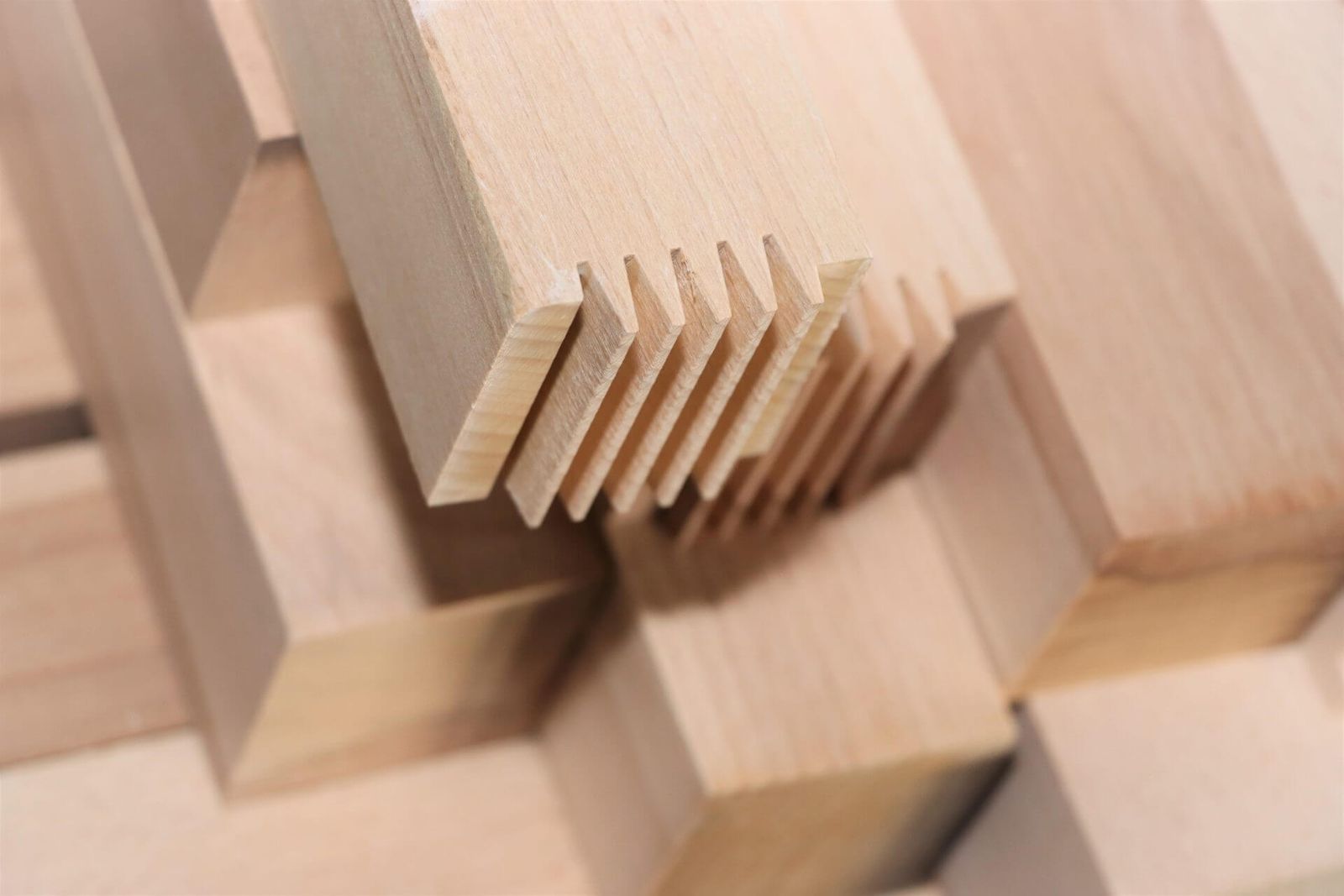
Hardwood logs rarely give long, clear boards. Knots, splits, bark pockets and colour defects break every board into shorter sections of good wood. A furniture maker who needs 2 m lamellas can either buy expensive long clear stock or cut the defects out of ordinary lumber and join the clear pieces back together end to end. The second route is what finger jointing (German Keilzinkung, Romanian îmbinare în dinți) does.
It is also the reason finger-jointed wood carries a reputation as a compromise. Buyers search for "finger jointed lumber vs solid wood" and "keilgezinktes Holz Tragfähigkeit" because they suspect the joint is a weak point. They are partly right. The question is how weak, under which load, and whether it matters for the part in hand. This article answers that from the engineering data, most of it for beech, birch and oak.
Finger jointing sits in the middle of a chain: dried boards are scanned or marked, an optimising cross-cut saw removes the defects, and the clear pieces are profiled, glued and pressed into continuous lengths. Those lengths become the lamellas of edge-glued panels, stair treads, frames and mouldings.
Anatomy of a finger joint: length, pitch, tip and slope
Gluing two boards end to end with flat faces does not work. End grain absorbs adhesive and offers little surface for a bond, so a plain butt joint reaches only about 25% of the tensile strength of the wood parallel to the grain, even with special techniques.1
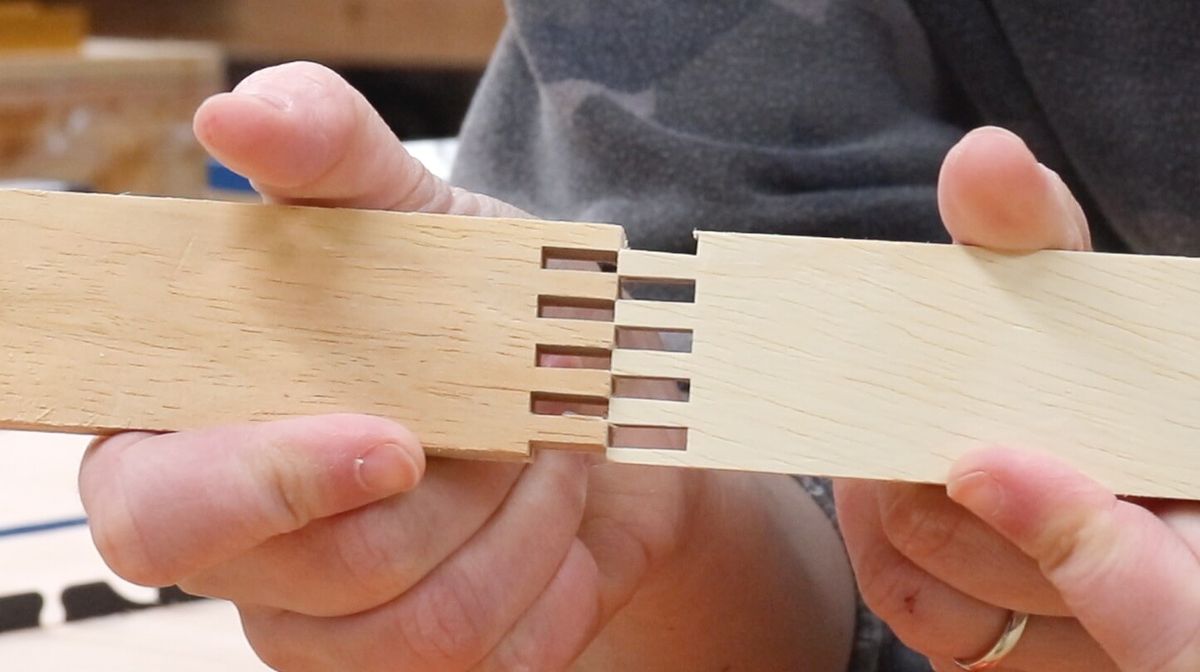
The fix is geometry. Wood is roughly ten times stronger in tension than in shear, so a scarf or finger joint needs a glued surface at least ten times the cross-section of the piece to approach the strength of clear wood. Joints with a slope of 1 in 12 or flatter give the highest strength; 1 in 8 is typical for structural plywood joints.1 A finger joint is a scarf joint folded over many times, so it gains that glued surface in a short length and with less waste.
Four dimensions describe a finger profile:
- Finger length: how deep the fingers reach into the wood.
- Pitch: the distance from one finger to the next.
- Tip width: the flat at the end of each finger. FPL notes that with a steep 1-in-12 slope the tip must be no thicker than 0.8 mm, and that 0.4–0.8 mm is about the practical minimum for machined tips.1
- Slope: follows from the three above. Thin tips and long fingers give a flat slope and a large glued area.
| Study and wood | Finger length | Pitch | Tip width | End pressure | Adhesive |
|---|---|---|---|---|---|
| Aicher et al. 2001, beech glulam laminations | 20 mm | 6 mm | 1.2 mm | Raised vs softwood | Melamine (EN 301) |
| Stolze & Militz 2024, beech and birch | 16.05 mm | 3.8 mm | – | 15 N/mm² beech, 11 N/mm² birch | PUR, MUF, PRF |
| Ayarkwa et al. 2000, three tropical hardwoods | 18 mm (best of three) | – | – | 4–12 N/mm² | Resorcinol-formaldehyde |
| Özçifçi & Yapıcı 2008, beech, oak and others | 21 mm (strongest tested) | – | – | – | PVAc (best result) |
| FPL rules of thumb | Slope 1:8 typical, 1:12 strongest | – | ≤ 0.8 mm at 1:12; 0.4–0.8 mm practical | – | – |
The Aicher profile corresponds to a slope of about 1:8.3 (our calculation: half of pitch minus tip, over finger length). Source: Aicher, Höfflin & Behrens (2001); Stolze & Militz (2024); Ayarkwa, Hirashima & Sasaki (2000); Özçifçi & Yapıcı (2008); Frihart & Hunt (2021), FPL Wood Handbook ch. 10.
Structural profiles and short furniture profiles
Structural profiles are long. A beech glulam study used fingers 20 mm long with a 6 mm pitch and 1.2 mm tips, one of the two most common geometries in Germany at the time.5 A 2024 study cut its standard profile with a cutter recommended for structural joints under EN 14080: pitch 3.8 mm, finger length set to 16.05 mm.2 Non-structural joints for furniture and joinery use much shorter fingers, which waste less wood and are easier to hide.1
Vertical and horizontal joints
A finger joint can be cut so that its profile shows on the wide face of the board, a vertical joint, or on the edge, a horizontal joint.1 Glulam usually uses vertical joints.2 Panel producers often choose the edge profile so that the zigzag does not show on the visible face.6 FPL adds a production detail: vertical joints cure faster than horizontal ones when the glue is cured with high-frequency heating.1
The standards: EN 15497, EN 14080, and why hardwoods sit outside them
Two European standards cover finger jointing for structural timber:
- EN 15497, structural finger-jointed solid timber, sets both performance requirements and minimum production requirements. It applies to coniferous species listed in the standard and to poplar. Some provisions may be used for broadleaf species, but those products are not covered.3
- EN 14080, glued laminated timber and glued solid timber, applies to glulam made of the listed coniferous species or poplar, with laminations from 6 to 45 mm thick. Glulam from specific hardwood species may be possible under some of its provisions, but then Annex ZA, the part that links the standard to CE marking, does not apply.4
Both standards require a small gap at the tip of each finger in structural joints. The gap gives a thin bond line and lets the joint lock itself as it is pressed, but it also weakens the cross-section at the base of the fingers, where failure tends to start.2
For hardwood the practical consequence is simple. A finger-jointed beech or oak lamella in a furniture panel, a worktop or a stair tread is a non-structural or product-specific use, not a CE-marked structural member. Its quality depends on the producer's process control, not on a structural standard.
How strong is a finger joint?
FPL puts the ceiling clearly: a well-manufactured scarf, finger or lap joint in end grain can reach up to 90% of the tensile strength of clear wood and behave much like it. The same source adds a warning that matters for chairs and anything loaded over and over: the number of load cycles to failure for a well-made end joint is often lower than for clear wood.1
Beech and birch: the 2024 Göttingen data
The most useful recent dataset comes from the University of Göttingen, which finger-jointed birch and beech lamellas on an industrial line and tested them in tension and bending.2
- Beech, tension: unjointed controls reached a mean of 98.1 N/mm². Lamellas with the standard profile and MUF adhesive reached 63.1 N/mm², about 64% of the controls; a modified profile reached 70.5 N/mm², about 72%.
- Birch, tension: controls 79.9 N/mm²; PUR 61.2, MUF 57.0 and PRF 36.8 N/mm² with the standard profile, about 77%, 71% and 46% of the controls.
The percentages are our calculation from the reported means. An older study of beech glulam laminations, finger-jointed industrially with a melamine adhesive, measured a mean joint tension strength of 70 ± 11 N/mm², after excluding two stems with high fibre deviation; it did not confirm the 80–100 N/mm² cited in earlier literature.5
Oak and beech: what longer fingers do
Finger length is the main design lever. In a comparison of oriental beech, oak, Scots pine, poplar and fir, bending strength rose with finger length up to the longest profile tested, 21 mm; the best result was beech with 21 mm fingers and PVAc glue at 57.4 N/mm², still below solid beech.7 A 2026 study on European beech and pedunculate oak (Fagus sylvatica and Quercus robur) reached ultimate tensile loads of up to 21,320 N for beech and 21,631 N for oak, and found that longer teeth and larger bonded areas generally raised both capacity and resistance to fracture.8 In three tropical hardwoods, an 18 mm profile gave the strongest joints of the three tested, and joint efficiency fell with density: 88% for the lightest species, 78% for the medium one and 60% for the densest.9
The pattern across studies is consistent. Longer fingers help, dense species are harder to joint efficiently, and the joint, not the wood between joints, usually decides where a finger-jointed lamella breaks.
The adhesive matters: PUR, MUF, PRF and PVAc
Structural finger joints in Europe are bonded with adhesives rated for load-bearing timber: melamine-urea-formaldehyde (MUF), phenol-resorcinol-formaldehyde (PRF) and one-component polyurethane (PUR). FPL lists melamine-urea as a primary adhesive for end-jointing and edge-gluing lumber, and PUR as widely used for structural applications in Europe.1 Non-structural furniture joints are often bonded with polyvinyl acetate (PVAc) dispersion glue, D3 or D4 under EN 204.6,10
The Göttingen birch results show how much the adhesive system can matter in practice. PUR and MUF joints were significantly stronger than PRF joints. The authors noted a long-lasting formaldehyde smell from the PRF joints, a sign of incomplete curing, possibly from too little hardener or too low a curing temperature.2 The lesson for a buyer is not that PRF is a poor adhesive, but that mixing ratio, temperature and curing time are part of joint quality.
Two regulations now shape adhesive choice. PUR adhesives containing at least 0.1% diisocyanates may be used industrially or professionally only by workers who have completed training, a REACH requirement in force since 24 August 2023, with refresher training at least every five years.11 And since 6 August 2026, furniture and wood-based articles placed on the EU market may release no more than 0.062 mg/m³ formaldehyde in the REACH chamber test, which matters for any product bonded with MUF or PRF.12 Our wood glue article covers the classes and the rules in detail.
End pressure: why beech needs more than birch or spruce
Once the fingers are glued, the two pieces are pushed together under end pressure so that the fingers seat fully and the bond line is thin. Denser wood needs more. In the Göttingen study, the joints were pressed for 5 seconds at 11 N/mm² for birch and 15 N/mm² for beech, the higher figure because of beech's higher density.2 In the beech glulam study, the end pressure had to be raised compared with finger jointing softwood laminations.5
More pressure is not automatically better. In the tropical-hardwood study, end pressures between 4 and 12 N/mm² had no significant effect on bending strength within the tested range, and the most economical pressure differed by species.9 The right setting depends on species, profile and adhesive, and a careful producer finds it by testing, not by copying a softwood setting.
Fibre deviation: the hidden strength killer
The beech glulam study by the Stuttgart materials testing institute reached a clear conclusion: fibre deviation in the wood next to the joint, not density, was the decisive factor for finger-joint strength. Laminations from two stems with high fibre deviation had to be excluded to reach the 70 N/mm² mean, and the authors note that this kind of deviation is very hard to detect by visual grading in beech.5 In the Göttingen tests, the few failures outside the finger joint were also mostly caused by grain deviations.2
For a buyer this means that the quality of a finger-jointed lamella is decided before the joint is cut. Straight-grained wood, careful defect removal around knots and their swirling grain, and drying that leaves the wood free of stress all count as much as the cutter and the press.
Profile and glue spread: what the bending tests show
The Göttingen team also tested a new profile with extra cross-grooved fingers, designed to give the adhesive more room. In bending tests on birch, the standard profile with MUF reached 60.4 N/mm², the new profile with the same glue spread 69.9 N/mm², and the new profile with twice the glue spread 82.0 N/mm², against 107.5 N/mm² for unjointed controls.2
Show the data
| Bending strength | |
|---|---|
| No joint (control) | 107.5 N/mm² |
| Standard profile, 350 g/m² | 60.4 N/mm² |
| New profile, 350 g/m² | 69.9 N/mm² |
| New profile, 700 g/m² | 82.0 N/mm² |
Source: Stolze & Militz (2024), Materials 17(20), 5063, table 6. Birch (Betula), 31 × 31 mm specimens.
The result is a reminder that the joint is a designed product. EN 14080 requires the adhesive to wet the fingers and squeeze out of the joint during pressing, and the study doubled the spread on the new profile to guarantee that.2 Starved joints, with too little glue on the fingers, are a common cause of weak finger joints in practice.
Where finger-jointed hardwood makes sense
- Edge-glued panels and worktops. The joints are spread across many lamellas, and the panel is rarely loaded in pure tension.
- Mouldings, frames, skirting and cladding. Long, straight, stable lengths matter more than tensile strength, and painted or stained profiles hide the joints.
- Stair treads. Widely made finger-jointed, but the span and load deserve attention; our oak stair treads guide covers the trade-offs.
- Chair parts and other cyclically loaded pieces. Use with care. FPL's warning about lower fatigue life applies directly to legs, rails and backs that see thousands of load cycles.1
Finger jointing also changes the economics of a log. Short clear pieces that would otherwise be burned become saleable lamellas, which is why finger-jointed panels cost less than continuous ones and why the technique is central to good yield.

How we finger-joint at SARAL
What to ask a supplier of finger-jointed hardwood
- Use and class. Is the product declared for non-structural or structural use, and to which standard or assessment?
- Profile. Finger length and pitch, and whether the joint is vertical or horizontal (visible on the face or on the edge).
- Adhesive. Type and class (EN 204 for non-structural PVAc), and for formaldehyde-based systems, evidence of compliance with the 2026 REACH limit.
- Moisture content at jointing and how pieces of different moisture are kept apart.
- Grading of the clear pieces. Which defects are cut out, and how grain deviation around knots is handled.
- Process control. How end pressure, glue spread and curing are set and checked, and whether the producer tests joints in bending or tension, and how often.
- Joint spacing and appearance. Minimum piece length, whether joints may fall at critical points of a part, and colour sorting.
If you buy components rather than lamellas, add one more question: where in the part may a joint fall?
Frequently asked questions
Is finger-jointed wood strong?
Strong enough for most furniture, panel and joinery uses, but not as strong as clear wood in tension. A well-made joint can reach up to 90% of clear-wood tensile strength; measured industrial beech joints reached about 64–72%.1,2
Finger-jointed lumber or solid wood: which should I choose?
Choose solid, continuous wood for long, highly stressed or cyclically loaded parts and when you want unbroken grain. Choose finger-jointed wood for panels, frames, mouldings and parts where straightness, stability and price matter more.1
What does finger-jointed timber mean?
It is timber made by gluing shorter pieces end to end with interlocking, tapered fingers. The fingers create a glued surface many times larger than the cross-section.1
Can finger-jointed wood be used outdoors?
Only with an adhesive rated for it. A PVAc glue classed D4 under EN 204 suits exterior use only when the surface is protected by an adequate coating, and it is for non-structural use; structural outdoor members need structural adhesives and a structural product standard.3,10