What a one-component PUR glue is
A one-component polyurethane wood glue is a liquid isocyanate prepolymer: a resin whose molecules still carry reactive isocyanate groups. Henkel's data sheet for a structural PUR describes it plainly as an isocyanate prepolymer, solvent-free and formaldehyde-free, that cures with air humidity and the moisture in the wood.6 Nothing is mixed in the workshop. The second "component" is water.
When the isocyanate groups meet water they react, cross-link into a solid polyurethane film and release carbon dioxide. That gas is why PUR glue foams out of a joint. The USDA Forest Products Laboratory (FPL) describes isocyanate adhesives as reactive with water, "producing CO₂ gas (foaming)", and lists one- and two-part polyurethanes as gap-filling, resistant to water and damp, and "widely used for structural applications in Europe", including glulam, LVL and cross-laminated timber.7 Henkel adds that slight foaming during hardening is a normal part of the curing reaction.6
Because PUR cures chemically, it does not soften again when warmed, as a thermoplastic PVAc glue can. That is its main attraction in joinery. Its limits are just as specific: it needs moisture to cure, it needs pressure while it cures, and the uncured glue is a respiratory and skin sensitiser. The wood glue guide compares all the adhesive families and explains the D classes; this article goes deeper on PUR.
Moisture: the reactant, not the enemy
With PVAc glue, wet wood is a problem because the glue has to lose water to set. With PUR it is the other way round. FPL notes that many adhesives need low wood moisture to penetrate properly, while isocyanates and polyurethanes "need some water to cure and may even perform better at higher moisture content".7
The data sheets put numbers on it:
- Lower limit. Kleiberit's 501.0 PUR must not be used on wood-based materials below 5% moisture content.2 The German general building approval (abZ) for Henkel's structural PUR range requires at least 8% for load-bearing bonds.1
- Working range. Kleiberit names 8–12% as the ideal wood moisture for its slow 501.6 version.8 Henkel's approved press times are defined at 12% wood moisture and 65% relative humidity.1
- Temperature. Kleiberit asks for substrates warmed to at least 18 °C and no use below +5 °C.2 The structural approval asks for wood at 18 °C or more, a room at 20 °C or more, and has only been proven up to 35 °C wood temperature.1
When the wood is very dry, makers allow water to be added. Kleiberit names a fine spray of about 20 g/m² of water, or heat between 40 °C and 80 °C, as ways to speed cross-linking.2 For structural bonding, the European standard for PUR adhesives, EN 15425, deals with water spraying only in an informative annex that neither allows nor forbids it.9 In practice that means spraying is a process the glue maker and the testing body have to sign off, not something to improvise.
Open time, press time and temperature
PUR glues are sold in speeds, and the speed is a trade-off: a long open time gives you more time to assemble but keeps the parts in the clamps longer. Kleiberit's general-purpose 501.0 gives an open time of about 20–25 minutes at 20 °C and 50% relative humidity, shortened by heat, high humidity or added moisture.2 Its press times depend strongly on temperature:2
Show the data
| Temperature | Minimum press time |
|---|---|
| 20 °C | 60 min |
| 40 °C | 30 min |
| 60 °C | 10 min |
| 80 °C | 5 min |
Times depend strongly on temperature and on the moisture available. Machining after about 2–3 hours, final strength after about 24 hours. Source: Klebchemie M. G. Becker, KLEIBERIT 501.0 technical data sheet, status 28.11.2022.
Even out of the press, the joint is not finished. Kleiberit allows machining after about 2–3 hours and gives final strength after about 24 hours.2 For comparison, the same maker's D3 PVAc glue needs at least 15 minutes in the clamps for edge joints at 20 °C, 5 minutes pre-warmed to 50 °C and 2 minutes at 80 °C, and reaches its final water resistance after seven days.3
Structural PUR: the product name tells you the waiting time
In Henkel's structural range the product code is the clock. In "HB S309", the digits before the final 9 give the maximum waiting time in minutes between spreading and pressing at 20 °C, 65% relative humidity and 12% wood moisture: 30 minutes. The range runs from 2 to 180 minutes.1 The approval then sets a minimum press or curing time for each grade. Longer waiting time means longer pressing:
Show the data
| Max. waiting time (from the product code) | Min. press or curing time | |
|---|---|---|
| HB S029 | 2 min | 4 min |
| HB S049 | 4 min | 8 min |
| HB S109 | 10 min | 20 min |
| HB S209 | 20 min | 45 min |
| HB S309 | 30 min | 75 min |
| HB S509 | 50 min | 125 min |
| HB S709 | 70 min | 180 min |
| HB S1809 | 180 min | 375 min |
Face bonds with glue lines up to 0.3 mm need longer: 90 min up to HB S309, 210 min for HB S709. Beech: at least 150 min. Source: DIBt (2024), general building approval Z-9.1-765 of 25 November 2024, sections 2.1 and 3.2.3 and table 5.
These are minimums for thin glue lines in softwood. For face bonding with glue lines up to 0.3 mm, the approval sets 90 minutes for the faster grades up to S309, rising to 210 minutes for S709 and 555 minutes for S1809.1 Mechanical loading is not allowed during the press and curing time, except for the minor loads of moving the parts.1
Pressure, gap filling and foam
"Gap-filling" is the most misread property of PUR. The foam does fill a gap, and FPL lists PUR as gap-filling.7 But the structural approvals are written for thin glue lines: no more than 0.1 mm for finger joints and narrow-face bonds, and no more than 0.3 mm for face bonds.1 The European classification of structural PUR glues is built around the same idea: EN 15425 tests adhesives for finger joints with a thin glue line, for "general purposes" at 0.3 mm and for "special purposes" at 0.5 mm.10 A joint that relies on a millimetre of foam is outside all of them.
Pressure is what keeps the glue line thin while the foam tries to push it open. Kleiberit asks for at least 0.6 N/mm² for laminating and edge-gluing and states that the more intensively the glue cross-links under pressure, the higher the later load capacity.2 Henkel's approval asks for at least 1.0 N/mm² when face-bonding Douglas fir or larch, and at least 1.2 N/mm² for beech.1 For narrow-face bonding of boards into single-layer panels, it scales pressure with lamella thickness: 0.6 N/mm² up to 25 mm, 0.8 N/mm² up to 35 mm and 1.0 N/mm² up to 48 mm.1
Fit matters as much as pressure. For narrow-face bonding with the fastest grades, the approval allows the width of a planed board to vary by no more than 0.05 mm along its whole length.1 That is a long way from "the foam will fill it".
D4 and heat resistance on a PUR label
Most workshop PUR glues are sold as "D4". Strictly, EN 204, the standard behind D1–D4, classifies thermoplastic adhesives such as PVAc.11 Thermosetting adhesives for non-structural uses have their own classes, C1 to C4, in EN 12765.12 In practice PUR makers have their glues tested to the EN 204 D4 sequences, and Kleiberit's 501.0 sheet cites an ift Rosenheim test report for D4.2 Read D4 on a PUR bottle as a statement about water resistance in non-structural joints, in the same sense as on a PVAc bottle.
Heat resistance is where PUR differs most. Kleiberit describes the 501.0 glue line as highly heat-resistant and tested to EN 14257, the WATT 91 test, but the sheet prints no value.2 EN 14257 measures strength at 80 °C and sets no pass mark, so ask for the measured value in N/mm², not for "passes WATT 91".13 The wood glue guide explains that test in detail.
Structural PUR: EN 15425, approvals and the 60 °C limit
Load-bearing timber is a different world from furniture. EN 15425 classifies one-component PUR adhesives by their suitability for load-bearing timber products under defined climate exposures. It applies to factory production only, not to on-site gluing, and it excludes modified wood such as acetylated or heat-treated timber.9 The tests go well beyond a shear test: they include delamination, an acid-damage test, the effect of wood shrinkage on shear strength, creep under cyclic climate and a long-term load test perpendicular to the glue line, the so-called glasshouse test.10
The standard has just changed. As of October 2026, the current edition is EN 15425:2023+A1:2026, published in June 2026; the German edition is DIN EN 15425:2026-08.9,14
A classification string summarises the result. Henkel's slower structural grades are classified as "EN 15425 I 90 GP 0,3 w" for the softwoods in their approval, and the fastest grades as "I 70 FJ 0,1 w".1 "GP 0,3" and "FJ 0,1" are the use category and tested glue-line thickness described above. Approvals then add the practical limits. Henkel's covers bonds up to a component temperature of 60 °C, excludes wood treated with chemical preservatives or fire retardants, and allows only factories holding a certificate for gluing load-bearing timber under DIN 1052-10 to use it.1
PUR is one of three adhesive families you will find in structural documents. A German glulam maker declares MUF to EN 301 for its spruce glulam.15 Pollmeier's European Technical Assessment for its beech LVL beam BauBuche GL75 allows PRF adhesives to EN 301 or PUR to EN 15425, type I.16 A Swiss producer declares PUR to EN 15425 with a primer for its beech and ash glulam.17 The beech in construction article covers these products.
Beech and oak: why hardwoods need a primer
PUR bonds spruce well. Dense hardwoods are harder. A study of ash, beech, oak and spruce bonded with 1K PUR found that a primer treatment "is able to significantly enhance the bonding quality of hardwoods", with effects that varied by species and by how the surface was machined.4 The primer is a dilute aqueous solution brushed or sprayed on before the glue.
The German approval for Henkel's PUR range shows what that means in production. For softwoods, the primer is optional; for beech it is compulsory, and only one grade, HB S309, is approved for it:1
| Requirement | Spruce, fir, pine | Beech |
|---|---|---|
| Approved adhesive grades | HB S049 to HB S1809 | HB S309 only |
| Primer | Optional (PR 3105) | PR 3105 as 10% aqueous solution, on both faces |
| Primer spread and reaction time | – | 20 ± 2.5 g/m², 10–20 min |
| Adhesive spread | 140–180 g/m² | 160–180 g/m² |
| Waiting time, spread to pressing | Up to 30 min for HB S309 | At least 10, at most 30 min |
| Minimum pressure | Not set in the approval | 1.2 N/mm² |
| Minimum press time with HB S309, 0.3 mm glue line | 90 min | 150 min |
| Finger joints | No primer, 120–160 g/m² | Primer PR 3105, 120–160 g/m², curing at least 150 min |
Source: DIBt (2024), general building approval Z-9.1-765 of 25 November 2024, tables 2–5 and sections 3.2.2–3.2.4.
Cross-laminated timber shows the same pattern. In a study of beech and beech-spruce CLT, plain 1K PUR gave the poorest results in all-beech panels, with high delamination and low shear strength, while a primer brought it close to MUF; in beech-spruce panels the adhesives performed alike.18,19 None of the adhesives met the delamination limits written for softwood CLT.19 Lighter hardwoods behave better: birch and aspen CLT bonded with 1K PUR reached bond shear strengths of 3.9 and 3.3 N/mm², against 1.9 N/mm² for spruce, but narrowly missed the 10% limit for total delamination.19
For oak, the same caution applies. The primer study included oak, and FPL notes that acidic extractives in some oaks can inhibit adhesive cure.4,7 Our finger-jointing article shows how much the adhesive system changes finger-joint strength in beech and birch.
PUR hot melt for edges and profiles
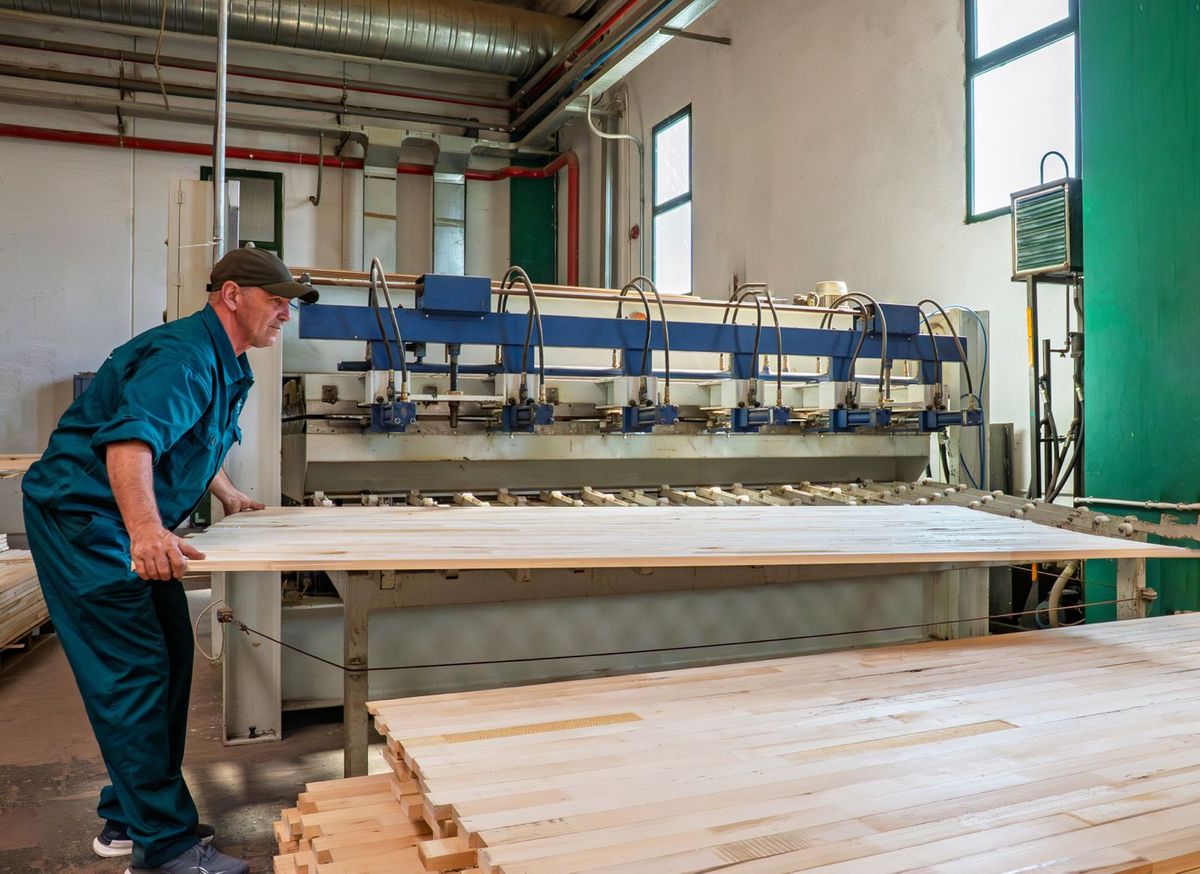
A second branch of the PUR family never sees a glue bottle. PUR hot melts are solid at room temperature, melted in sealed machines and applied hot, like ordinary hot-melt glue. FPL describes conventional hot melts as quick to build strength on cooling but weaker than conventional wood adhesives and only moderately resistant to moisture.7 Reactive PUR hot melts add a second stage: after cooling they keep reacting with moisture.
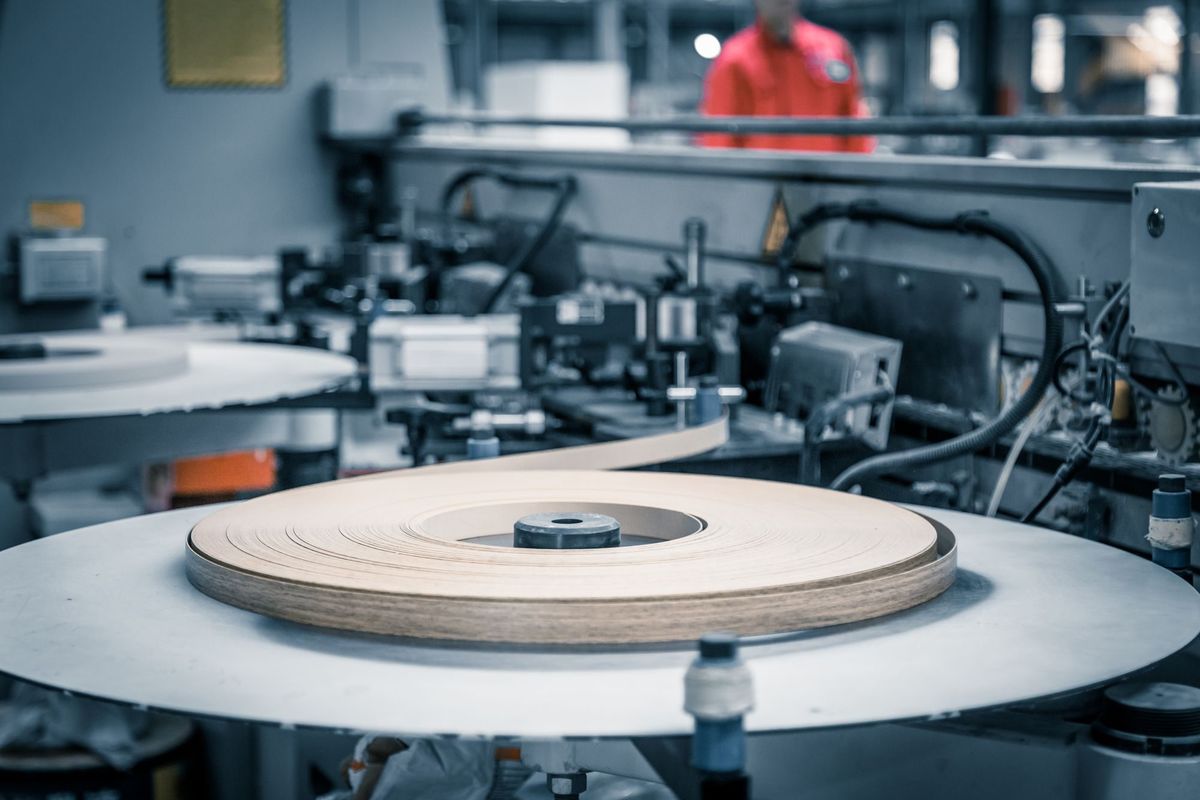
Jowat's data sheet for an edgebanding PUR hot melt shows the numbers. It is processed at 100–120 °C, has an open time of about 7 seconds at 120 °C and a softening range of about 65 °C, and needs about 4–7 days to finish reacting, depending on ambient conditions.20 Until then the bond is still partly a thermoplastic one. The same sheet asks for substrates of at least 18 °C, moisture-proof containers and special flushing agents; cross-linked material in the machine has to be dissolved with a dedicated cleaner.20 The same sheet lists plastic, resinated paper, pretreated aluminium and veneer edgebands as uses.20 PUR hot melts also wrap profiles: trade press reports one Kleiberit wrapping grade for PVC window profiles and films with heat resistance of up to 150 °C, depending on the substrate, and cold resistance down to −40 °C.21
PUR and PVAc side by side
Comparing two glues from the same maker removes most of the marketing noise. Here are Kleiberit's general-purpose PUR and its D3/D4 PVAc, as their data sheets state them:
| Property | KLEIBERIT 501.0 (1K PUR) | KLEIBERIT 303.0 (PVAc) |
|---|---|---|
| How it cures | Reacts with moisture from air and wood | Dispersion, loses water |
| Durability class (EN 204) | D4 | D3; D4 with 5% hardener |
| Open time at 20 °C | About 20–25 min | 6–10 min |
| Press time at 20 °C | From 60 min | From 15 min (edge gluing) |
| Press time at 80 °C | From 5 min | From 2 min (edge gluing) |
| Wood moisture | Not below 5% (wood-based materials) | 8–10% indoors, 10–14% windows |
| Minimum working temperature | Substrates at 18 °C or more; never below +5 °C | Not below +10 °C; best 18–20 °C |
| Pressure | At least 0.6 N/mm² for laminating and edge gluing | 0.7–1 N/mm² for lamella and laminated gluing |
| Spread | 100–200 g/m², one side (the less porous part) | 150–200 g/m² for solid wood; both sides for hardwoods |
| Ready for use | Machining after 2–3 h; final strength after about 24 h | Final D3/D4 water resistance after 7 days |
| Cleaning | KLEIBERIT 820.0 cleaner | Water |
Source: Klebchemie M. G. Becker, technical data sheets KLEIBERIT 501.0 (status 28.11.2022) and KLEIBERIT 303.0.
The table explains the usual division of labour. PVAc is faster, cleans up with water and suits most indoor furniture. PUR earns its place where joints stay wet, where the glue must not soften with heat, where oily or mixed materials are bonded, or where formaldehyde-free structural bonding is required. Two-component PVAc reaches D4 as well, but its hardener is a product that has to be labelled. Check its safety data sheet for diisocyanates: the REACH training duty follows the content of the product, not the name of the glue family.3,5
Health and the diisocyanate rule
Uncured PUR is a chemical hazard; cured PUR is not. FPL calls diisocyanates sensitisers capable of causing occupational asthma, says chronic contact with uncured EPI, PEP and PUR adhesives should be avoided, and states that properly cured isocyanate adhesives are not considered hazardous in bonded wood products.7 The hazard statements for Kleiberit's slow PUR include H334 (may cause allergy or asthma symptoms if inhaled) and H317 (may cause an allergic skin reaction).8 Henkel calls gloves and safety glasses best practice when handling its structural PUR.6
REACH Annex XVII, entry 74, turns this into law. Since 24 August 2023, products with 0.1% or more diisocyanates may be used industrially or professionally only after the employer has ensured that users have completed training. Since 24 February 2022, such products must carry the statement "As from 24 August 2023 adequate training is required before industrial or professional use".5 The rule sets three training levels:5
- General training for every industrial and professional use: chemistry, toxicity, exposure, sensitisation, protective equipment, cleaning and waste.
- Intermediate training added for handling open mixtures at ambient temperature, application by roller, brush, dipping and pouring, spraying in a ventilated booth, machining parts that are not fully cured, and cleaning and waste.
- Advanced training added for handling incompletely cured, still-warm articles, open handling of formulations above 45 °C, maintenance and repair that needs access to equipment, and spraying outside a booth.
A joiner who spreads PUR with a roller or brush is therefore in the intermediate group. A line that opens a PUR hot-melt unit for maintenance is in the advanced group, because the melt is handled above 45 °C. The employer must document the training, which must be renewed at least every five years.5 Anyone trained just before the deadline in August 2023 is due again by August 2028.
Common mistakes with PUR glue
- Gluing bone-dry wood in a cold room. Below the maker's moisture and temperature limits the glue cures slowly or incompletely.1,2
- Taking the clamps off when the foam looks hard. The surface skin cures first. Follow the press times, which at 20 °C run to an hour or more.1,2
- Relying on the foam. A thick glue line is weak. Approvals for load-bearing bonds stop at 0.3 mm.1
- Too little pressure. Foam pushes joints open. Keep at least the maker's minimum pressure, 0.6 N/mm² in one workshop sheet and 1.2 N/mm² for structural beech.1,2
- Skipping the primer on dense hardwoods where the maker requires one.1,4
- Leaving an open container in the workshop. PUR reacts with air humidity. Kleiberit gives about nine months' storage in sealed containers at 20 °C and asks for opened containers to be used quickly.2
- Letting it cure on tools. Clean tools straight after use with the cleaner the maker names. PVAc washes off with water; PUR does not, and cross-linked PUR hot melt in a machine needs a dedicated cleaner.2,3,20
How we glue at SARAL
What to ask a supplier of PUR-bonded parts
- Which adhesive, exactly? Product name and type: 1K PUR, PUR hot melt, 2K PVAc, MUF or EPI.
- Which classification? D4 to EN 204 for non-structural parts; EN 15425 type and approval for load-bearing parts, with the approved species listed.
- Primer? For beech, oak and ash, whether a primer was used and at what dilution and spread.
- Wood moisture and temperature at gluing, and the press time and pressure actually used.
- Glue-line thickness, especially for finger joints and face bonds.
- Heat resistance as a number, an EN 14257 value in N/mm², if parts will sit near heat or in sun.
- Diisocyanate training records for the staff who apply it, if you audit suppliers.
The same questions apply to joinery and furniture components bought ready-made: the glue line is set at the press.
Frequently asked questions
Is polyurethane wood glue better than PVA?
Not in general. PVAc is faster and easier for dry indoor furniture: one D3 PVAc needs 15 minutes in the clamps at 20 °C, against 60 minutes for a PUR from the same maker.2,3 PUR is the better choice for wet service, heat, mixed materials and formaldehyde-free structural bonding, provided the wood is moist enough and the joint is clamped tight.
Is PUR glue waterproof?
Workshop PUR glues are typically tested to D4, the highest water-resistance class for non-structural joints, which still assumes exterior joinery is protected by a coating.2,11 FPL describes polyurethanes as resistant to water and damp but with limited resistance to prolonged and repeated wetting and drying.7
How long does PUR glue take to cure?
For one general-purpose PUR: clamp at least 60 minutes at 20 °C or 5 minutes at 80 °C, machine after 2–3 hours, full strength after about 24 hours.2 Structural PUR grades need from a few minutes to several hours, depending on the grade.1 PUR hot melts keep reacting for days.20
Do I need training to use PUR glue?
In the EU, yes, for professional and industrial use of products with 0.1% or more diisocyanates. Look for the training statement on the packaging. Below 0.1%, the training duty does not apply.5
How do you clean up PUR glue?
Remove squeeze-out and clean tools before the glue cures, with the cleaner the maker names; PUR does not wash off with water like PVAc. Wear gloves: uncured PUR is a skin sensitiser.2,3,8