What a live-edge slab is
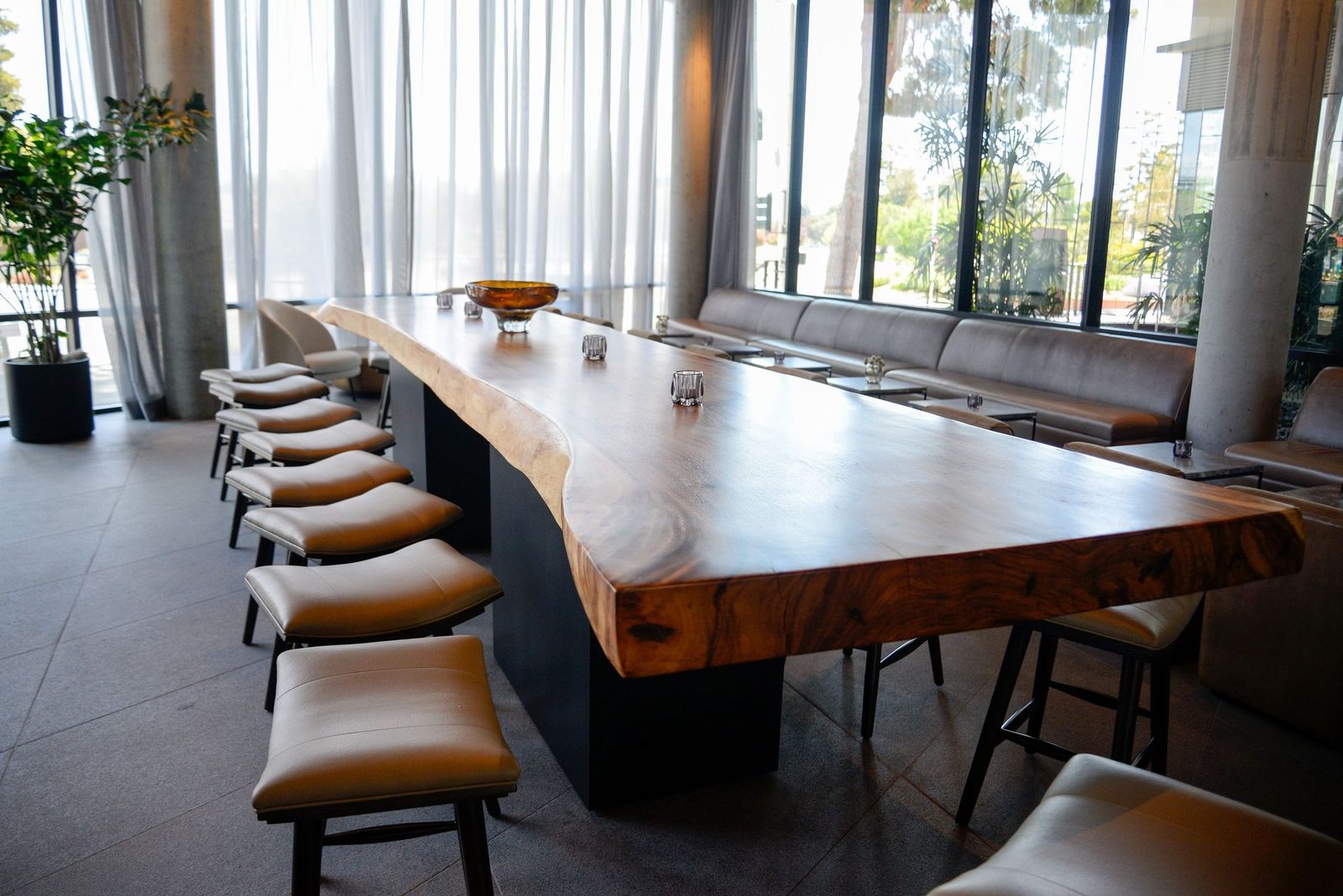
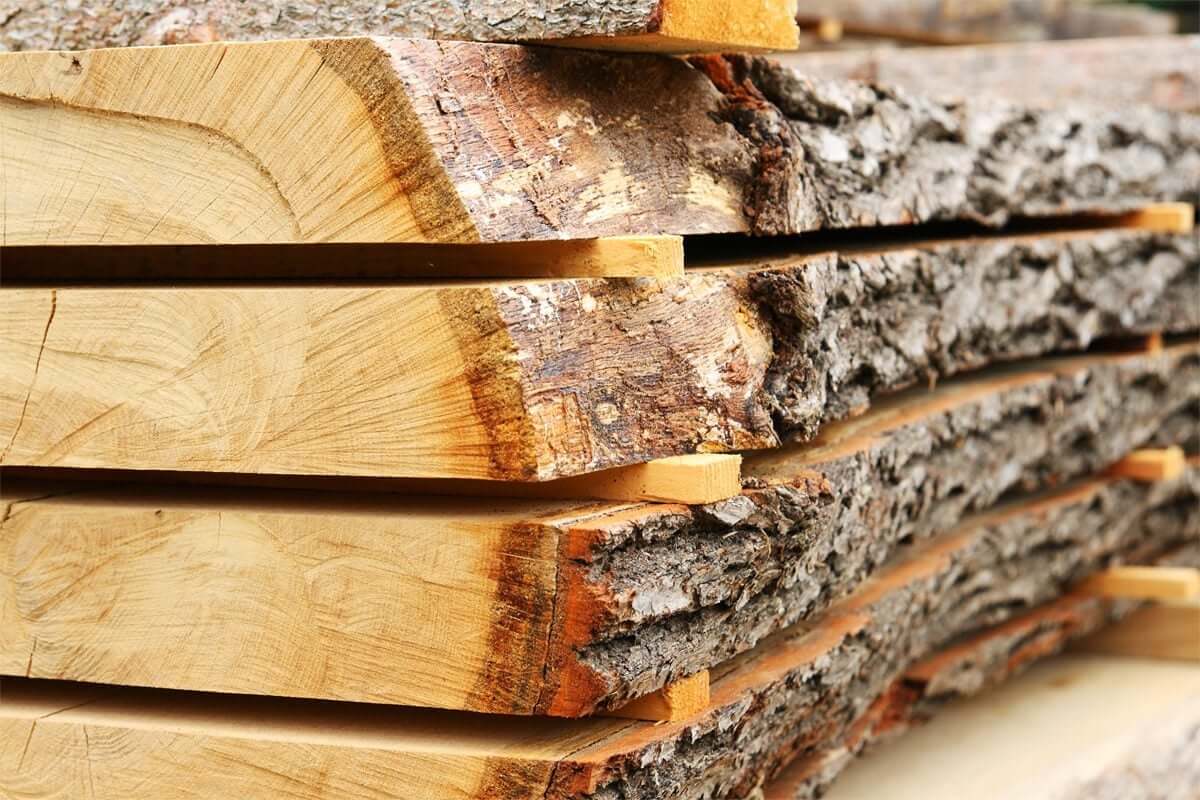
A live-edge slab (Baumkante in German) is a wide, thick board sawn through the log, parallel to its length, with one or both edges left in the natural shape of the trunk. In normal timber grading that natural edge is a defect called wane; in panel grading it is usually excluded outright. One producer's grade rules for oak panels allow no wane on either the A or the B face.6 In a slab table, the same edge is the reason people buy it.
Because slabs are cut straight through the log, most of the wood in them is flat-sawn, with the growth rings running across the thickness, and the centre slabs may contain the pith. Our article on sawing patterns explains why that matters: flat-sawn wood moves and cups more than quarter-sawn wood. A slab is, in effect, the least stable way to cut a tree, chosen for its beauty. Everything that follows is about managing that.
Which species make good slabs
Oak, walnut, ash, elm, cherry, maple and beech are all cut into slabs. What separates them for slab work is not hardness but how unevenly they shrink. Wood shrinks most along the growth rings (tangentially) and less across them (radially). The larger the ratio between the two, the more a flat-sawn slab cups as it dries, and the more stress builds up around the pith.
Show the data
| Tangential | Radial | |
|---|---|---|
| Beech | 11.8% | 5.8% |
| Oak | 8.9% | 4.3% |
| Cherry | 8.7% | 5.0% |
| Maple | 8.2% | 3.8% |
| Ash | 8.0% | 5.0% |
| Walnut | 7.5% | 5.4% |
Tangential-to-radial ratio (our calculation): beech 2.0, oak 2.1, cherry 1.7, maple 2.2, ash 1.6, walnut 1.4. Source: Industrieverband Klebstoffe (2024), TKH-Merkblatt 3, annex 2 (after Toscha and Lohmann, Holzlexikon). European species.
The chart shows total shrinkage from green to oven-dry for six European hardwoods. Walnut stands out: its tangential shrinkage is only about 1.4 times its radial shrinkage, which helps walnut slabs stay flat. Oak and beech shrink about twice as much tangentially as radially, and beech also has the largest total shrinkage, which makes wide beech slabs harder to keep flat. Ash and cherry sit in between, while maple, with the smallest radial shrinkage, has the highest ratio of the six.2 The oak, beech and ash comparison covers the other properties.
Why thick slabs take so long to dry
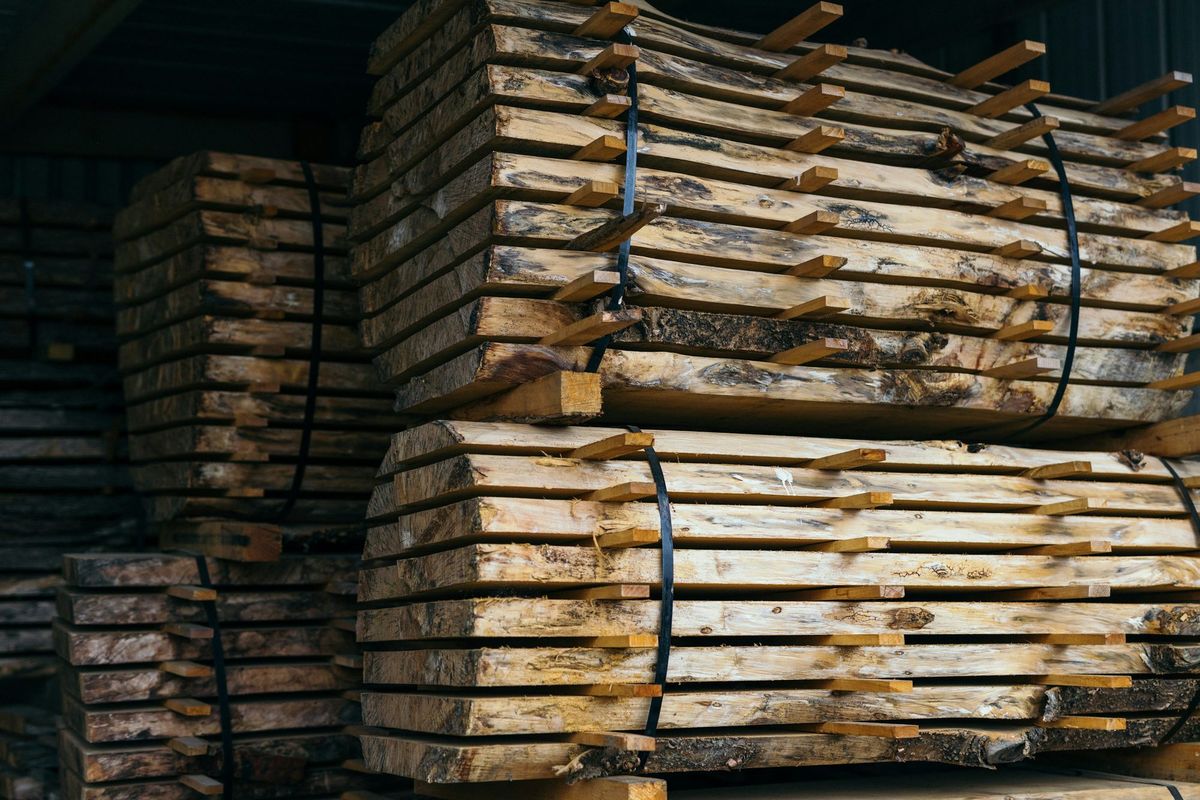
Thickness is what makes slabs hard. Moisture has to travel from the core to the surface, and both the distance and the time grow with thickness. The US Forest Products Laboratory (FPL) puts it plainly: one theoretical approach suggests that drying time, under similar conditions, is a function of the square of the thickness. In practice, air drying nominal 2-inch stock takes three to four times as long as 1-inch stock, and in kilns 8/4 lumber needs about three times the drying time of 4/4.1
Show the data
| Relative drying time | |
|---|---|
| 25 mm | 1 × |
| 50 mm | 4 × |
| 75 mm | 9 × |
| 100 mm | 16 × |
In practice FPL reports about 3× for 8/4 vs 4/4 in kilns and 3–4× in air drying, so the rule is an upper guide, not a forecast. Source: Calculated by SARAL from the square-of-thickness rule in Denig, Wengert & Simpson (2000), Drying Hardwood Lumber, USDA FPL-GTR-118, chapter 4.
The FPL's own air-drying estimates for the central United States show the jump. Black walnut, ash and hard maple of 4/4 thickness need 45–80 days to reach about 20% moisture content (MC); at 8/4 they need 180–230 days and still only reach 23–27%. Upland oak needs 50–90 days at 4/4 and 190–250 days at 8/4.1 The figures are for American species, but European oak and walnut behave in the same way. Our kiln drying article explains why the old "one year per inch" rule misleads; for slabs of 60–100 mm it misleads even more.
Kiln drying thick slabs
FPL is blunt about thick hardwood: kiln drying it from green when it is thicker than 8/4 is often impractical because of the long kiln time. The common practice is to air dry, shed dry or pre-dry first, then finish in the kiln.1 The kiln step brings the core down to the indoor target, equalises the slabs and relieves the stresses that drying has built up. Air drying alone cannot get there, because wood outdoors never dries below the moisture level of the outdoor air.
The schedules for thick stock are milder than for boards. FPL's schedule codes show it: as thickness grows, the T-number (temperature schedule) falls or stays at its lowest, and the wet-bulb depression number (how dry the air is allowed to get) drops. For 16/4 (about 100 mm) stock, ash, cherry and hard maple all end up on T3-A1, a low temperature schedule combined with the mildest wet-bulb depression, 1.1 FPL notes that the thick-stock schedules are less well established than those for thinner lumber and should be used with caution.
| Species (American) | 25 mm (4/4) | 50 mm (8/4) | 64 mm (10/4) | 76 mm (12/4) | 102 mm (16/4) |
|---|---|---|---|---|---|
| White oak (upland) | T3-C2 | T3-C1 | T3-B1 | T3-B1 | – |
| Red oak (upland) | T3-D2 | T3-D1 | T3-C1 | T3-C1 | – |
| White ash | T7-C3 | T5-C2 | T5-B3 | T3-B2 | T3-A1 |
| Black cherry | T8-B4 | T5-B3 | T5-B2 | T3-B2 | T3-A1 |
| Hard maple | T7-C3 | T5-C2 | T3-B2 | T3-A1 | T3-A1 |
| Black walnut | T5-D4 | T3-D3 | T3-D3 | T3-C2 | – |
| American elm | T5-D4 | T5-D3 | T5-D2 | T3-C2 | – |
Source: Denig, Wengert & Simpson (2000), Drying Hardwood Lumber, USDA FPL-GTR-118, tables 7.4 (4/4 and 8/4) and 8.5 (10/4 to 16/4; all schedules capped at 71 °C dry-bulb).
End checks start on day one
Thick stock checks at the ends first, because end grain loses water many times faster than the faces. In uncoated thick stock, hairline end checks can run 305 mm or more into the piece. The fix is an end coating applied as soon as the slab is cut: in one test on red oak, a coating applied three days late gave only a third of the benefit of one applied to fresh ends.1 For a slab table that will be cut to length anyway, this decides whether the checks fall inside or outside the finished top.
Checks, cupping and the pith
A slab containing the pith carries a built-in conflict. Around the centre, the tangential direction is a circle and the radial direction points outwards. Because tangential shrinkage is about twice the radial shrinkage in oak and beech, the outer rings try to shrink around the inner ones, and the stress is often released as a radial split from the pith.2 Wood near the pith is also juvenile wood, which shrinks more along the grain than mature wood and can cause bow.1
Slabs cut away from the centre behave differently. FPL describes how flat-sawn pieces cup towards the bark, because the bark side is more tangential than the pith side and shrinks more.1 On a live-edge slab that means the edges tend to curl towards the face that was nearer the bark. Narrow, quarter-sawn boards avoid this, which is exactly what a slab table does not use.
What can a buyer accept? Small, stable checks are part of the look of many slab tables; open splits through the pith, checks that grow during the first heating season and honeycomb inside the slab are not. The drying defects article shows how each of them forms.
How to know a thick slab is dry
A pin moisture meter reads near the surface, and a slab can be dry at the surface and wet in the core for months. For kiln control of 8/4 and thicker stock, FPL cuts each moisture section into thirds: the outer third (shell), the middle third and the inner core, and determines the MC of each separately by weighing and oven-drying.1 For an expensive slab, ask how the core moisture was measured, not just the surface reading.
The target is the same as for any indoor furniture. At 20 °C, wood settles at about 7.5% MC in air at 40% relative humidity and 9.1% at 50%; the German adhesives association assumes about 8% for wood in living spaces.2 A slab delivered at 12% into a heated room will keep shrinking for months after it is flattened. The moisture content article has the full table.
Bark on or bark off
Keeping the bark is tempting, but it rarely stays. Bark beetles bore through the outer bark to lay eggs, and their tunnels loosen the bark until it falls off in patches. FPL advises debarking logs quickly, storing them in water, or felling in the dormant season and stacking them so the inner bark dries before the beetles fly in spring.3 Many makers therefore remove the bark and keep the natural shape of the edge underneath, cleaned and finished.
The more serious risk is in the sapwood. Powder-post beetles of the genus Lyctus lay their eggs in the open pores of the sapwood of ash, oak and other large-pored hardwoods as it begins to season, and the adults can emerge years later, after the table has been sold. Covering the whole surface with a finish stops egg-laying, but larvae already inside keep developing under paint, oil or varnish.3 That is why heat matters: holding the centre of the wood at 56 °C for 30 minutes kills insects in infested lumber, and the final steps of a hardwood kiln schedule run hotter than that.3,1
The catch is the time it takes heat to reach the core of thick wood. In FPL trials in air at a nominal 71 °C, red oak pieces of 51 × 152 mm took about 49 minutes for the centre to reach 56 °C, 102 × 102 mm pieces about 109 minutes and 152 × 152 mm pieces about 252 minutes, before the 30-minute hold even starts.7
Butterfly keys: what they do and what they don't
Butterfly keys (also called bow-tie keys or dovetail keys) are small double-dovetail inserts let into the surface across a crack. They are partly decoration and partly a clamp: a key with its grain running across the crack holds the two sides together so the crack does not open further or run along the slab. They do not stop the slab from shrinking and swelling, and they cannot pull a crack closed.
Three practical rules follow from how wood moves. Fit keys only when the slab is at its service moisture content, otherwise the crack keeps moving underneath them. Keep each key short across the grain, because the key itself shrinks and swells across its own width. And treat a key as a sign of a crack that has been managed, not as a repair for a slab that was dried too fast and is still splitting.
Epoxy and river tables: the facts
Epoxy fills voids, stabilises bark inclusions and knots, and makes the "river" between two slabs. It is a casting resin, and its main limit is the heat of its own cure. One manufacturer's deep-pour epoxy allows single layers up to 3 inches (about 75 mm) in small castings but recommends no more than 2 inches (about 50 mm) for larger slab pours. Its data sheet warns that the heat of the reaction arrives with a delay, 6–24 hours after mixing, and that resin which gets too hot can shrink, crack or yellow; it asks for a thin skim coat on the wood first, so that air in the wood does not rise into the pour.4 Products differ widely, so follow the sheet of the resin you use.
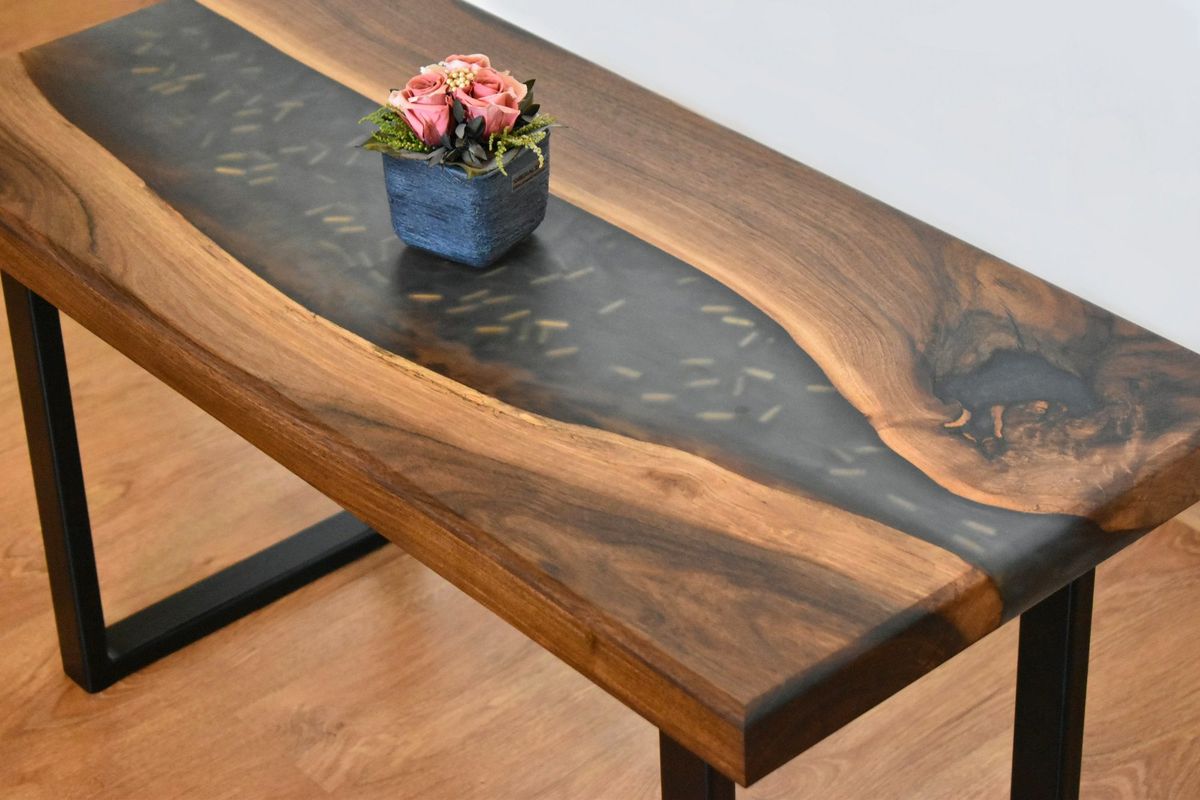
The wood on either side of a river keeps moving with humidity. For an oak slab, every point of moisture change moves the width by about 0.34% tangentially; over the seasons, moisture effects dominate over thermal expansion in wood.2,8 A resin river glued to both edges has to live with that movement, which is why the slab must be dry before the pour and why the base must let the whole top move.
Food contact and bisphenol A
Liquid epoxy resins are typically made from bisphenol A (BPA) or from its derivative BADGE, as the regulation itself notes. Regulation (EU) 2024/3190 bans the use of BPA in the manufacture of food-contact materials, including plastics and varnishes and coatings, and requires that materials made with other bisphenols contain no residual BPA. Repeat-use food-contact articles made with BPA could be placed on the market for the first time only until 20 July 2026, with exceptions for professional food-production equipment until 20 January 2028.5 A dining table is not usually sold as a food-contact article, but a resin serving board or a slab sold for food preparation is. If that is the use, ask the resin maker for a food-contact declaration that covers this regulation.
Flattening, finishing and fixing a slab
Thick slabs are rarely flat after drying. They are surfaced with a router sled, a wide-belt sander or a CNC router, after the slab has reached its service moisture content. Take wood from both faces rather than all from one: a slab that still holds drying stresses moves when one face is machined much deeper than the other, the same effect that makes unconditioned boards bow when they are resawn.1
Finish both faces and every edge, including the end grain and any cracks. A finish slows moisture exchange but cannot stop it, so an unfinished underside dries and wets faster than the top and pulls the slab out of flat.9 Oil and hardwax oil suit slabs well because damage can be repaired locally; our finishes article compares them with lacquer.
Finally, fix the top so it can move. A slab table base should hold the top with buttons or slotted brackets that let it shrink and swell across its width, never with a rigid frame glued or screwed tight across the grain. The same rule is explained for solid wood worktops.
How we handle thick timber at SARAL
Buying a live-edge slab: what to ask
- Species and origin. Botanical species, where it was felled, and the due-diligence data that the EUDR requires for wood placed on the EU market.
- Thickness, width and whether the slab contains the pith. Pith slabs are the most prone to splitting.
- How it was dried. Air dried, pre-dried, kiln dried, or a combination; how long; and whether it was conditioned at the end.
- Moisture content and how it was measured, ideally shell and core, not just a surface meter reading.
- Insects. Whether the slab was heated to a core temperature of at least 56 °C for 30 minutes, and whether the sapwood shows any exit holes or fine powder.
- Bark. On or off, and if on, how it is secured.
- Checks and repairs. Where they are, whether they are stable, and whether keys or resin have already been used.
- Flatness and machining. Rough, surfaced or finished to final thickness, and the allowance left for flattening.
Frequently asked questions
How long does a live-edge slab take to dry?
Much longer than a board. Drying time grows roughly with the square of thickness; FPL estimates 180–230 days of air drying for 8/4 walnut or ash in the US Central region, and that only reaches 23–27% MC. Thicker slabs take longer still, and they need a kiln to reach indoor moisture.1
Should I remove the bark from a live-edge slab?
Usually, yes. Bark beetles loosen bark, so it tends to fall off in patches; many makers remove it and keep the natural edge underneath. If you keep it, the slab should be heat-treated against insects and the bark secured.3
Do butterfly keys stop cracks?
They stop a crack from opening further or running along the slab. They do not stop the wood from moving, and they should be fitted only once the slab is at its service moisture content.
Is an epoxy river table food safe?
It depends on the resin and on what you claim. Under Regulation (EU) 2024/3190, BPA may not be used to make food-contact materials, and new repeat-use articles made with BPA could be placed on the market only until 20 July 2026, with limited exceptions.5 Ask the resin maker for a food-contact declaration if food will be prepared or served directly on the resin.