Four materials that can look the same
A wardrobe door sold as "oak" can be four different things: solid oak, oak veneer on particleboard, oak veneer on MDF, or a printed oak décor on a melamine-faced board. In a photograph they are hard to tell apart. In use they are not. They differ in how they react to a wet cloth on the edge, whether a deep scratch can be sanded out, what they release into the room, and what they cost.
This guide explains how each material is made, how to recognise it, what the 2026 formaldehyde rules changed, and where each one makes sense. It is written for furniture buyers, interior designers and purchasers who specify furniture or components, and for anyone comparing a "mobilă lemn masiv" offer with a cheaper one.
- Solid wood is sawn from the log. The grain runs continuously through the whole thickness of each part. Panels glued edge to edge from solid strips (lamellas) are still solid wood.
- Veneer is a thin sheet of wood cut from a log by peeling, slicing or sawing, glued onto a carrier board.2
- Particleboard (chipboard, PAL in Romanian shops) is made of wood particles coated with adhesive and pressed into a panel with heat and pressure.3
- MDF (medium-density fibreboard) is made of wood fibres, produced by grinding wood between discs, bonded with resin and pressed.3
Solid wood: what "massiv" actually means
In Germany, the word has a written definition. DIN 68871 says a piece of furniture may be called solid wood furniture, "massiv" or "Vollholz" when all parts, except the back panel and the drawer bottoms, are made in their natural structure through their full thickness, entirely of the named species, and not veneered. Where parts of solid surfaces are joined in length, for example by finger jointing, this must be stated.1
A DIN standard is not a law. A lawyer's analysis of the rule points out that breaching it does not by itself give competitors a claim, but that calling furniture "massiv" when it is not can still mislead buyers about what they are getting.1 For a buyer anywhere in Europe, the definition is a useful checklist: ask part by part, not product by product.
Glued and finger-jointed solid wood
Wide solid parts such as table tops and cabinet sides are rarely one board. They are glued from narrower lamellas, either full-length (continuous) or made of short pieces joined end to end with finger joints. Both are solid wood through their thickness. Our guide to edge-glued solid wood panels covers how they are graded and specified. Under DIN 68871 the finger joints still have to be declared.1

Veneer: real wood, half a millimetre thick
Veneer is often treated as a fake. It is not: it is wood, cut thin. The German veneer standard DIN 4079 sets nominal thicknesses that usually lie between 0.5 and 0.6 mm, called normal veneer. Micro-veneers of 0.1–0.3 mm are translucent and tear easily; thick veneers run from 0.9 to 2.5 mm.2
The veneer is glued onto a carrier board, normally particleboard or fibreboard. A guide published by the German veneer industry initiative with TU Dresden describes fibreboard as the higher-quality carrier and particleboard as the cheaper one, at densities of about 750 and 680 kg/m³.2 Its advantage is economy and design freedom: one valuable log yields a great deal of surface, sheets can be matched into mirror-image patterns, and a veneered panel moves far less with humidity than solid wood of the same width.2
Veneer is not the same as a wood décor
A printed décor paper or foil with a wood pattern, laminated onto particleboard or MDF, contains no wood on the surface at all. The pattern repeats exactly, the "pores" are an embossed texture, and the surface cannot be sanded or oiled. Shops often describe it with the species name ("oak décor", "stejar sonoma"), so read the full product description.
Particleboard (PAL) and MDF: the engineered cores
Particleboard
Particleboard is made from sawdust, planer shavings and other wood residues. It is usually made in three layers, with fine particles on the faces and coarser material in the core, which gives a smooth surface for laminating, painting or veneering. The US Forest Products Laboratory (FPL) calls it the predominant material in ready-to-assemble furniture. Most particleboard is bonded with urea-formaldehyde (UF) resin, with a resin content of 4–10% of the dry particle weight, usually 6–9%.3
A 2025 environmental product declaration (EPD) for raw particleboard from a German producer shows what goes in. Its wood mix is 14% fresh and thinning wood, 35% sawmill residues, about 50% recycled wood and about 1% bark. The board averages about 650 kg/m³, and its declared thickness swelling after 24 hours in water is 12–17%.4
MDF
MDF is made from fibres rather than particles. The wood is broken down in a refiner, coated with UF or melamine-urea-formaldehyde (MUF) resin and pressed. Because wood is fibrous, fibreboard uses its strength better than particleboard does. The FPL notes that MDF is often used instead of solid wood, plywood and particleboard in furniture, and for door skins, mouldings and interior trim.3 Its homogeneous structure also takes edge coatings better than particleboard.2 That is why painted, profiled kitchen fronts are almost always MDF.
How to tell solid wood, veneer and board apart
Look at the end grain and the edges
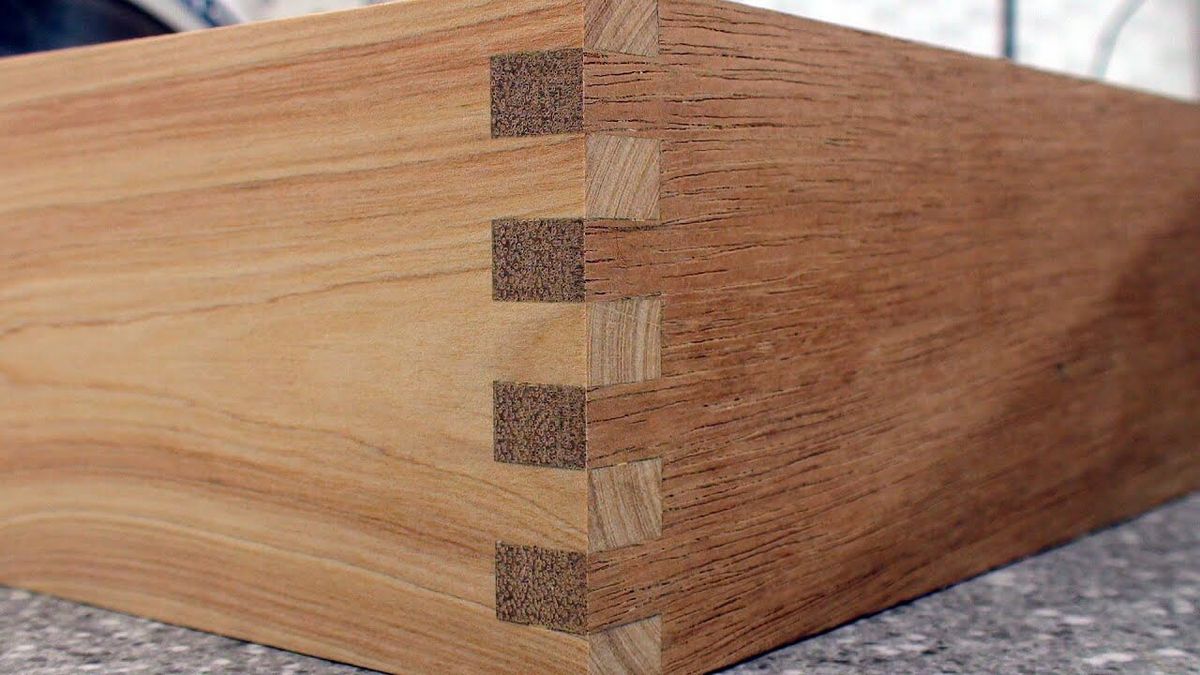
This is the most reliable test. On solid wood, the end of a part shows end grain: growth rings and pores that continue from the face around the edge. On a veneered or melamine-faced panel, the edge is a separate strip, either a thin edge banding or a glued-on solid lipping, and you can usually see the joint line. Where a hole has been drilled for a hinge or a cable, the inside shows either clean wood or compressed particles or fibres.
Compare both faces
On a solid board, the grain on the front matches the grain on the back and continues across the edge. A veneered panel usually has a different, plainer veneer on the hidden side. A printed décor repeats: look for the same knot or figure appearing at regular intervals.
Weight is a weak test
Heavy is often taken to mean solid. The numbers do not support it. European oak averages about 675 kg/m³ and beech about 710 kg/m³ at 12% moisture content.7,8 Particleboard carriers average about 680 kg/m³ and fibreboard about 750 kg/m³.2 A painted MDF door can easily be heavier than the same door in solid oak.
| Material | What it is | How to recognise it | Typical density | Sanding and repair |
|---|---|---|---|---|
| Solid wood | Sawn wood, one piece or glued from solid lamellas | End grain on cut ends; grain continues around the edge and matches on both faces | Oak ~675, beech ~710 kg/m³ (12% MC) | Can be sanded and refinished several times; joints can be reglued |
| Veneered panel | 0.5–0.6 mm wood sheet glued on particleboard or MDF | Separate edge strip or lipping; plainer veneer on the back | Carrier ~680–750 kg/m³ | Light sanding only; deep damage reaches the carrier |
| MDF | Wood fibres bonded with UF or MUF resin | Smooth, uniform brown core in holes and cut edges | ~750 kg/m³ | Cannot be sanded back to wood; swells if edges get wet |
| Particleboard (PAL) | Wood particles in three layers, usually UF-bonded | Coarse chips visible in the core of holes and cut edges | ~650–680 kg/m³ | Not repairable once swollen; screws tear out |
| Décor-faced board | Printed paper or foil on MDF or particleboard | Pattern repeats exactly; embossed texture instead of pores | As the carrier | Cannot be sanded or oiled |
Source: Densities: The Wood Database (oak, beech); Initiative Furnier + Natur, TU Dresden & IHD (2011); Pfleiderer EPD (2025). Construction: FPL Wood Handbook (2021), ch. 11. Recognition and repair: SARAL summary.
Strength, moisture and stability
Solid wood moves. It swells and shrinks across the grain as the humidity of the room changes, and furniture made of it has to allow for that: floating panels, slotted fixings, tops that can move on the frame. Our article on wood moisture content shows how much. Particleboard and fibreboard react to humidity too, but they are far more stable in their own plane than solid wood.2 That is their great practical advantage for large flat surfaces such as carcass sides and sliding doors.
Their weakness is liquid water. UF-bonded boards are meant for interior use because moisture breaks down the cured resin.3 The particleboard EPD above declares 12–17% thickness swelling after 24 hours in water.4 Once the edge of a kitchen carcass next to a dishwasher has swollen, it does not shrink back. Moisture-resistant grades exist and should be specified for wet zones.2
Solid wood is the material of choice where joints carry repeated load: chair frames, table legs, bed frames, stair parts. A mortise-and-tenon or dowel joint in beech or oak can be reglued; a screw that has torn out of particleboard usually cannot be refixed in the same place. Chairs sold in Europe are tested for strength and durability to EN 12520 (domestic) or EN 16139 (non-domestic).9,10
Repair and service life
The real difference often shows after ten years. A 20 mm solid oak top can be sanded and refinished several times; every sanding removes a fraction of a millimetre. A 0.5–0.6 mm veneer allows a light sanding at most, and a deep scratch goes straight through to the carrier.2 Melamine and foil surfaces cannot be sanded at all.
Solid wood also accepts local repairs: a dent can often be steamed out, a loose joint reglued, a worn oiled surface re-oiled. How easily depends on the finish: oiled surfaces are the easiest to touch up locally. Panel furniture tends to be repaired by replacing the part.
Formaldehyde: from E1 to the 2026 REACH limit
Formaldehyde is classified in the EU as a category 1B carcinogen, among other hazards.5 It matters for furniture because the most common panel adhesives are formaldehyde-based: UF, MUF, melamine-formaldehyde and phenol-formaldehyde resins.3
What E1 meant
For years the European benchmark was emission class E1 of EN 13986, the harmonised standard for wood-based panels. It corresponds to an equilibrium concentration of 0.1 ppm in a test chamber.2 The European Panel Federation states that its members have produced only E1 or lower since 2007, and that the 0.124 mg/m³ limit originally proposed for REACH matched E1.6
What changed on 6 August 2026
Commission Regulation (EU) 2023/1464 added entry 77 to Annex XVII of REACH. Since 6 August 2026, articles may not be placed on the market if they release more than 0.062 mg/m³ of formaldehyde (furniture and wood-based articles) or 0.080 mg/m³ (other articles) under the test conditions of its Appendix 14.5 Those conditions are a chamber at 23 °C and 45% relative humidity, a loading of 1 m² of sample per m³ of chamber, one air change per hour, and a steady-state result within at most 28 days.5 For furniture the limit applies to the whole complex product, not only to the boards in it.5
Several articles are exempt. The most important for this topic are articles in which formaldehyde or formaldehyde releasers are present only naturally in the materials, articles used only outdoors, and second-hand articles.5 Wood itself releases traces of formaldehyde, which is why the first exemption exists. A solid wood chair glued with a formaldehyde-free adhesive such as PVAc and finished without formaldehyde releasers falls under it. A solid wood part glued with MUF does not.
Germany had its own stricter national rule and test procedure since 2020. According to the German Environment Agency, that national rule has now been removed and the EU regulation applies; correctly applied, the EU guidelines give roughly the same level of protection as the former German procedure.11
Price logic: what you actually pay for
Solid wood furniture costs more, but not mainly because the raw material is dearer by the tonne. Eurostat trade data give a rough idea of material values. In 2025, German exports of sawn beech averaged about €727 per tonne, the same as MDF over 9 mm thick, while particleboard averaged about €532 per tonne. Sawn oak averaged about €1,312 per tonne.12
Show the data
| Germany | Romania | |
|---|---|---|
| Sawn oak (4407 91) | 1,312 €/t | 652 €/t |
| Sawn beech (4407 92) | 727 €/t | 538 €/t |
| Hardwood plywood (4412 33) | 1,759 €/t | 1,350 €/t |
| MDF over 9 mm (4411 14) | 726 €/t | 388 €/t |
| Particleboard (4410 11) | 532 €/t | 512 €/t |
Unit values mix grades, dimensions and moisture levels; they are not price quotes. Source: Eurostat Comext DS-045409, exports 2025, queried 24 October 2026.
The difference is made in the factory. A panel arrives as a flat, defect-free sheet that is cut on a panel saw and edge-banded. Sawn hardwood has to be dried, cut around knots and cracks, often glued up or finger-jointed, machined and finished. In US studies of rough mills, which cut lumber into furniture parts, the share of usable parts ranged from about 81% on top-grade (FAS) red oak to 41–50% on No. 2A Common.13 The rest becomes offcuts and chips. Our article on yield optimisation follows the whole chain from log to part. You pay for that yield loss, for more machine time and for more skilled hand work.
Carbon and end of life
All four materials store carbon. The IPCC default carbon fraction for temperate broadleaved wood is 0.48 of dry mass.14 For oak at about 675 kg/m³ and 12% moisture, that is roughly 600 kg of dry wood and about 290 kg of carbon per cubic metre, equal to about 1.06 tonnes of CO₂ (our calculation from the cited density and carbon fraction).7,14 The particleboard EPD declares about 281 kg of biogenic carbon per cubic metre, equal to 1,039 kg of CO₂, and fossil emissions of about 125 kg CO₂-equivalent per cubic metre from raw materials to factory gate (our sum of modules A1–A3).4
Per cubic metre, then, storage is similar, and particleboard has the merit of using residues and recycled wood. The difference lies in how long the carbon stays in use. The EPD recommends energy recovery where reuse or recycling is not practicable.4 A solid wood table that is refinished and kept for decades holds its carbon longer than a carcass that is replaced when its edges swell. There is no universal winner; service life decides.
Which material for which part
- Chairs, legs, frames and bed rails: solid wood. These parts carry concentrated loads at the joints.
- Table tops and worktops: solid or edge-glued solid wood if you want to sand and refinish; veneer on a stable carrier for very large, thin or bookmatched surfaces.
- Carcass sides, shelves, backs and drawer bottoms: panels make sense. Even DIN 68871 allows back panels and drawer bottoms in other materials.1
- Kitchen fronts: painted MDF, veneer or solid frames with panels. Near sinks and dishwashers, use moisture-resistant boards and sealed edges.
- Mixed designs: solid frames with veneered panels are a long tradition in good furniture, not a shortcut, as long as they are described honestly.
How we work with solid wood at SARAL
What to ask before you buy or specify
- A material list, part by part. Which parts are solid, which are veneered, which are particleboard or MDF, and which surfaces are décor.
- The species, by name. "Oak" or "beech", not "wood-look", and for veneer, which species is on the face.
- How solid parts are built. One piece, edge-glued, or finger-jointed lamellas. Under DIN 68871 length joints must be disclosed.1
- Veneer thickness and carrier. Normal veneer is 0.5–0.6 mm; ask what is underneath.2
- Formaldehyde compliance. Evidence that the finished product meets REACH entry 77, tested under the conditions of Appendix 14, and which adhesives are used.5
- Moisture content of solid parts. Furniture hardwood is normally kiln dried to 6–8%.15
- Finish and repair. Oil, hard-wax oil or lacquer, and how a damaged surface can be repaired.
Frequently asked questions
How can I tell if furniture is solid wood or veneer?
Look at the end grain and the edges. Solid wood shows growth rings and pores that run around the edge; veneered panels have a separate edge strip and often a different veneer on the back. Weight is unreliable, because particleboard and MDF weigh about as much as oak or beech.2,7
Is MDF or particleboard (PAL) better for a kitchen?
MDF machines and paints better and takes edge coatings more cleanly, which is why it is used for profiled painted fronts. Particleboard is cheaper and is the usual carcass material.2,3 Both swell if water reaches an unsealed edge, so use moisture-resistant grades near the sink and dishwasher.2,4
Is veneered furniture lower quality than solid wood?
Not necessarily. Veneer is real wood and allows stable, large, bookmatched surfaces. Its limits are thickness, usually 0.5–0.6 mm, which leaves little room for sanding, and the quality of the carrier board underneath.2
Does solid wood furniture release formaldehyde?
Wood itself releases traces, which is why REACH exempts articles where formaldehyde is present only naturally. If solid parts are glued or finished with formaldehyde-based products, the 0.062 mg/m³ limit applies to the finished piece.5
Why is solid wood furniture more expensive?
Mostly because of processing, not raw material. Sawn hardwood must be dried, cut around defects, glued and machined, and rough mills lose up to half of the timber to offcuts, depending on grade.12,13