Why the RFQ decides the quality of the parts
A request for quotation is more than a price enquiry. For solid wood components such as chair legs, frames, table tops, fronts or stair parts, it is the first version of the specification, and often the only one the supplier sees before quoting. Wood is a natural material with knots, colour variation and moisture-driven movement. If the RFQ does not say what is acceptable, each supplier decides for you, and quotes for whatever it assumed.
A good RFQ makes quotes comparable, prevents disputes and shortens development. This guide goes through what to specify, section by section, gives a ready-to-use RFQ structure and lists the red flags to watch for when the answers come back. It is written for furniture makers, joinery firms and purchasers buying hardwood parts, whether from Romania or anywhere else.
Define the part before you ask for a price
Drawings, models and reference samples
Send a dimensioned drawing with a number and a revision letter, plus a 3D model (STEP or similar) if the part has curves or CNC work. If appearance matters, add a reference sample or annotated photos showing what is acceptable and what is not. A physical sample that both sides keep and sign is worth more than a page of adjectives.
Volumes and call-offs
State the annual volume, the expected size of each call-off, the first delivery date and whether the part is a one-off, a trial or a running series. Price per piece depends heavily on batch size, because set-up time on optimising saws, moulders and CNC machines is spread over the batch.

Visible faces and grain direction
Mark on the drawing which faces are visible in the finished product, which are hidden and which will be glued or covered. Grain direction matters for strength as well as appearance: in a chair leg, a rail or a stretcher the grain should run along the length, because wood is far weaker across the grain than along it. If slope of grain is critical, state a limit, or ask the supplier how it is controlled when parts are cut and optimised.
Species and grade
Name the species, not just the genus
"Oak" covers dozens of species. For European oak, write Quercus robur and/or Q. petraea; for beech, Fagus sylvatica; for ash, Fraxinus excelsior. The EUDR information system also asks for identification at species level, as our EUDR guide explains. Say whether steamed or unsteamed beech is wanted and whether heartwood colour (red heart in beech, sapwood in oak) is allowed on visible faces.
Appearance grade
For oak and beech sawn timber, EN 975-1 sets appearance grades based on the size and number of features such as knots, splits and colour.3 Naming a class, for example Q-F 2 for oak strips, gives both sides the same rulebook. Our article on hardwood lumber grading explains the classes and how they compare with the American NHLA grades. For finished components, many buyers write their own grading sheet per face: which faces are visible, which features are allowed on each and in what size.
Grade drives price in two ways: higher grades cost more per cubic metre, and lower grades yield fewer usable parts. In US rough-mill studies, the share of usable parts ranged from about 81% on top-grade (FAS) red oak to 41–50% on No. 2A Common.13 A supplier who quotes a low price for a high grade either has a cheap source or a different grade in mind.
Moisture content: target, tolerance and method
Moisture is the most common source of trouble with solid wood parts. Hardwood for furniture, cabinets and millwork is normally kiln dried to 6–8%, close to the equilibrium moisture of a heated interior.1 An RFQ should state three things:
- Target and tolerance: for example 8% ± 2%, and whether every piece or only the batch average has to meet it.
- Method: oven-dry samples to EN 13183-1, or a resistance meter to EN 13183-2, with the species correction applied.2 EN 14298 describes how to assess the drying quality of a batch, including the spread between pieces.14
- When it is measured: at dispatch, at arrival, or both. Wood picks up moisture in transport and storage if it is not wrapped.
Our article on wood moisture content explains how to choose the target for the climate where the furniture will be used.
Construction: solid, edge-glued or finger-jointed
Say whether a part must be one piece of wood or may be glued. Wide parts are usually edge-glued from lamellas, which can be continuous or finger-jointed. Both are legitimate; they differ in appearance, price and yield. If finger joints are not acceptable on visible faces, write it down. For glued solid wood panels, EN 13353 sets requirements including dimensional tolerances, moisture content at dispatch, bond quality and formaldehyde release.15
Specify the adhesive by performance class rather than by brand. EN 204 classifies non-structural wood adhesives from D1 to D4 by durability: D1 for interiors where wood moisture stays at or below 15%, up to D4 for interiors with frequent long-term exposure to water and for exteriors with adequate surface protection.4 Kitchen and bathroom furniture typically meets the conditions described for D3, outdoor furniture those described for D4. If the adhesive is formaldehyde-based, the finished part must still meet the REACH limit.8
Dimensions and tolerances
Wood changes size with moisture, so a tolerance is only meaningful together with the moisture content at which it is measured. For sawn hardwood, EN 1313-2 sets permitted deviations and preferred sizes.16 For machined components there is no general standard you can simply quote: the drawing must give the tolerances that matter for assembly, for example tenon thickness, hole positions and overall length, and leave looser ones elsewhere. Tight tolerances everywhere make parts expensive without making them better.
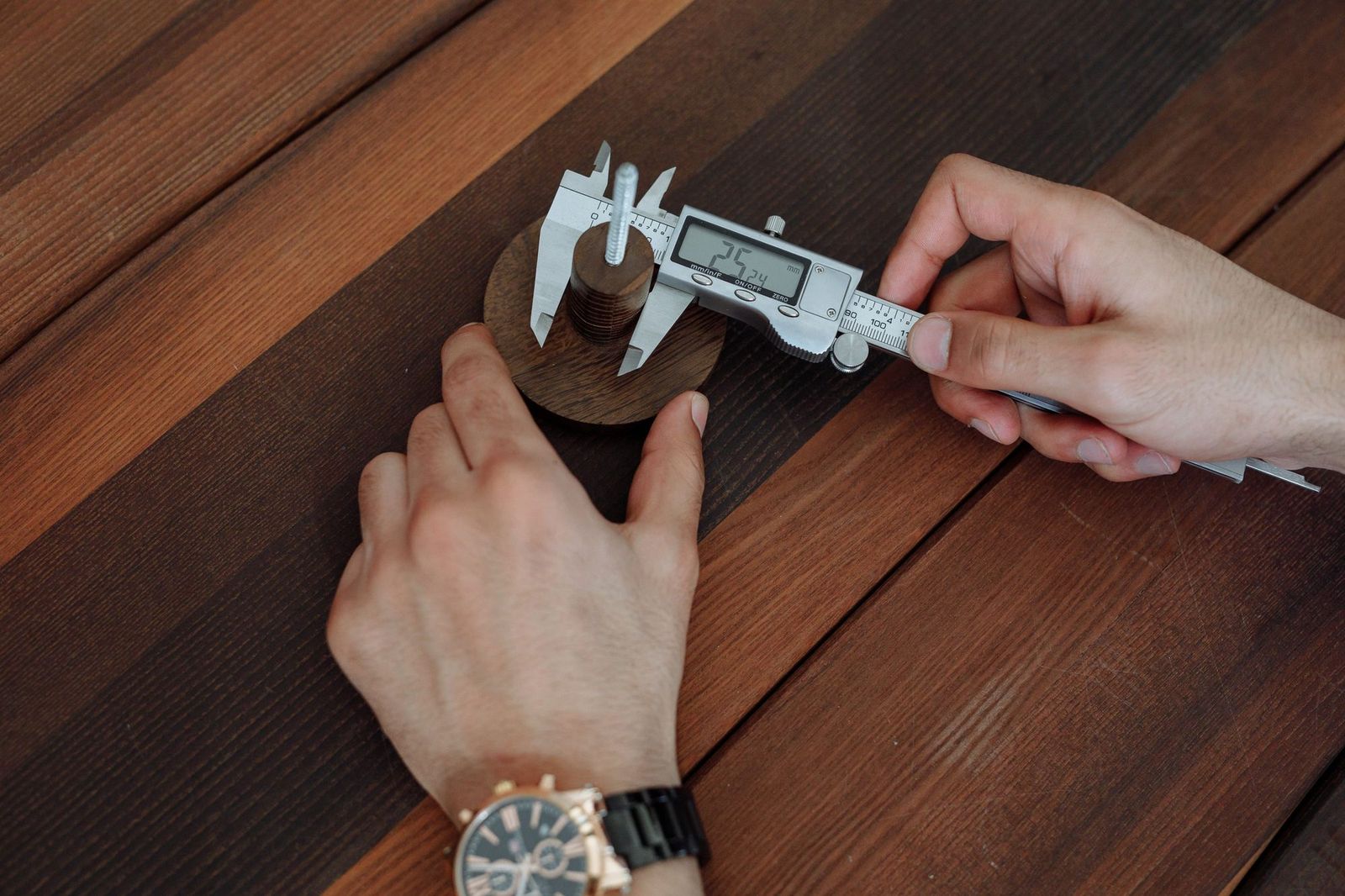
Agree on how parts will be measured: which tool, at what temperature and humidity, and how many pieces per batch. A first-article inspection report, with every dimension on the drawing measured on the first production pieces, settles most disputes before they start.
Surface and finish
State whether parts are delivered raw, sanded or finished. For sanded parts, give the final grit and say whether edges are broken (and by what radius). For finished parts, name the system (oil, hard-wax oil, water-based or polyurethane lacquer), the sheen and the colour reference, and add a signed colour sample. Ask how the finish is tested and what it releases: under REACH entry 77, furniture and wood-based articles placed on the market after 6 August 2026 may not release more than 0.062 mg/m³ of formaldehyde in the reference chamber test.8
Compliance documents
EUDR
For most companies the EU Deforestation Regulation applies to wood products from 30 December 2026. If you buy components made from wood already covered by a due diligence statement, you are usually a downstream operator: you keep the names of suppliers and customers and the reference numbers of the statements for five years.7 Make the reference number a line on every delivery note.
Test reports
For chairs and other seating, ask for test reports to EN 12520 (domestic) or EN 16139 (non-domestic, now in its 2025 edition), naming the exact product and the test level.5,6 A report for a different model, or one from years ago with a different construction, proves little.
Certificates
If FSC or PEFC certified material is required, ask for the certificate number and check it yourself in the public FSC certificate search or the PEFC database.9,10 Check that the certificate is valid and that its scope covers the products and species you are buying. A logo on a website is not a certificate.
| Document | What it shows | Basis | Watch out for |
|---|---|---|---|
| Moisture report | Moisture content of the batch and spread between pieces | EN 13183-1/-2, EN 14298 | Average only, no method, measured long before dispatch |
| Grading statement | Appearance class of the visible faces | EN 975-1 or an agreed grading sheet | "A quality" without a named rule |
| Adhesive declaration | Glue type and durability class | EN 204 (D1–D4) | A brand name without a class |
| Formaldehyde evidence | Emission of the finished article | REACH Annex XVII entry 77, Appendix 14 | An E1 panel label instead of evidence for the finished product |
| EUDR information | Operator and due diligence statement reference number | Regulation (EU) 2023/1115 as amended by 2025/2650 | No reference number on the delivery note |
| Seating test report | Strength and durability of a specific model | EN 12520 or EN 16139 | A report for another model or an older construction |
| FSC or PEFC certificate | Chain of custody for certified material | Public FSC and PEFC databases | Number not found, expired, or scope not covering your product |
| ISPM 15 mark | Heat-treated wooden packaging | ISPM 15 | Unmarked pallets on shipments leaving the EU |
Source: SARAL summary of EN 13183, EN 14298, EN 975-1, EN 204, EN 12520, EN 16139, Commission Regulation (EU) 2023/1464, Regulation (EU) 2025/2650 and ISPM 15.
Packaging, labelling and transport
Solid wood parts need protection from moisture and from damage to edges and finished faces. Specify the packaging (pallet type, wrapping, corner protection, maximum weight per pallet), the labels (part number, revision, quantity, batch, EUDR reference) and how parts are stacked. If parts are shipped outside the EU on wooden pallets or in crates, the packaging will usually have to meet ISPM 15, which requires heat treatment to at least 56 °C for 30 continuous minutes throughout the wood, or another approved treatment.17
Agree on the Incoterms rule in the RFQ, not in the order confirmation. It decides who arranges and pays transport, who clears the goods for export and import, and where the risk passes. Under EXW the buyer does almost everything; under DAP the seller delivers to the named place and bears the risk until then; under DDP the seller also clears the goods for import and pays duties.11
| Rule | The seller delivers when the goods are… | Main transport arranged by | Risk passes to the buyer |
|---|---|---|---|
| EXW Ex Works | at the buyer's disposal at the seller's premises or another named place, not loaded | Buyer | When the goods are placed at the buyer's disposal |
| FCA Free Carrier | handed to the carrier nominated by the buyer at the named place | Buyer | At the named point of delivery |
| DAP Delivered at Place | at the buyer's disposal on the arriving vehicle, ready for unloading at the named destination | Seller | At the destination, before unloading |
| DPU Delivered at Place Unloaded | unloaded and at the buyer's disposal at the named destination | Seller | At the destination, after unloading |
| DDP Delivered Duty Paid | as under DAP, and cleared for import | Seller | At the destination; the seller also pays import duties |
Under EXW the seller does not have to load the goods or clear them for export. Under DDP the seller clears the goods for export and import and pays the duties. Source: HM Revenue & Customs, Customs valuation: Incoterms (GOV.UK guidance), summarising ICC Incoterms 2020.
Samples, first articles and acceptance inspection
Separate three stages. Development samples show that the supplier understands the part; they may be made by hand. First articles come from the production machines and processes that will make the series, and are measured against every dimension on the drawing. Series deliveries are then checked by sampling.
For acceptance sampling, ISO 2859-1 is the usual reference. It sets sampling plans indexed by an acceptance quality limit (AQL): from the lot size and the inspection level, it gives how many pieces to check and how many defects are allowed before the lot is rejected.12 Agree the AQL per defect type, for example a stricter one for dimensional defects that stop assembly than for small appearance features.
What to look at on a factory visit
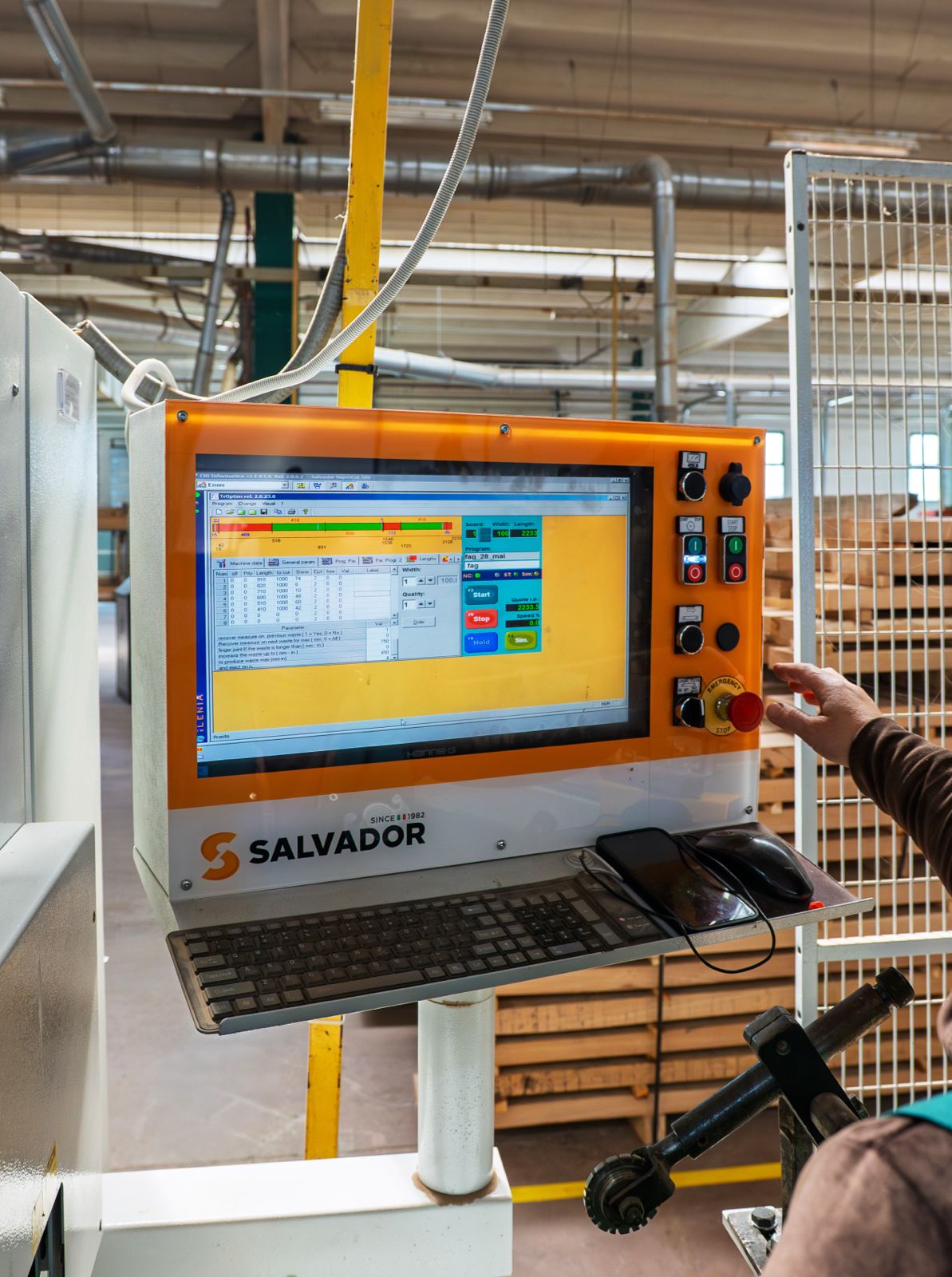
A visit tells you more than any questionnaire. Look at how timber is stored after drying and whether stacks are covered. Ask to see kiln records and moisture measurements for recent batches. Watch how cutting rules and defect lists are set on the optimising saws, how glue is mixed, spread and pressed, and whether pressing times and temperatures are recorded. Ask how first articles and in-process checks are documented, and how finished parts are packed. In each case, ask for the record, not the description.
A structure for your RFQ
The table below is a template you can copy into your own RFQ document. Each line should have an answer before a supplier can quote a comparable price.
| # | Section | What to specify | Example |
|---|---|---|---|
| 1 | Project and volumes | Annual volume, call-off size, first delivery date, one-off, trial or series | 3,000 legs a year in four call-offs, first delivery in week 10 |
| 2 | Part definition | Drawing number and revision, 3D model, signed reference sample | Drawing 1042-03 rev. C, STEP file, sample signed by both sides |
| 3 | Species | Botanical name, steamed or unsteamed, colour rules on visible faces | Fagus sylvatica, steamed, no red heart on visible faces |
| 4 | Grade | Grading rule and class, or own grading sheet per face | EN 975-1, oak strips Q-F 2 on visible faces |
| 5 | Moisture content | Target, tolerance, per piece or average, method, when measured | 8% ± 2% per piece, EN 13183-2, at dispatch |
| 6 | Construction | One piece, edge-glued or finger-jointed; where joints are allowed | Edge-glued, continuous lamellas on visible faces |
| 7 | Adhesive | Durability class; formaldehyde-based or not | EN 204 D3, formaldehyde-free |
| 8 | Dimensions | Critical tolerances and the moisture content at which they apply | Tenon 10 mm +0/−0.2 mm, measured at 8% moisture content |
| 9 | Surface and finish | Raw, sanded or finished; grit, edge radius, finish system, sheen, colour sample | Sanded to P180, edges R2, unfinished |
| 10 | Documents | Moisture report, grading, adhesive class, formaldehyde evidence, EUDR reference, test reports, certificates | DDS reference number on every delivery note |
| 11 | Packaging and labels | Pallet, wrapping, corner protection, labels, maximum weight; ISPM 15 outside the EU | Wrapped pallets, label with part number, revision, batch and EUDR reference |
| 12 | Delivery terms | Incoterms 2020 rule and named place, lead time, call-off notice | FCA supplier's works, or DAP buyer's warehouse |
| 13 | Inspection | Development samples, first-article report, sampling plan and AQL per defect type | First-article report on five pieces; AQL agreed per defect class |
| 14 | Commercial terms | Currency, price validity, payment terms, index clauses | Prices in EUR, valid for six months |
Source: SARAL template. Standards named: EN 975-1 (class names as summarised by French Timber and APECF, 2012), EN 13183, EN 204, ISO 2859-1; Incoterms 2020 (ICC).
Red flags when the answers come back
- "Kiln dried" with no number. Ask for the target, the tolerance and the method. A supplier that cannot answer probably does not measure.
- No questions back. A good supplier asks about visible faces, grain direction, tolerances and volumes. Silence often means the RFQ was not read closely.
- A price far below the others for the same grade. Check whether the grade, moisture content and construction (finger-jointed instead of continuous) are really the same.
- Certificates you cannot find. If the number is not in the FSC or PEFC database, or the scope does not cover your product, the claim is not usable.9,10
- A VAT number that does not validate. Check an EU supplier's VAT number in the Commission's VIES service before the first invoice.18
- Test reports for another product. Seating reports must name the model you are buying.5,6
- Refusal to make a first article on production equipment, or to let you visit. Development samples made by hand do not prove the series process.
- Vague answers on EUDR. From 30 December 2026, ask who the operator is and how reference numbers will reach you.7
How we handle RFQs at SARAL
Frequently asked questions
What should a request for quotation for wooden parts include?
Drawings with revision, volumes and call-offs, species and grade, moisture target with tolerance and method, construction (solid, edge-glued or finger-jointed) and glue class, tolerances, surface and finish, required documents, packaging, Incoterms rule, and how samples and deliveries will be inspected.1,2,4,11
Which moisture content should I specify for furniture components?
For furniture used in heated interiors, hardwood is normally dried to 6–8%. Give a tolerance and the measuring method, for example EN 13183-2 with a resistance meter.1,2
Which glue class do I need for kitchen or outdoor furniture?
EN 204 classes run from D1 to D4. D3 covers interiors with frequent short-term exposure to water and exteriors protected from the weather; D4 covers frequent long-term exposure and exteriors with adequate surface protection.4
How do I check a supplier's FSC or PEFC certificate?
Ask for the certificate number and search it in the public FSC certificate database or the PEFC "find certified" search. Check validity and that the scope covers your products.9,10
What is a first-article inspection?
The measurement of the first parts made on the production machines against every dimension and requirement on the drawing. It confirms that the series process, not just a hand-made sample, can make the part.