What a laminated window scantling is
A window frame starts as a square-edged blank, the scantling (German Kantel), which the window maker then profiles on a moulder or CNC line. A solid scantling is sawn from a single piece of wood. A laminated scantling is glued from three or four lamellas face to face, and each lamella may itself be finger-jointed in length. The German adhesives association notes that window profiles are increasingly made this way, with laminated cross-sections and finger joints both within the lamellas and across the full section.1
The reason is twofold. Laminating and finger-jointing let the producer use the wood better and optimise its quality: knots, resin pockets and other defects are cut out before the lamellas are glued, and the remaining clear wood is arranged so that the profile stays straight.1 In the Romanian market the same product is sold as lemn stratificat, and windows made from it as tâmplărie din lemn stratificat.
Why laminated wood stays straight
Wood moves with moisture, and it does not move evenly. The US Forest Products Laboratory (FPL) puts it simply: wood shrinks most along the growth rings (tangentially), about half as much across them (radially) and only slightly along the grain. Tangential shrinkage is about twice the radial, and the difference, combined with the curvature of the rings, is what distorts a piece of wood as it dries or takes up moisture.2 A window frame cut from one wide board carries that board's ring pattern, its stresses and any reaction or juvenile wood with it. Juvenile wood and reaction wood can shrink about 2% lengthwise from green to oven-dry, against 0.1–0.2% for normal wood, and the FPL lists bow, crook and twist as the result.2
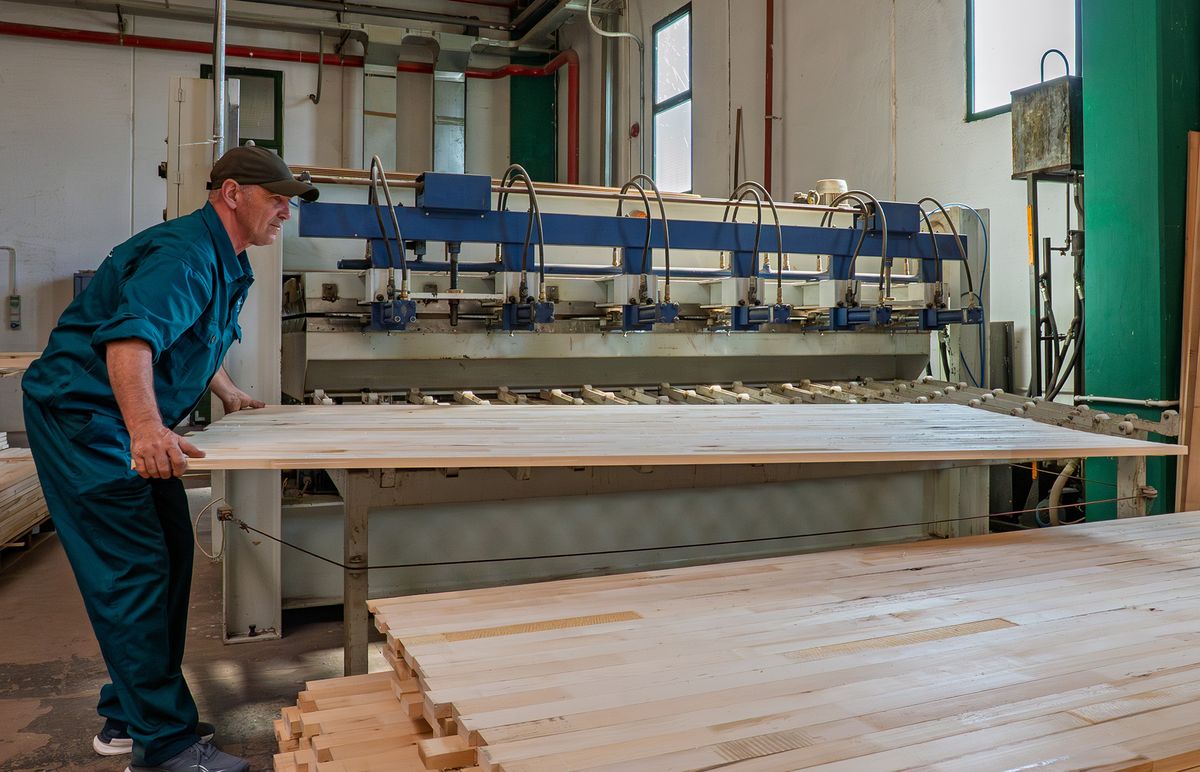
A laminated scantling breaks the section into three or four thinner pieces and puts them together deliberately. Two rules from the German glue guidance for window profiles show how:1
- Symmetry. The profile must be built symmetrically: opposite lamellas should match in thickness, species and wood structure, meaning the position and width of the growth rings.
- Matching at the finger joint. On both sides of a finger joint the wood structure should be the same, so that the two pieces of one lamella swell and shrink alike.
Matching matters more than the rule of thumb "laminated means stable" suggests. A study in the journal Drvna industrija glued spruce lamellas of different ages, from 5-year juvenile wood to 40-year mature wood, and measured how the pairs bowed in humid and dry climates. Mixing wood of different ages could cause bowing, and the effect was mostly unpredictable, which is why the authors cite window production as a case where it matters.7
Rift and half-rift lamellas
Supplier lists for window scantlings specify the lamella orientation: "rift" and "half-rift" faces, the German trade terms for quarter-sawn and rift-sawn wood, in which the growth rings stand steeply to the face.4,8 Across the width of such a lamella the wood moves in the radial direction, which shrinks about half as much as the tangential.2 The guide to sawing patterns explains how such boards are cut from the log, and EN 13307-1 has an informative annex on the orientation of growth rings in laminated blanks.6
IV68, IV78 and IV92: what the profile names mean
Window systems in the German-speaking world are named after the depth of the frame. In a tool maker's glossary, IV68, IV78 and IV92 are listed as the common variants: "IV" refers to multiple glazing, and the number is the profile depth in millimetres, the window profile thickness in the sense of DIN 68121-1.3
- IV68. A 68 mm system in one manufacturer's range takes glass units from 24 to 32 mm and reaches a window U-value (Uw) of 1.20 W/(m²K) with double glazing.9
- IV78. The same maker's 78 mm system takes 28–42 mm glass and reaches 0.87 W/(m²K) with triple glazing.10 Another producer lists 36 mm triple glazing for its 78 mm profile.11
- IV92. A 92 mm profile takes glass units of up to 48 mm, triple or quadruple glazed, in the same producer's data.11
For comparison, Germany's Building Energy Act caps the U-value of windows replaced or newly installed in existing homes at 1.3 W/(m²K).12 Deeper frames are the window industry's answer to thicker, heavier glass, and they need deeper blanks. Suppliers' lists of scantlings start at 72, 84 and 96 mm thickness, in widths of about 86, 115 and 145 mm.4,8 In those lists the blanks are 4–6 mm thicker than the profile depths, which leaves the moulder material to plane away.
DKD, KKK and the other build-ups
German supplier lists describe a scantling with a short code, read from one face to the other: D for a continuous lamella (durchgehend) and K for a finger-jointed one (keilgezinkt). One German timber distributor lists its oak, pine and spruce scantlings as three- or four-layer DKD or DKKD blanks with continuous face lamellas, and separately as KKK and KKKK blanks in which every lamella is finger-jointed.4
| Code | Build-up | Lengths offered |
|---|---|---|
| DKD | 3 lamellas: continuous faces, finger-jointed core | Pine 70–330 cm, oak 210–360 cm |
| DKKD | 4 lamellas: continuous faces, two finger-jointed core lamellas | Listed with DKD, same ranges |
| KKK | 3 finger-jointed lamellas | 590–600 cm |
| KKKK | 4 finger-jointed lamellas | 590–600 cm |
Source: Carl Götz GmbH (2024), Lieferprogramm Fensterholz, edition 02/2024. Glue line D4 to EN 204 for all build-ups in the list.
The difference shows in two places. A continuous face shows no joints, which matters under a transparent stain or a clear finish; under an opaque paint the finger joints of a KKK blank disappear. And length: in the same list, blanks with continuous faces come in mixed lengths of up to about 3.3–3.6 m, while fully finger-jointed blanks are sold in fixed lengths of about 6 m.4 The core lamellas are finger-jointed in both versions, which is why the glue rules apply to the joints inside the profile as much as to the visible faces: the finger joints of a middle lamella must stay tight and strong under weathering even though they are never exposed directly.1 The finger-jointing article covers how strong such joints are and what weakens them.
Species for window scantlings
The German window glue guidance is based on experience with the species most used for windows: spruce, pine and meranti. For other species, modified wood and composites, the constructions have to be tested for fitness for use.1 It also sets minimum densities: 0.45 g/cm³ for hardwoods and 0.35 g/cm³ for softwoods, at 15% moisture content.1 Oak, larch and plantation eucalyptus are the other species found in scantling ranges.4,8
| Species | Density (kg/m³) | Shrinkage radial / tangential (%) | EN 350 class |
|---|---|---|---|
| Norway spruce (Picea abies) | 330–680 | 2.0 / 4.0 | 4 |
| Scots pine (Pinus sylvestris) | 510–550 | – / 4.5 | 3–4 |
| European larch (Larix decidua) | 540–600 | 3.0 / 4.5 | 3–4 |
| European and American white oak (Quercus robur, Q. petraea, Q. alba) | 650–760 | 2.5–3.1 / 4.0–5.5 | 2–4 |
| Dark red meranti (Shorea spp.) | 540–760 | 3.0 / 5.5 | 2–3 (4) |
| Plantation eucalyptus (E. grandis, E. saligna) | 460–800 | 4.1 / 8.7 | 3 |
Durability classes apply to heartwood only. The radial shrinkage of pine is not legible in the source sheet. Source: Teknos Deutschland, Holzinformationsblätter (version 03), prepared with the Thünen Institute: Fichte, Kiefer, Lärche, Weißeiche, Dark Red Meranti, Eukalyptus. Densities converted from g/cm³.
Three points stand out in the data. First, the durability classes from EN 350 range from 1 (highly durable) to 5 (non-durable) and apply to heartwood only: sapwood is never durable.13,14 Window frames sit in the usage classes for joinery exposed to the weather, so species choice and coating work together.13 Second, for dark red meranti, unlike most species, durability rises with density; the wood information sheet advises a density above 0.55 g/cm³ to get classes 2 and 3, and suppliers sell meranti scantlings graded by minimum density.4,14 Third, plantation eucalyptus shrinks much more tangentially than the others, which makes the orientation of its lamellas especially important.14
Oak brings its own chemistry. The wood information sheet for European and American white oak rates its gluability as good to medium and warns that strongly acidic or alkaline adhesives can cause colour reactions.14 The wood glue article explains why tannins and iron stain oak glue lines. Meranti and eucalyptus are imported, and from 30 December 2026 large and medium operators placing them on the EU market must meet the EU Deforestation Regulation, as of October 2026.15 Our EUDR guide covers what that means for timber buyers.
Moisture content: 13 ± 2% and the 3-point rule
Laminating does not suspend physics: a scantling glued from wet and dry lamellas will bend as they equalise. The German guidance sets the permitted wood moisture before processing at 13 ± 2%, and limits the moisture difference within one profile's cross-section to 3 points, a value it takes from the ift Rosenheim guideline HO-10/1.1 The same 13 ± 2% applies to the wood used for the frame corner joints.1
That target is higher than for indoor furniture, because a window frame sits between a heated room and the outdoor air. The article on moisture content and EMC shows how the equilibrium moisture of wood follows the air around it. EN 13307-1 also has a clause on moisture content at delivery, so a scantling supplier should be able to state both the target and how it was measured.6
The glue: D4 plus heat resistance
For laminated profiles and their finger joints, the German adhesives association lists two requirements: the adhesive must be classed D4 under EN 204, and the bond must reach a heat resistance of at least 7 N/mm² in the EN 14257 test at 80 °C.1 For the frame's corner joints, D3 or D4 is accepted, again with at least 7 N/mm² heat resistance.1
D4 is the most demanding of the four durability classes for non-structural thermoplastic wood adhesives. EN 204 describes its use as interiors with frequent long exposure to running or condensed water, and exteriors exposed to weather but protected by an adequate surface coating; the standard names windows among the typical applications.16 In other words, the glue line in a window relies on the paint or stain system as much as on its own chemistry. The window guidance adds that the lamination glue lines should not be exposed to direct weathering.1
Process rules that decide the bond
The same guidance lists the shop-floor rules that make the difference between a scantling that lasts and one that opens:1
- Glue planed lamellas within 24 hours; resinous species can lose wettability if left longer.
- Surfaces must be smooth, without torn or crushed fibres, with a knife-mark pitch under 3 mm.
- Lamella thickness may vary by no more than 0.1 mm across the whole section.
- After finger jointing, leave the lamellas for about a day before planing, so that the swelling around the joint can settle.
- Apply glue evenly to both flanks of the fingers, covering at least four-fifths of their depth.
- After pressing there must be a continuous, tight glue line in every lamination joint and finger joint.
- Do not exceed the adhesive's open and closed times, and do not reopen a press once closed; set press times by trials with the adhesive maker.
EN 13307-1 and the other rules for scantlings
EN 13307-1, Timber blanks and semi-finished profiles for non-structural uses, part 1: requirements, is the European product standard for window scantlings. It covers blanks and semi-finished profiles of hardwood and softwood used in joinery, including glued laminated and glued finger-jointed products, and gives requirements for dimensions, stability and moisture content. Production control requirements and tests are in a separate part, 13307-2.5
The published table of contents shows what a scantling is checked for: species; cross-sectional dimensions, length tolerances and warp; condition of surface; moisture content at delivery; timber quality and growth rings; finger joints and butt joints; and, for laminated blanks, lamella thickness, mixing of species and glue-line bonding, plus marking.6 The 2006 edition is still listed as valid.5 The numbers themselves are in the paid text, so ask your supplier for the clauses and classes they work to.
Three more documents complete the picture:
- ift guideline HO-10/1 (2002), Solid, finger-jointed and laminated profiles for wooden windows: requirements and testing, published by the window institute ift Rosenheim. It serves as a basis for internal and third-party quality control of window profiles.1 Some scantling producers state that their products are made and certified to it.8
- EN 14220 gives the material requirements for timber and wood-based products in external windows and doors, including appearance and biological durability.17
- EN 14351-1 is the product standard for the finished window, with its performance characteristics.18 The scantling is a semi-finished product on the way there.
Almost all windows in the German-speaking world have no structural function in the sense of the timber construction code, which is why these rules deal with non-structural bonding.1
Europe's wooden window trade in numbers
Customs statistics give an idea of where wooden windows are made for export. Under HS 441811 and 441819, windows, French windows and their frames of tropical and other wood, EU countries exported €1,808.7 million in 2025, including trade between EU countries. Poland alone accounted for €662.2 million, about 37% of the total, followed by Germany with €264.9 million.19
Romania is a small exporter of finished wooden windows, with €23.9 million in 2025, but its exports have more than doubled since 2015, while imports have stayed between €4.6 million and €8.4 million a year.19
Show the data
| Year | Exports | Imports |
|---|---|---|
| 2015 | 9.5 €m | 5.1 €m |
| 2016 | 10.8 €m | 4.6 €m |
| 2017 | 10.8 €m | 5.7 €m |
| 2018 | 18.2 €m | 6.4 €m |
| 2019 | 16.5 €m | 6.8 €m |
| 2020 | 14.3 €m | 6.6 €m |
| 2021 | 19.5 €m | 8.4 €m |
| 2022 | 31.5 €m | 7.6 €m |
| 2023 | 33.8 €m | 7.8 €m |
| 2024 | 24.7 €m | 7.5 €m |
| 2025 | 23.9 €m | 7.2 €m |
The HS code for wooden windows was split into tropical and other wood in 2022. Source: Eurostat Comext DS-045409, queried 24 October 2026. HS 441810 until 2021, HS 441811 + 441819 from 2022, summed by us.
How we work with lamellas at SARAL
Specifying window scantlings: what to ask your supplier
- Profile system and cross-section. IV68, IV78 or IV92, and the blank size, for example 72 × 86 mm.
- Build-up. DKD, DKKD, KKK or KKKK; number of lamellas; whether face lamellas are rift or half-rift.
- Species and grade. Heartwood only for exterior faces, minimum density for meranti, accepted colour variation for oak.
- Moisture content. 13 ± 2% at processing, maximum 3 points within a profile, and how it was measured.1
- Adhesive. EN 204 class D4, and EN 14257 heat resistance of at least 7 N/mm² at 80 °C, from the glue maker's data sheet.1
- Standards and control. EN 13307-1, the production control applied, and whether the product is monitored to ift HO-10/1.
- Lengths and packing. Random or fixed lengths, length distribution, wrapping against moisture pick-up.
- Origin data. For imported species, the information your EUDR due diligence needs.15
If you are buying the windows rather than the scantlings, the same list works in short form: ask the window maker for the species, the build-up of the frame, the glue class and the profile depth, and compare Uw values for the same glass.
Frequently asked questions
What is laminated wood for windows?
It is a window blank glued from three or four lamellas, usually with defects cut out and the lamellas finger-jointed in length. The lamellas are matched and arranged symmetrically so that the profile stays straight, and they are bonded with a D4 adhesive.1
Are laminated wood windows better than solid wood windows?
For straightness and consistency, generally yes: lamination splits the section, removes defects and balances the movement of the wood, which a single board cannot do.1,2 The result depends on matching, moisture and glue quality, so the producer's process matters as much as the principle.7
What does IV68 mean?
IV68 is a window profile system with a frame depth of 68 mm. IV78 and IV92 are the deeper systems, with 78 and 92 mm, which take thicker triple-glazed units.3,11
Which wood is best for laminated window frames?
Spruce, pine and meranti are the species the German glue guidance is based on; oak, larch and plantation eucalyptus are also common. Durable heartwood, a sound coating and correct detailing matter more than the species name.1,13